Does stewardship work in controversial sectors?
As at 2025 there were 56 stewardship codes worldwide, 49 of them jurisdiction-specific across 24 jurisdictions and six continents, yet the field has not agreed what stewardship is ultimately for. Codes and practitioner guidance converge on process: written policies, prioritisation by severity, escalation, contribution reporting. Legal scholarship published in 2026 questions whether shareholder pressure alone shifts corporate behaviour at all.

How this article was made: It was drafted by Altiorem’s research assistant from records held in the Altiorem library, and cites only those records. It was reviewed and approved for publication by Pablo Berrutti. Every figure and quotation is referenced to its source below.
Altiorem Evidence Review | Stewardship
As at 2025 there were 56 stewardship codes worldwide, 49 of them jurisdiction-specific across 24 jurisdictions and six continents [1, p.11], yet the field has not agreed what stewardship is ultimately for. Codes and practitioner guidance converge on process: written policies, prioritisation by severity, escalation, contribution reporting. Legal scholarship published in 2026 questions whether shareholder pressure alone shifts corporate behaviour at all [4, p.16]. For contested sectors, the objective has to be written down by the investor rather than inferred from a code.
The answer in brief
Stewardship in contested sectors works where the objective is specified in advance and tested against outcomes, not activity. The Aotearoa New Zealand code requires a stewardship policy that explains the rationale for voting and engagement approaches, sets ESG priorities, describes how outcomes integrate into investment processes and outlines key performance indicators [3, p.9]. Effectiveness is best evidenced as contribution rather than causality, with KPIs reported alongside case studies linking objectives, activities and outcomes [6, p.3]. Company-level work has produced documented results, including Phillips 66’s Paris-aligned lobbying report following a CalSTRS-led campaign [7, p.23]. Even so, it does not scale, and system-level opportunities such as regulation affecting all listed companies are missed when resources go to single large holdings [7, p.57]. Where the sector’s harms are severe, prioritise by gravity, meaning severity, scope and irreversibility [13, p.12], and prepare governance before engaging affected rights-holders [14, p.25].
What stewardship is meant to achieve, and whose objective that is
The Global stewardship principles define stewardship as “the responsible management of something entrusted to one’s care”, implying a fiduciary duty of care owed by agents to end beneficiaries [2, p.4]. The International Corporate Governance Network states that stewardship promotes high standards of corporate governance, which contributes to sustainable value creation and so raises the long-term risk-adjusted return to beneficiaries [2, p.4].
The Guiding principles for responsible investment stewardship in Aotearoa New Zealand go further, setting three interconnected goals [3, p.4]:
- to create and preserve long-term value for current and future generations
- to ensure the efficient management of capital whilst considering the best interests of clients and beneficiaries
- to contribute towards achieving sustainable outcomes for our environment, society, and economy.
The definitional split matters most in contested sectors, because it decides whose harm counts. In The purpose of investor stewardship, Katelouzou (2025) reduces stewardship to three elements: power, exercised on behalf of others, and for others, the last covering employees, society, the environment and future generations [1, p.17]. Katelouzou adds a caution the codes do not: stewardship “should not be assumed to always equate to delivering broader benefits”, and the extent to which broader interests are taken into account remains at institutional investors’ discretion [1, p.25]. That discretion is the practical problem. An investor in a controversial sector who has not stated which materiality applies, financial, double or intrinsic, has no test by which to call an engagement successful.
Whether it changes behaviour
The strongest challenge comes from Socially-minded investors and corporate behavior, which finds little affirmative evidence that boards adopt changes that reduce shareholder value in order to advance a social goal, even where most shareholders would favour those changes [4, p.16]. The European Corporate Governance Institute paper concludes that a move away from shareholder value maximisation cannot be expected to arise organically, nor from simply adjusting managers’ fiduciary duties [4, p.13]. It also closes the litigation route: no court has recognised a derivative suit arguing that a corporation’s best interests require pursuing a social goal, and because of the business judgment rule such a claim would almost certainly fail [4, p.40]. Practitioners engaging contested sectors should not assume legal backstops behind an escalation ladder.
Proof is hard on the investor’s side too. Investing for outcomes states plainly that engagement impact “is still very challenging to prove and to measure”, and that engagement is more impactful at scale [5, p.20]. Citi (2022) offers no method that resolves this, so claims of stewardship success in high-controversy holdings rest on weaker evidence than their prominence in reporting suggests.
A practitioner’s perspective reframes the test rather than solving it. WHEB Asset Management (2024) argues that showing causality is an unhelpful test, because companies face many stakeholder pressures and investors are only one of them, so the aim should be evidence of contribution to specific outcomes [6, p.12]. It reports that 20 per cent of UK Stewardship Code reports failed to disclose basic information such as the proportion of engagement activity focused on ESG issues, and nearly three-quarters of case studies failed to disclose the material outcome sought [6, p.17].
Documented positive cases exist. System-level investing: Case studies of investors leading the way records that CalSTRS, with the support of Climate Action 100+, led a shareholder proposal and public campaign at Phillips 66, a top-40 Fortune 500 company with a market value of $46 billion, after which the company published a lobbying activity report in October 2021 showing alignment of its policy goals with the Paris Agreement [7, p.23]. A second case is collaborative rather than solo: UPP joined the University Network for Investor Engagement, a Shareholder Association for Research and Education initiative, and the strengthened voice of that network led to successful negotiations with a Canadian bank to measure and report carbon risk in its lending portfolio [7, p.46].
Company, sector or system
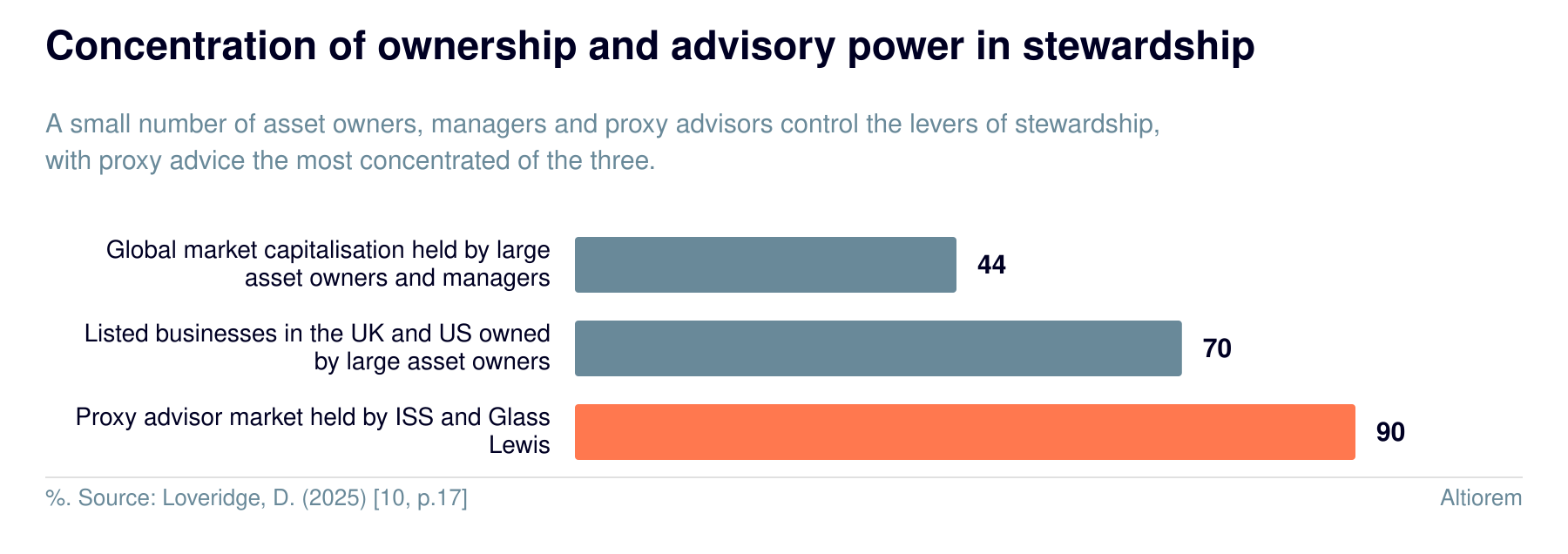
A small number of asset owners, managers and proxy advisors control the levers of stewardship, with proxy advice the most concentrated of the three.
The same case study collection supplies the argument against a purely company frame. A 2022 report from Wespath’s work with the Net-Zero Asset Owner Alliance set out the limitations of conventional corporate engagement: the significant resources required, and the lack of scaling, because investors concentrate on individual large listed holdings and so miss system-level opportunities such as regulation affecting all listed companies [7, p.57].
Time to get real states the same conclusion from the policy side. Volans (2026) lists four realisations behind the case for real-economy climate policy engagement: climate risk is increasingly assessed as non-diversifiable, government policy determines the pace of transition, asset allocation and company-level engagement strategies “are falling short”, and better disclosure is not the panacea it has been presented as [8, p.11]. Recalibrating feedback loops frames why this matters for asset owners: systemic risks in an interconnected world have tipping points that once passed cannot be reversed, and they threaten long-term returns across all asset classes in ways traditional risk management cannot cope with [9, p.115].
Sector framing sits between the two. Guidance on integrating deforestation into net zero strategies observes that deforestation tends to be pervasive, with entire sectors exposed, so investors need further prioritisation among high-risk assets [11, p.25]. The Institutional Investor Group on Climate Change records two approaches in use: tiered engagement, with broad low-resource methods such as voting and mass letters for laggards and targeted engagement for companies of strategic importance, and grouping companies by position in the value chain [11, p.25].
Power concentration shapes which frame is available. Systems-informed stewardship cites OECD research covering 31,000 businesses in 100 countries finding that large asset owners and managers held 44 per cent of global market capitalisation at the end of 2022, with large asset owners owning 70 per cent of listed businesses in the UK and US and ISS and Glass Lewis holding 90 per cent of the proxy advisor market [10, p.17]. Loveridge (2025) also names a contradiction relevant to contested holdings: some institutional investors integrate climate considerations to manage financial risk while simultaneously holding assets that harm the environment [10, p.12]. Making the case records that public equity voting and engagement remain the most common tactics for system stewardship [12, p.27].
What “controversial” adds to the method
Severity, not materiality alone, drives prioritisation in the one framework here written for a controversial sector. The ESG investment framework for controversial weapons prioritises risks by the gravity, that is the severity, scope and irreversibility, of actual or potential adverse impact [13, p.12]. The Social and Economic Council anchors this in the UN Guiding Principles on Business and Human Rights and the OECD Guidelines for Multinational Enterprises [13, p.3].
Rights-holders must be identified before engagement design. The Taskforce on Nature-related Financial Disclosures’ Guidance on engagement with Indigenous Peoples, local communities and affected stakeholders distinguishes Indigenous Peoples and Local Communities, rights-holders, own workforce and value chain workers, the last including migrant workers and smallholder farmers [14, p.18]. It states that policies, processes, systems and strategy must be in place before engagement begins [14, p.25], and lists barriers that make engagement nominal rather than meaningful: access to timely information, language and literacy, cultural appropriateness of venues, respect for Indigenous decision-making structures, and the trust required to engage “without fear of retaliation” [14, p.37].
The International Finance Corporation (2007) sets out measures for information on sensitive and controversial issues: tailor it to different affected stakeholders, present the facts transparently, explain the uncertainties and their limits across worst, best and most likely scenarios, and explain what input is needed and how it will be used [15, p.45]. Its Minca case in Bolivar State, Venezuela records a partnership between a gold mining company, health authority, community groups and an NGO that mobilised more than $2 million for a health centre designed to serve 12,000 people [15, p.158].
Corporate-level commitments can fail at the point of delivery. We know our lives are in danger reports that communities regularly say broad-based consultation on social and labour plans does not occur, that draft plans need not be made public, and that operators may amend commitments without consulting beneficiaries [16, p.29]. The Centre for Environmental Rights and co-authors cite the South African Human Rights Commission finding that shortcomings in design and compliance “limit their ability to drive socio-economic transformation in mining-affected communities” [16, p.29].
What is changing
Guidance published in 2026 is moving the unit of analysis outward. Volans argues that a firm’s case for climate policy engagement should be anchored in its investment beliefs, mandate and interpretation of fiduciary duties, and integrated with its wider strategy for capital allocation and company-level engagement [8, p.11]. That is a policy and strategy design task, not a stewardship team task. Sector guidance is becoming explicitly non-prescriptive: IIGCC describes its deforestation guidance as a flexible, practical toolkit rather than a prescriptive protocol, standard or reporting framework, to be used within investors’ own strategies, client mandates and regulatory settings [11, p.4].
Reporting practice is shifting toward disclosed governance controls. An engaged market: The 2026 state of stewardship report highlights Amova’s table of specific stewardship conflict scenarios and the controls used to manage them, noting it moves beyond high-level policy statements to explain how conflicts arise and are mitigated [18, p.7]. On the reform side, the European Corporate Governance Institute treats mandated disclosure by investment funds claiming to support particular social ends as “the least controversial reform” available [4, p.107].
Recommendations
- Write a substantiable stewardship policy. Avoid generic ambitions, explain the rationale for voting and engagement approaches and ESG priorities, and outline key performance indicators, with senior-level commitment and resourcing [3, p.9].
- Document what happens when engagement fails. Engagement policies typically describe how topics are identified, which companies are prioritised, how engagement is carried out and by whom, how progress is monitored, and what to do when engagement is unsuccessful; consequences should be disclosed if material [3, p.13].
- Prioritise by gravity. Rank risks by the severity, scope and irreversibility of actual or potential adverse impact, against the UNGPs and OECD Guidelines [13, pp.3, 12].
- Tier engagement across the sector. Use broad, low-resource methods for laggards and targeted engagement for companies of strategic importance, or group companies by value chain position [11, p.25].
- Tie stewardship targets to portfolio targets. The Nature target setting framework treats stewardship sub-targets as the lever through which investors influence companies to meet portfolio KPI thresholds in high impact sectors, calling the two complementary and indissociable [17, p.35].
- Report contribution, not volume. Activity metrics are most useful when linked to targeted outcomes, and KPIs gain value when reported alongside case studies showing the connection between objectives, activities and outcomes [6, p.3].
- Prepare before engaging affected stakeholders, with the right policies, processes, systems and strategy in place, and design engagement to remove identified barriers [14, pp.25, 37].
- Build the policy-engagement case at institutional level, anchored in investment beliefs and mandate and integrated with capital allocation and company engagement [8, p.11].
What the reader can use today
| Tool | What it does | Run by | Supports |
|---|---|---|---|
| Corporate human rights benchmark investor guidance | Assesses company performance in high-risk sectors and supplies investor engagement questions | World Benchmarking Alliance | Rec 3 |
| FAIRR’s meat sourcing engagement series | Documents collaborative investor dialogue with food companies on meat and dairy sourcing risks | Ceres and FAIRR | Rec 4 |
| Climate Engagement Canada | Public database of engagement themes, progress and outcomes at company level | Climate Engagement Canada | Rec 6 |
| Transition Minerals Tracker | Tracks company policies and human rights allegations in transition-mineral mining | Business and Human Rights Resource Centre | Rec 7 |
| SAIL: Systems Aware Investing Launchpad | Supports strategy development, benchmarking and reporting for system-level investing | The Investment Integrated Project | Rec 8 |
| Evidence base | |
|---|---|
| Passages read | 58 |
| Records cited | 18 |
| Publishers or author groups | 17 |
| Publication years | 2007 to 2026 |
| Largest single source share | 12% (Guiding principles for responsible investment stewardship in Aotearoa New Zealand) |
| Tools and databases found | 15 |
References
- Katelouzou, D. (2025) The purpose of investor stewardship, pp. 11, 17, 25.
- International Corporate Governance Network (2020) Global stewardship principles, p. 4.
- Stewardship Code Aotearoa New Zealand (2023) Guiding principles for responsible investment stewardship in Aotearoa New Zealand, pp. 4, 9, 13.
- European Corporate Governance Institute (2026) Socially-minded investors and corporate behavior, pp. 13, 16, 40, 107.
- Citi (2022) Investing for outcomes: Why impact is relevant beyond impact investing, p. 20.
- WHEB Asset Management (2024) A practitioner’s perspective: from obstacles to outcomes: Enhancing effectiveness in stewardship and engagement, pp. 3, 12, 17.
- The Investment Integrated Project (2024) System-level investing: Case studies of investors leading the way, pp. 23, 46, 57.
- Volans (2026) Time to get real: Current and future best practice for investor engagement on climate policy, p. 11.
- The Investment Integrated Project (2023) Recalibrating feedback loops: Guidance for asset owners and institutional investors assessing the influence of system-level investing, p. 115.
- Loveridge, D. (2025) Systems-informed stewardship: Reimagining investment stewardship for a sustainable future series, pp. 12, 17.
- Institutional Investor Group on Climate Change (2026) Guidance on integrating deforestation into net zero strategies, pp. 4, 25.
- The Shareholder Commons (2026) Making the case: Macroeconomic risk & portfolio impact: A tool for system-level investors, p. 27.
- Social and Economic Council (2021) Agreement on international responsible investment in the insurance sector: ESG investment framework for the theme: Controversial weapons and the trade in weapons with high-risk countries, pp. 3, 12.
- Taskforce on Nature-related Financial Disclosures (2023) Guidance on engagement with Indigenous Peoples, local communities and affected stakeholders, pp. 18, 25, 37.
- International Finance Corporation (2007) Stakeholder engagement: A good practice handbook for companies doing business in emerging markets, pp. 45, 158.
- Centre for Environmental Rights, Earthjustice and Human Rights Watch (2019) We know our lives are in danger: Environment of fear in South Africa’s mining-affected communities, p. 29.
- Finance for Biodiversity Foundation (2024) Nature target setting framework for asset managers and asset owners, p. 35.
- Aotearoa New Zealand Stewardship Code (2026) An engaged market: The 2026 state of stewardship report, p. 7.
Tools
- World Benchmarking Alliance, Corporate human rights benchmark investor guidance
- Ceres and FAIRR, FAIRR’s meat sourcing engagement series
- Climate Engagement Canada, Climate Engagement Canada
- Business and Human Rights Resource Centre, Transition Minerals Tracker
- The Investment Integrated Project, SAIL: Systems Aware Investing Launchpad
Relevant library resources

Global stewardship principles

Guiding principles for responsible investment stewardship in Aotearoa New Zealand
The purpose of investor stewardship
Socially-minded investors and corporate behavior

Investing for outcomes: Why impact is relevant beyond impact investing