

Starting in and transitioning into sustainable finance careers
This guide explores ways to get started in and transition into sustainable finance careers. It focuses on how professionals can build foundational knowledge, apply transferable skills, and take opportunities to create impact. Through expert insights it highlights strategies to navigate evolving roles and align finance with real sustainability outcomes.


Introduction
Social and environmental issues such as climate change, biodiversity loss, modern slavery, and inequality are driving fundamental shifts across industries to make way for positive change. The finance industry, a powerful lever for such change, is increasingly showcasing this shift through the rise of environmental, social and governance (ESG) considerations. As a result, more professionals and students are seeking ways to align their finance careers and education with sustainability goals.
While sustainable finance is steadily growing, it can still be difficult to build a career in the field. This is due to a range of factors, including the nuances and complexity of sustainable finance practice, the variation in role titles and expectations across regions, and the evolving definitions of what constitutes sustainability in financial contexts. Moreover, the interdisciplinary nature of the sector, combining finance, economics, environmental science, communications, policy, and social impact, means that career pathways are often fragmented and not clearly defined.
This expert guide helps readers navigate entry into sustainable finance and transition into sustainable finance by outlining the skills and pathways needed to work in the space successfully. It is designed for students, early-career professionals, and experienced practitioners who are exploring or beginning their journey into sustainable finance roles. This guide charts a pathway for building a purpose-driven career at a time when ESG values and sustainability objectives are redefining the financial landscape. Through this guide, readers will develop a clear understanding of how sustainable finance differs from traditional finance, discover the motivations and mindset shifts needed to engage in it, and explore the skills and roles that support this transition. Along the way, readers will also gain insights into common entry points and real-world case studies that demonstrate successful career journeys.
This guide is informed by insights from key industry experts: Visakhan Vythilingam (Founder of Greenfluence, ESG Analyst at Australian Council of Superannuation Investors), Cassandra Austen (Director at Pollination), Kyle Robertson (Market Forces) and Elle Yudelman (South32). It serves as a blueprint for professionals to navigate challenges and drive meaningful outcomes when entering into sustainable finance.
* This guide is for informational purposes only and does not constitute professional, financial, or investment advice.
Key insights
- Sustainable finance is a powerful level for systemic change: By integrating ESG factors into financial decision-making, finance professionals can drive long-term resilience and align capital with sustainability goals.
- ESG integration goes beyond compliance: It is increasingly embedded into core investment analysis and decision-making, helping investors to manage risks and drive sustainable outcomes.
- The spectrum of sustainable finance is diverse: From impact investing to marketing, different strategies allow individuals and institutions to engage at various levels depending on their capacity and objectives.
- Building foundational knowledge is essential: Understanding climate and nature risks, regulations, and ESG frameworks is key for anyone transitioning into the field, regardless of their background.
- Transferable skills accelerate career transitions: Financial modelling, risk analysis, communication, and stakeholder engagement remain valuable and applicable in sustainable finance roles.
- Upskilling signals credibility: Certifications and short courses in ESG and sustainable investing are powerful tools for demonstrating commitment and competitiveness in a growing job market.
Sustainable finance: Concepts, approaches and the ecosystem
What is sustainable finance?
Sustainable finance is commonly understood as a spectrum of approaches that reflect different ways capital can respond to environmental and social challenges. Rather than a single methodology, the spectrum illustrates how financial practices range from managing sustainability-related risks to actively contributing to positive, measurable outcomes.
In the Australian context, this spectrum can be most clearly articulated through RIAA’s Responsible Investment Spectrum, which spans from ESG integration and screening approaches through to thematic or sustainability-focused investing, and ultimately impact investing. Across this spectrum, the role of sustainability shifts from avoiding harm and managing risk to actively financing solutions that contribute to environmental and social goals.
As Visakhan Vythilingam, Founder of Greenfluence, describes:
“I’d look at sustainable finance as a way that businesses can really build long-term resilience and a way for investors to safeguard and manage risk and opportunities in the portfolio. You’ve got ESG integration, which is looking at core non-financial factors that affect pricing and valuation, then sustainable investing, which is capturing the theme, and finally impact investing, which considers risk, return, and impact together.”
This spectrum helps explain why sustainable finance roles and strategies can look very different in practice, while still sitting within a shared ecosystem.
Approaches within sustainable finance
Sustainable finance is best understood as a set of complementary approaches that sit along a spectrum, reflecting different ways capital can account for environmental and social considerations. Building on commonly used frameworks in the Australian market — including RIAA’s Responsible Investment Spectrum — three core approaches are most often referenced: ESG integration, sustainable investing, and impact investing.
Each approach represents a different level of ambition in how sustainability is embedded into financial decision-making. Together, they shape the day-to-day work of analysts, investors, consultants, bankers, and sustainability teams, and form the foundation of many sustainable finance career pathways.
Visakhan’s framing of the spectrum points directly to three core approaches to sustainable finance: ESG integration, sustainable investing, and impact investing. Each represents a different level of ambition in embedding sustainability into financial decision-making and shapes the day-to-day work of analysts, investors, consultants, and sustainability teams. Understanding these approaches is essential as they form the foundation for many sustainable finance career pathways.
ESG integration
On the RIAA spectrum, ESG integration sits toward the mainstream end and represents the most widely adopted approach across financial markets. It involves the systematic consideration of environmental, social, and governance factors within traditional financial analysis, with the primary aim of improving risk management, valuation, and long-term financial performance.
ESG integration does not require an investment to deliver positive social or environmental outcomes. Instead, it focuses on understanding how sustainability-related factors affect a company’s resilience, cost of capital, and future cash flows. As such, it is commonly applied across entire portfolios, asset classes, and institutions.
Example roles:
- ESG Analyst / ESG Associate
- Sustainable Finance or ESG Advisor (consulting or banking)
- ESG Portfolio Analyst or Portfolio Manager
- Climate Risk Analyst or Manager
- Sustainability Reporting or Disclosure Specialist (TCFD, ISSB, TNFD)
- Corporate Sustainability Manager
- Stewardship or Active Ownership Manager
- Credit Analyst incorporating ESG risks
- Risk and Compliance roles specialising in sustainability
At its most advanced, ESG integration becomes a tool for driving corporate change. Investor coalitions (e.g., Climate Action 100+) use stewardship and engagement to influence company behaviour on climate transition, diversity, human rights, and governance.
Sustainable investing (thematic and opportunity focus)
Further along the RIAA spectrum sits sustainable investing, sometimes referred to as thematic, sustainability-themed, or responsible investing. This approach goes beyond risk management by actively allocating capital towards companies, sectors, and themes expected to benefit from sustainability-related trends, while still targeting competitive financial returns.
Investments typically focus on areas such as renewable energy, sustainable infrastructure, water and waste systems, circular economy solutions, health, and social inclusion. While sustainability outcomes are an important consideration, investments are generally selected based on their exposure to these themes rather than on asset-level impact measurement.
Example roles:
- Sustainable Investment Analyst / Associate
- Thematic Research Analyst (e.g., renewable energy, circular economy)
- Portfolio Manager of sustainable or ethical funds
- ESG Product Development Manager (designing ETFs, superannuation products, green funds)
- Sustainable Finance Strategist
- Sustainable Debt or Green Bond Structurer (in banks or investment banks)
- Sustainability or Responsible Investment Advisor
From a system-wide perspective, sustainable investing plays a key role in mobilising large pools of institutional capital towards activities aligned with climate and social objectives. RIAA highlights the importance of clear standards and credible frameworks to ensure these capital flows are genuinely aligned with sustainability outcomes, rather than relying on marketing or broad labels alone.
Impact investing (intentional impact focus)
At the most proactive end of the RIAA Responsible Investment Spectrum is impact investing. This approach intentionally directs capital into investments that are designed to deliver measurable positive social or environmental outcomes alongside financial returns.
RIAA defines impact investing by three core characteristics:
- Intentionality – a deliberate aim to achieve positive impact
- Measurement – tracking and reporting on impact outcomes
- Financial return – investments are expected to generate returns (not grants)
Impact investing often targets areas where market failures exist or where traditional finance is unwilling to take risk, such as affordable housing, regenerative agriculture, climate adaptation, nature-based solutions, community finance, and early-stage climate technology.
Example roles:
- Impact Analyst / Impact Measurement Specialist
- Impact Investment Associate / Investment Manager
- Venture Capital Analyst or Associate in climate tech or social innovation
- Blended Finance Specialist
- Program/Portfolio Manager in foundations or development finance institutions
- Impact Reporting & Evaluation Specialist
- Nature finance or natural capital investment roles
- Community finance and social impact roles (e.g., CDFIs, social enterprises)
Reading the spectrum in practice
The RIAA Responsible Investment Spectrum shows how sustainable finance approaches move from:
- Managing ESG risks and long-term value,
- To allocating capital towards sustainability-aligned opportunities,
- To intentionally financing solutions that generate measurable impact.
Understanding this progression is essential for navigating sustainable finance roles and organisations. While not every role sits at the impact end of the spectrum, each approach contributes to shifting financial systems toward more resilient, inclusive, and sustainable outcomes.
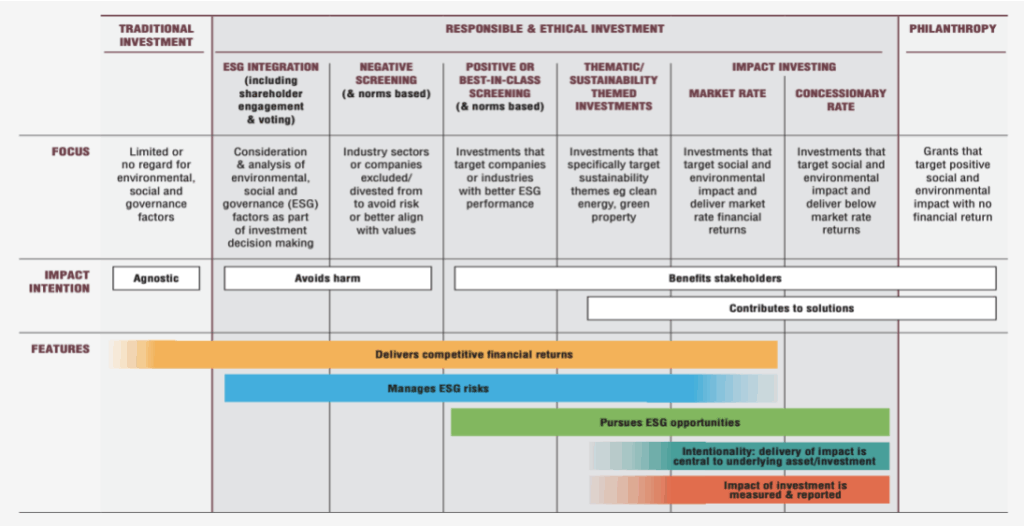
Source: RIAA’s Responsible Investment Spectrum from RIAA’s 2018 Australian impact investor insights
Beyond investment approaches
While ESG integration, sustainable investing, and impact investing are three core approaches, sustainable finance today spans a broader set of practices that shape career pathways. These include stewardship and active ownership, sustainable finance instruments such as green and sustainability-linked bonds, transition finance for supporting decarbonisation pathways, and the rapidly growing areas of climate and nature risk assessment (e.g., TCFD, ISSB, TNFD). Emerging fields such as carbon and biodiversity markets, nature finance, and fintech-enabled sustainability data also play an increasingly important role. Together, these approaches create a diverse ecosystem of work that extends far beyond investment roles alone.
Example roles:
- Stewardship & Engagement Manager
- Sustainable Finance or Green Bond Structurer
- Climate or Nature Risk Specialist
- Sustainability Reporting / Disclosure Manager (ISSB, TCFD, TNFD)
- Carbon Markets or Nature Finance Analyst
- ESG Data or Sustainability Analytics Specialist
Sectors and functions in sustainable finance
Investment management and superannuation
Asset managers, institutional investors, and super funds allocate capital to sustainable projects such as low-carbon infrastructure, clean energy and sustainable agriculture.
Example roles:
- Portfolio Manager
- Investment Analyst
- Stewardship Lead
- Sustainability Strategist
Advisory and investment banking
Advisory firms and investment banks play a central role in structuring sustainability-linked loans, green bonds, and transition finance products.
Example roles:
- Sustainable Finance Advisor
- Green Bond Structurer
- Transition Finance Specialist
- ESG Due-Diligence Consultant
Development finance and blended finance
Development finance institutions (DFIs) support early-stage or higher-risk sustainability initiatives by providing concessional capital to unlock private investment.
Example roles:
- Impact Investment Manager
- Development Analysts
- Blended-Finance Specialist
Policy, regulation and governance
Policymakers, regulators and standard-setting bodies shape the rules that standardise ESG disclosure and direct financial flows toward sustainable outcomes.
Example roles:
- Policy Analyst
- Regulatory Advisor
- Climate Disclosure Specialist
- Governance Professionals (to influence system-wide collaboration and accountability).
Fintech and data innovation
Emerging sectors such as fintech accelerate the transition by enabling impact tracking, carbon accounting and democratised access to sustainable investment products.
Example roles:
- ESG Data Analyst
- Sustainability Product Designer
- Carbon Accounting Technologist
Insights from CPIC’s impact investment blueprint show how blended finance partnerships between private investors and local enterprises can unlock capital for high-impact projects in underserved sectors like smallholder agriculture. Together, these roles and sectors create a comprehensive ecosystem that moves finance beyond short-term profit and toward driving measurable social and environmental progress at scale.
Other roles in sustainable finance (direct, indirect and adjacent)
Beyond traditional finance and investment positions, sustainable finance also creates space for less visible but equally important roles. Marketing and communications professionals, for example, play a critical part in translating complex climate finance concepts into compelling narratives that engage stakeholders and build public trust. As recognised by the UN, communications hold a central role in making sustainable consumption a reality, with marketing having an incredible capacity and skills to ignite the transition that businesses need. These positions demonstrates that sustainable finance extends well beyond capital allocation, relying on a broad ecosystem of talent to accelerate impact.
Communications, marketing and public engagement
These roles translate complex sustainability and climate finance concepts into accessible narratives that shift public behaviour and influence investment decisions.
- Marketing Manager (sustainability or ESG focus)
- Communications Specialist / External Relations
- Content Strategist / Writer (e.g., sustainability thought leadership)
- Brand or Campaign Manager
- Creative Producer for sustainability storytelling
Advocacy, campaigning and policy influence
These roles push for systemic change by influencing governments, regulators, financial institutions and corporate actors.
- Climate or Finance Campaigner
- Advocacy Manager (climate, nature, justice)
- Policy Advisor (sustainable finance, environment, economics)
- Government Relations & Public Affairs roles
- NGO or think-tank policy specialist
Research, analysis and insights
These roles generate evidence, insights and frameworks that guide industry practices and regulatory reform.
- Sustainability Researcher
- Environmental Economist
- Climate Science Researcher
- Applied Research Fellow (universities, think tanks)
- Social impact researcher
Science, technical and environmental expertise
Many sustainable finance teams rely on scientists to support modelling, risk assessment, and technical due diligence.
- Climate Scientist
- Environmental Scientist or Ecologist
- Nature/ Biodiversity Specialist
- Energy Systems Analyst
- Emissions Accountant / Carbon Footprinting Specialist
Facilitation, collaboration and systems change
These roles specialise in convening stakeholders, designing cross-sector partnerships and enabling large-scale transitions.
- Facilitator (climate or sustainability programs)
- Systems Change Practitioner
- Multi-stakeholder Partnership Lead
- Sustainability Educator / Trainer
- Workshop designer for ESG capability-building
Technology, data and product development
Sustainable finance increasingly relies on data platforms, carbon accounting tools and digital innovation.
- ESG Data Analyst
- Sustainability Product Designer (fintech)
- Impact Measurement Platform Developer
- Data Engineer (sustainability focus)
- Climate-tech Product Manager
Legal, governance and compliance
Legal and governance professionals help organisations navigate reporting, risk and regulatory requirements.
- Sustainability or ESG Lawyer
- Governance Specialist
- Compliance Manager (sustainability reporting, disclosures)
- Ethics & Responsible Conduct Advisor
“From the governance perspective, sustainability is really about making sure the right people in an organisation are doing the right things by the sustainability commitments that company has made. It’s about ensuring clear frameworks that connect what we’ve committed to do, how we do it, and who’s accountable for it.” — Elle Yudelman, Sustainability Governance Specialist, South32
Sustainable finance is a broad ecosystem
Sustainable finance is a broad ecosystem across investment, banking, corporate sustainability, advocacy, consulting, policy, research, education and fintech. These areas apply ESG, sustainability and impact concepts in different ways, shaping the types of skills and career pathways available.
Why Sustainable Finance matters now
Sustainability is reshaping the role of finance
The Australian Sustainable Finance Capability Framework (ASFI)’s Australian Sustainable Finance Capability Framework makes clear that sustainability is now a core requirement of financial practice. Sustainable finance is essential for addressing climate risk, strengthening community resilience, and supporting First Nations economic self-determination.
As a result, finance professionals increasingly need capabilities in transition planning and systems thinking to integrate sustainability into financial decision-making.
For finance professionals, this represents a shift in the nature of the work itself. Sustainability considerations now shape:
- how companies are valued
- how investment and credit decisions are made
- how risk is assessed at both firm and system level
Sustainability is no longer a peripheral concern; it is becoming a core driver of financial strategy, risk management, and capital allocation.
“We can’t deny climate change anymore – the global community has come to terms with the impacts we are creating, and you can’t ignore it. Corporate sustainability, including mitigating the impacts and risks of climate change, cannot be seen as an add-on anymore, it needs to be embedded into the DNA of how companies operate.” — Elle Yudelman, South32
From ethical option to commercial imperative
Across the economy, businesses increasingly recognise climate change and nature loss as immediate commercial risks, driven by carbon regulation, mandatory climate reporting, and market pressure.
Where environmental investment was once largely cosmetic, physical and transition risks are now forcing companies to prioritise supply-chain resilience, cost stability, and long-term viability.
“It’s becoming less about a nice to have and more about a commercial imperative.” — Cassandra Austen, Director, Pollination
This shift is expanding demand for finance professionals who can identify, quantify, and manage climate and nature-related risks in practice.
Regulatory and market shifts
At the same time, regulatory and market expectations are converging to accelerate change. Australia’s move toward mandatory climate disclosure, combined with growing investor demand for ESG-aligned products, signals a systemic shift toward accountability and transparency. Research from 2022 shows that 83% of Australians expect their money to be invested ethically, and investors are no longer willing to compromise on aligning their portfolios with their values. Similarly, responsible investment funds have outperformed traditional funds over multiple time horizons, demonstrating that sustainable finance is not just ethically sound but financially competitive. These trends are not only changing how finance operates, they are reshaping hiring needs, skill requirements, and career pathways across the industry.
The human dimension: why people matter
There is also a growing human dimension. Students and early-career professionals increasingly seek “green and social jobs” that align with their values. Yet as climate change and inequality intensify, the consequences of inaction are mounting. Sustainable finance requires transition planning and systemic resilience to address these urgent challenges. Sustainable finance requires people who can combine financial expertise with systems thinking, and who are willing to engage with complexity, uncertainty, and long-term outcomes.
A pathway for impact and influence
The growth of sustainable finance offers a dual opportunity:
- to help protect businesses and the financial system from climate-related disruption
- to mobilise capital toward solutions that strengthen resilience and support people and planet
For individuals, working in sustainable finance provides a pathway to influence real-world outcomes at scale, using finance as a lever for systemic change.
Barriers to the growth of sustainable finance
Despite the strong case for sustainable finance, a range of structural, organisational, and workforce-related barriers continue to slow its growth. These challenges affect not only how capital is allocated across the economy, but also how accessible and navigable the field is for people seeking to enter or transition into sustainable finance careers.
Barrier to entry: Knowledge and skills gap
Many professionals moving from traditional finance face a steep learning curve when entering sustainable finance, lacking the specialised knowledge required to integrate sustainability into decision-making. This highlights the need for a deeper understanding of climate and nature risks, as well as the regulatory frameworks that govern them. Closing this gap will require targeted upskilling programs and education to equip professionals with the confidence to embed ESG factors effectively across investment strategies. Those we interviewed suggest traditional finance professionals need to learn about climate and nature risks, regulatory frameworks, decarbonisation pathways and nature-positive strategies.
“There is quite a big knowledge gap between being able to work in traditional finance versus sustainable finance … You might have underlying technical skills that you can leverage and adapt, but you would still have a very significant knowledge base that you would need to shift for.” — Cassandra Austen, Director at Pollination
Short-termism and lack of strategic integration
A persistent challenge to the growth of sustainable finance (which is also a challenge to the expansion of sustainable finance roles) is that some organisations continue to treat ESG as an add-on rather than a core business driver. While ESG adoption is rising, many investment approaches remain focused on risk avoidance rather than generating long-term positive outcomes.
“A lot of companies still see sustainability as a branding exercise rather than as good business practice. When budgets tighten, sustainability programs are often first to go — seen as nice-to-haves rather than enablers of value, risk avoidance, or workforce strength. Whereas if a company can stay the course and maintain and advance their sustainability practices, risks will be better managed and ultimately it would be better for the bottom line. – Elle Yudelman, South32
A narrow focus like this, limits capital flows into transformative projects (which create sustainable finance roles) and undermines the potential for finance to drive systemic change.
Politicisation of ESG
ESG investment has become a flashpoint in political debates, particularly in the U.S., where some conservatives have criticised ESG practices as incompatible with traditional fiduciary duty and accused asset managers of pursuing “woke capitalism.” Meanwhile, legal and academic discourse continues to debate whether including ESG factors in investment decisions may breach or expand fiduciary obligations. In contrast, Australia has so far maintained a steadier trajectory, with regulatory and institutional systems generally supporting ESG integration rather than rejecting it outright. This is reflected in the introduction of mandatory, internationally aligned climate-related financial disclosures for certain entities, set to take effect for financial years beginning in 2025.
“Right wing politicians think ESG doesn’t align with fiduciary duty, which has had a bit of a flow and effect in other parts of the world … But thankfully in Australia, I think there is a strong agreement that ESG factors need to be integrated in business.” — Visakhan Vythilingam, Founder of Greenfluence.
Data and measurement challenges
Reliable and consistent data remain a major obstacle, as many companies lack granular information across their supply chains. According to the Task Force on Climate-related Financial Disclosures (TCFD) 2022 survey, both asset managers and asset owners identified insufficient information from investee companies as the top challenge to climate-related reporting. Complementing this, research on the visibility of climate-related disclosures by ASX50 companies found that physical risks are often under-reported, disclosures are inconsistent across sectors, and companies frequently state they cannot reliably estimate or measure full financial impacts. Together, these data gaps make it difficult for investors to assess true portfolio risks, compare performance, and avoid accusations of greenwashing.
Beyond operational hurdles, the lack of data transparency can also pose a barrier to entering the sustainable finance sector, particularly for new professionals navigating complex and evolving reporting frameworks.
Developing the ability to critically assess the quality and reliability of ESG data is therefore a core skill for emerging professionals in this space. An article on implementation of the International Sustainability Standards Board (ISSB) standards identifies that implementation guidance on sustainability reporting is still evolving, with expectation of some fuzziness throughout 2025.
“Measuring emissions is great, but if it’s not accurate, does it actually create value for business and also broader society? — Visakhan Vythilingam, Founder of Greenfluence
This highlights how improving data integrity is not only essential for companies to meet compliance and credibility standards, but also for building the analytical capabilities of the next generation of sustainable finance professionals, who must learn to navigate and interpret imperfect datasets in their daily work.
Limited career visibility and knowledge expectations
Entry points into sustainable finance are often opaque, leaving early-career professionals unsure of pathways to build the right skills or break into the field. This emphasises the need to demystify career pathways and provide structured transition opportunities to meet rising interest. A Harvard blog highlights that the industry lacks clearly defined entry-level roles and standardised career progression frameworks, making it more challenging for students and early-career workers to chart a pathway into the sector. This lack of transparency can deter talented candidates who might otherwise contribute to the transition finance workforce.
“Initially the barrier was probably people associating a role in ESG with coming from an environmental or science background … I’ve noticed the demand has increased and it’s created a lot more competition.” — Visakhan Vythilingam, Founder of Greenfluence
The demand for sustainable finance professionals has increased, but the field has also become more competitive and specialised. In the past, employers were willing to take people with general finance backgrounds into ESG roles. Now, certifications (eg. CFA on sustainable investing, SCR Certificate by GARP, GRI Academy) and demonstrable expertise are becoming more necessary.
Note: This is a double-edged sword: Increased certification and demonstrable expertise means the industry is being taken seriously and that more effort is going into legitimising sustainable finance. However, we need to mobilise the finance sector to be more sustainable and for that we need more people on the ground.
Structural and systemic barriers
Beyond organisational challenges, several systemic factors further slow sustainable finance adoption. Industry lobby groups continue to exert significant influence over climate and finance policy, often resisting ambitious reforms despite publicly expressing support. This resistance weakens regulatory certainty and slows capital mobilisation. In addition, a shortage of bankable sustainable projects constrains the scale of investment, illustrating the gap between financial ambition and real-economy opportunities. Fragmentation and siloing across finance, policy, and environmental sectors further hinder coordinated action, while low public trust in the finance sector limits the momentum needed to accelerate change. These systemic challenges also shape the experience of professionals working in sustainable finance, who often need to advocate for long-term change within slow-moving institutional and policy environments.
“When you’re advocating for change inside large institutions, you have to set yourself up for the long haul — change is slow, but that makes the impact all the more meaningful.”— Kyle Robertson, Market Forces
Consequences of inaction
If these barriers remain unaddressed, entering the sustainable finance space will remain unnecessarily difficult and exclusionary, slowing the development of the skills and workforce needed to meet climate and social goals. Rather than becoming an accessible and innovative field, sustainable finance risks being reduced to a compliance exercise. Inconsistent data and short-term thinking could lead to missed opportunities for risk mitigation and expose businesses to higher transition and physical risks. Investors may lose confidence, slowing capital mobilisation for critical climate and social solutions.
How to enter, or transition into sustainable finance
Entering sustainable finance is rarely a single step — it’s a process of building capability, positioning yourself thoughtfully, and navigating a fast-evolving ecosystem.
i. Build foundational knowledge and mindset
Entering sustainable finance starts with developing both knowledge and mindset.
Beyond understanding climate and nature risks, ESG frameworks, and regulation, this field calls for adaptability, systems thinking, and an ability to connect finance with real-world sustainability outcomes.
“Having an open mind, an analytical and problem-solving mindset is key – this industry is constantly changing and the need to adapt, problem-solve, and be agile is essential.” – Georgina Murray, Associate Director, Pollination
Practical actions
- Adopt an agile, problem-solving mindset: The industry evolves quickly and employers value curiosity, critical thinking and the ability to adapt to changing contexts.
- Deepen your technical foundations: Learn about climate and nature risks, sustainability reporting and finance regulations (e.g., TCFD, ISSB and IFRS, EU Taxonomy).
- Think systemically: Recognise how financial decisions influence environmental and social systems, not just economic ones. Altiorem’s library of resources is a great place to start for credible, validated resources on sustainable finance and ESG issues.
- Reframe your career trajectory: Sustainable finance is a pathway, not a single role. Focus on building experiences that align with your long-term purpose.
“it’s not about the title — it’s about the problem you want to solve and the purpose that drives your work.” — Cassandra Austen, Director at Pollination
Visakhan Vythilingam, Founder of Greenfluence, echoes this perspective:
Entering sustainable finance is “less about chasing a job title and more about clarifying the problem you want to solve … Purpose should be your core foundation.” — Visakhan Vythilingam, Founder of Greenfluence
The Australian Sustainable Finance Institute’s Capability Framework reinforces that systems thinking, ethical behaviour, and an openness to interdisciplinary learning are essential capabilities for future practitioners.
ii. Develop relevant and transferable skills
Once the mindset is established, the next step is developing practical and technical skills that demonstrate capability and commitment.
Technical skills
- Strengthen capabilities in ESG data analysis and disclosure.
- Understand climate risk modelling and sustainable product design.
- Practice impact measurement and reporting.
- Understand financial modelling with sustainability factors.
Short certification courses, such as those offered by PRI Academy or CFA’s ESG Investing Certificate, can help bridge knowledge gaps and “signal commitment to employers” – Visakhan Vythilingam
Transferrable skills
Many skills from traditional finance, consulting or business roles remain valuable:
- Communication and stakeholder engagement
- Strategic presentation and data storytelling
- Client relationship management
- Problem-solving and analytical reasoning
“A huge part of consulting [in my experience] was presenting the work to clients. A huge part of this work [in sustainable finance] is presenting information to investors and banks.” – Kyle Robertson, Research Manager at Market Forces
Certifications and practical experience also demonstrate initiative. They not only help candidates stand out in a competitive market but also accelerate progression within current roles by positioning individuals as emerging subject-matter experts.
iii. Leverage transition strategies
Transitioning into sustainable finance does not necessarily mean starting over. Oftentimes, the most effective first step is to explore internal opportunities. This may involve contributing to sustainability-related projects or building networks that align with one’s sustainability goals.
Transition roadmap:
- Explore internal opportunities: Volunteer for sustainability initiatives or ESG committees in your organisation.
- Build internal capabilities: Collaborate on cross-functional projects that integrate sustainability considerations.
- Network intentionally: Engage with internal or external mentors (e.g., LinkedIn outreach) who are already working in sustainability.
- Pursue external pivots: Once you’ve built relevant skills and networks, explore roles in consulting, investment, or advocacy that align with your goals.
“If you’re in a traditional finance role, there are ways you can transition internally … you can start building your own sustainability network and capabilities within your organisation before moving externally.” – Cassandra Austen, Director at Pollination.
Kyle Robertson, Research Manager at Market Forces shared that adaptability was essential when he transitioned from consulting to finance advocacy:
“When I moved into the job, at first I think I was kind of a bit overwhelmed by the scale of knowledge that’s required… but the amount I’ve picked up through experience has been incredible.” – Kyle Robertson, Research Manager at Market Forces
iv. Build networks and visibility
Networking and visibility are key enablers for entering and advancing in sustainable finance. The sector is collaborative by nature, and opportunities often arise through relationships and active engagement.
Practical networking actions
- Attend 2-3 sustainability events or webinars each quarter (Find them on LinkedIn or websites of organisations you may follow/value). There are hundreds of Organisations profiled in Altiorem’s library working in sustainable finance and adjacent areas.
- Join communities such as Altiorem, Greenfluence, RIAA or Finding Nature.
- Publish 1-2 LinkedIn reflections or articles per quarter to share insights and signal thought leadership.
- Seek mentors and peers who challenge your thinking and help expand your network.
“Build your own network … engage with industry groups … and just get in there and start having conversations with people who are working in this space.” – Cassandra Austen
It is essential for fresh individuals to actively participate in conversations that move the industry forward. This aligns with Visakhan’s own journey as he described co-founding Greenfluence as a creative outlet and a platform for growth. By taking initiative and creating opportunities for others, he was able to position himself as a contributor.
“If a few people value it, it’s better than lots of people who just like it and not do anything with it… One of the things I’ve really enjoyed is being able to connect people to other people. That’s ultimately how we build communities.” – Visakhan Vythilingam
For Kyle Robertson, active engagement with the finance industry was equally important:
“a huge part of this work [for me] is presenting information to investors…ensuring that decision makers are armed with the right information to make change and affect change.” – Kyle Robertson, Market Forces
These interactions underline why visibility and engagement in the sustainable finance space matter. Networking is about being part of the conversation while communicating impact through meaningful contribution.
v. Assess role and organisation fit
As role titles and responsibilities vary widely across the sustainable finance landscape, it’s important to look beyond job labels and assess whether a role and organisation genuinely align with your values, skills, and impact goals.
How to assess role and company fit:
- Review the role activities and expectations.
- Is this something you are happy to do most days?
- Do you think that it will contribute to positive environmental and/or social outcomes.
- Can you build on your current skillset in this role?
- Perform some research due diligence on the company or organisation to ensure it legitimately cares about sustainable finance, impact and sustainability.
- Review the company’s science-based targets or validated transition plans.
- Examine their governance.
- Is sustainability embedded at the executive level of the organisation?
- Read their Climate Transition Action Plans for measurable decarbonisation goals.
- Watch for overreliance on offsets (This is a sign of weak commitment to sustainability).
“A big indicator [of whether a company is serious about sustainability] is whether companies are aligned to a science-based target. …a lot of companies set net zero targets, and the problem is that those targets are 25 years away… A science-based target … is a really good start.” – Visakhan Vythilingam
Visakhan cautioned against overreliance on offsets, stating, “When a company is over relying on [offsets], that’s a clear sign that maybe it might not be one of their priorities.”
Evaluating these signals helps ensure alignment between your personal values and the organisation’s actual impact.
vi. Cultivate continuous learning and adaptability
Sustainable finance is a fast-evolving field with policies, data and expectations shifting rapidly. Success depends on staying informed, agile, and open to change.
Steps to maintain relevance
- Follow updates from ASFI, PRI, ISSB and major sustainability standard bodies.
- Dedicate time each year to upskilling: Complete one new certificate, workshop, or research area.
- Reflect on experiences: What impact did I create? How did I adapt to new challenges?
- Stay curious: Cross-learn from adjacent fields such as biodiversity, social impact and circular economy finance.
“My path has been diverse — I’ve always followed what I enjoy and where I can add value. The key is curiosity, adaptability, and keeping sight of the big picture — how complex systems interact and where you can make a difference.”- Elle Yudelman, South32
Investor demand research underscores that future finance professionals must develop ESG literacy to meet market expectations. Organisations are increasingly seeking professionals who also recognise targets, transition plans, stakeholder commitments, and investor relations. This dual understanding positions individuals to make strategic career decision in an evolving sector.
Case Studies
Case studies translate the insights in this guide into real-world practice. They show how individuals and organisations apply sustainable-finance principles to achieve tangible outcomes, demonstrating that the transition is both possible and impactful. The first case highlights how an individual leveraged transferable finance skills to enter the field, while the following example showcases how a leading organisation integrated ESG and purpose into their core strategies. Together, they illustrate that sustainable finance is not a single role or model, but a collective effort across people, processes, and systems.
Cassandra Austen: Working on the Woodland Carbon Project
About
Cassandra Austen, now a Director at Pollination, leveraged her finance background to model a woodland carbon project under the Woodland Carbon Code, despite having no prior forestry experience.
Context and objective
Tasked with developing financial projections for carbon credit generation and sequestration rates, Cassandra applied core financial principles to a new sustainability context.
Approach and strategy
- Core skills: Cash flow modelling, scenario testing, and financial analysis.
- Method: Built a model mapping key assumptions and uncertainties, collaborating with technical experts for validation.
- Mindset: Transparent about knowledge gaps and proactive in problem-solving.
“I’d never done anything like that before… but I had done lots of work with financials and understanding how cash flows for businesses.” — Cassandra Austen
Lessons and impact
- Transferable financial skills can bridge technical knowledge gaps.
- Clarity, curiosity, and structured problem-solving build credibility.
- Adaptability and initiative are as valuable as technical expertise.
“I showed my assumptions clearly… even without prior experience, that structure gave confidence to the team.” — Cassandra Austen
Aware Super: Integrating ESG into superannuation
About
Aware Super, one of Australia’s largest super funds (A$160 billion AUM), is widely recognised as a leader in responsible investment and ESG integration.
Context and objective
Aware Super embeds environmental, social, and governance (ESG) factors into every investment decision to deliver strong long-term returns and positive societal outcomes.
Approach and strategy
- ESG integration: Applies sustainability criteria across asset classes.
- Active ownership: Engages portfolio companies on decarbonisation, equity, and governance.
- Impact investments: Channels capital into affordable housing, renewables, and essential infrastructure.
- Transparency: Publishes detailed stewardship and climate-risk reports.
Lessons and Impact
- Demonstrates how large funds can align fiduciary duty with sustainable outcomes.
- ESG integration enhances risk management and resilience.
- Serves as a model for mainstreaming sustainability in institutional investing.
Conclusion
Sustainable finance is no longer a niche interest. It is rapidly becoming a defining force that shapes how markets allocate capital and manage risk. This guide has outlined how ESG considerations are driving this shift, creating new career pathways while demanding new skills, mindsets, and ways of working. It has also shown that entering this field does not necessarily require starting from scratch. Professionals can leverage their existing expertise and apply it to ESG integration, impact investing, or advocacy roles, provided they approach the transition with curiosity and strong adaptability.
The case studies demonstrate how sustainable finance is enabling real change across different industries, from energy to fashion. They highlight how strategic capital allocation and cultural shifts within organisation can influence market behaviour on a large scale. While knowledge gaps and structural barriers remain, regulatory momentum and rising investor demand are accelerating sustainability growth.
For future practitioners. This evolving industry offers a change to help shape a financial system that aligns economic prosperity with environmental and social well-being. By combining traditional finance skills with ESG capabilities, professionals can position themselves at the centre of this transition. The path forward calls for collaboration, and it holds meaningful opportunities for those ready to take their first step.
Learn more
Jobs of Tomorrow: Social and Green Jobs for Building Inclusive and Sustainable Economies
This report identifies the growing demand for social and green jobs required to build inclusive, sustainable economies, highlighting how labour markets are shifting in response to environmental and social challenges. It helps readers understand emerging job needs, skills gaps, and opportunities shaping future careers — including in sustainable finance.
Related Research

Financing our future: Actions to scale up and accelerate the pace of change towards a more sustainable financial system

Australian Sustainable Finance Capability Framework: Updated pilot version
Unlocking Australia's sustainable finance potential

Investing for the common good: A sustainable finance framework

Climate Intrapreneurs: Insights from the front lines of bank climate action
The visibility of climate-related disclosures by large Australian companies
References
Accenture (2025) What’s changing: Sustainable finance Retrieved 22 Oct 2025
Accounting for Sustainability (A4S) (2018) Financing our future: Actions to scale up and accelerate the pace of change towards a more sustainable financial system Retrieved 9 September 2025
Altiorem, Ellysa Zainul (2024) Australian Sustainable Finance Capability Framework: Updated pilot version Retrieved 8 September 2025
Altiorem, Ellysa Zainul (2024) Impact investment unlocking equity for scaling the use of agriculture by-products for sustainable livelihoods Retrieved 9 September 2025
Altiorem, Kylie Charlton, Sakshe Vasudeva, Emmalene Wysocki (2025) Total Impact Portfolio: Constructing an investment portfolio with an impact lens Retrieved 24 Sep 2025
Amanda Shanor, Sarah E. Light (2023) Anti-Woke Capitalism, the First Amendment, and the Decline of Libertarianism Retrieved 16 Oct 2025
Australia Sustainable Finance Institute (2025) Australian Sustainable Finance Taxonomy Retrieved 9 September 2025
BSR (2024) Conducting a Double Materiality Assessment with a Financial Institution Retrieved 18 Sep 2025
David A. Cifrino (2024) The Politicization of ESG Investing Retrieved 16 Oct 2025
Dirk Schoenmaker, Pensioenfonds Zorg & Welzijn (2017) Investing for the common good: A sustainable finance framework Retrieved 9 September 2025
Dr Melissa Edwards, Dr Scott Kelly, Dr Alice Klettner, Dr Paul Brown (2019) Unlocking Australia’s sustainable finance potential Retrieved 9 September 2025
Elena Loukoianova, Fabio M Natalucci, Yi David Wang, Shiho Kanada (2024) Fintech Applications for Boosting Climate Finance Retrieved 8 Oct 2025
Ethical Invest Group (2022) Australian investors have spoken and it is ethical investments they want Retrieved 9 Sep 2025
Finance Strategists, True Tamplin, BSc, CEPF® (2023) ESG Integration Retrieved 18 Sep 2025
Financial Stability Board (FSB) (2023) 2023 TCFD Status Report: Task Force on Climate-related Financial Disclosures Retrieved 20 Oct 2025
IMD (2025) What is sustainable investing & why is it important? Retrieved 18 Sep 2025
International Sustainability Standards Board (ISSB) (2025) ISSB – The Global ESG Blueprint Everyone’s Quietly Adopting Retrieved 20 Oct 2025
James Chen (2025) Impact Investing: Definition, Types, and Examples Retrieved 8 Oct 2025
Jonathan A. McGowan (2022) The Trouble with Tibble: Environmental, Social, and Governance (ESG) and Fiduciary Duty Retrieved 18 Oct 2025
KPMG (2025) Australian sustainability reporting legislation and standards finalised Retrieved 18 Oct 2025
Kesley Gomes (2022) What role does marketing have to play in a sustainable future? Retrieved 20 Oct 2025
Louis Thompsett (2023) Achieving net-zero: A fintech priority Retrieved 8 Oct 2025
Lydia Hascott, Climate Safe Lending Network (2020) Climate Intrapreneurs: Insights from the front lines of bank climate action Retrieved 8 Sep 2025
Marianne Hayes (2024) Do Hiring Managers Really Care About Professional Certificates? Retrieved 22 Oct 2025
Matthew Sekol (2024) The Plagues of an ESG Career Retrieved 9 Sep 2025
Melissa Denchak, Shelia Hu, NRDC.org (2025) Paris Climate Agreement: Everything You Need to Know Retrieved 23 Oct 2025
Melissa Russell (2023) How to Start a Career in Sustainable Finance Retrieved 8 Oct 2025
Peijing Yang, Tanya Fiedler, Clinton Free (2024) The visibility of climate-related disclosures by large Australian companies Retrieved 20 Oct 2025
Responsible Investment Association Australasia (RIAA) (2018) Benchmarking Impact: Australian Impact Investment Activity and Performance Report 2018 Retrieved 24 Sep 2025
Responsible Investment Association Australasia (RIAA) (2025) Responsible Investment Funds in Australia & Aotearoa New Zealand Retrieved 9 Sep 2025
Responsible Investment Association Australasia (2024) Responsible Investment Benchmark Report 2024 Retrieved 18 Sep 2025
Vivek Saini (2025) The Dark Side of Fashion: How the Industry’s Race for Speed is Costing the Planet Retrieved 23 Oct 2025
World Economic Forum (2023) Jobs of Tomorrow: Social and Green Jobs for Building Inclusive and Sustainable Economies Retrieved 8 Sep 2025
World Economic Forum (2023) Patagonia – Sparking the sustainability cultural shift at every level Retrieved 8 Sep 2025


