Systems-informed stewardship part I: Reshaping sustainable and impact finance through systems thinking
This article introduces systems thinking and explains how it is reshaping sustainable and impact finance by addressing interconnected systemic risks like climate change and inequality. It outlines four emerging applications; from systemic risk management to systems-informed stewardship, highlighting the implications for investors’ roles, tools, and decision-making.

AUTHORS


Many investors are increasingly concerned about the convergence of compounding and interrelated challenges – climate change, biodiversity loss and growing social inequality – are and will impact on the asset values and the wellbeing of economic, environmental and social systems. This is leading to discussions of systems, systematic risks and systems change.
However, its early days as practitioners navigate and test new language and concepts and question what ‘systems’ means for them. This article summarises what systems thinking is and describes four ways systems concepts are entering sustainable and impact finance discussions.
This article opens a three-part series on systems-informed stewardship based on research that emerged out of a curiosity about the effectiveness of stewardship and sustainable finance on real-world outcomes. The second article examines stewardship through a systems lens and the third outlines the key shifts required to move from conventional stewardship to practices embedding systems thinking.
Systems – core concepts
A system comprises interconnected elements that influence one another in ways that shape the behaviour of the whole. An iceberg illustrates this: visible elements above the waterline—policies, resource flows and formal practices—sit atop deeper forces such as power dynamics, norms and mental models. Sustainable change requires shifts in these deeper layers; otherwise, adjustments above the waterline remain superficial, temporary or fragile.
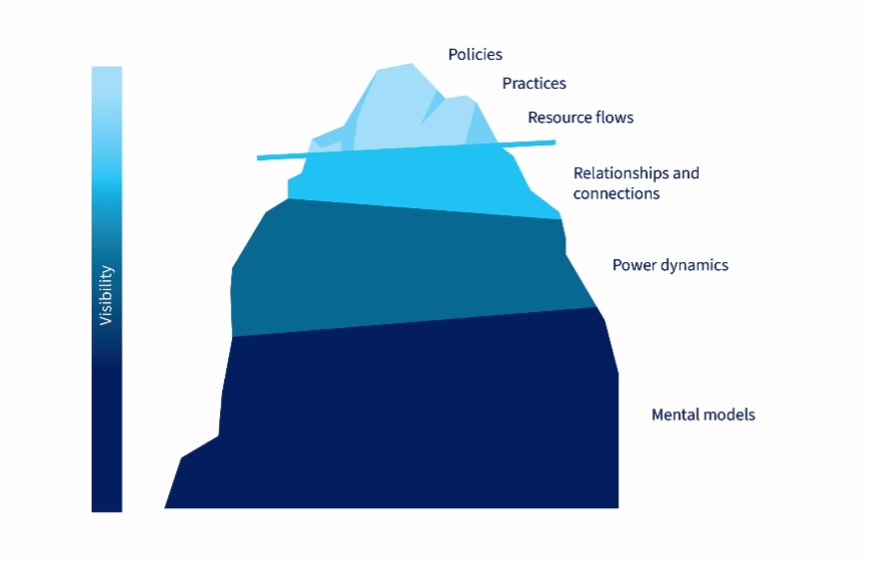
| System elements | |
|---|---|
| Policies | Covers: multilateral agreements; government policies, legislation, regulations and guidelines; industry standards; and the organisational policies of investment sector actors. |
| Practices | Covers what actors in the investment value chain do in practice. This may differ from practices covered in policies such as standards and practices. |
| Resource flows | Includes money, staff, knowledge and other resources and where and how they are allocated throughout a system. |
| Relationships and connections | Concerns the formal and informal relationships between individuals and organisations. |
| Power dynamics | Relates to the formal and informal distribution of power and decision-making authority within and across organisations. |
| Mental models | Social, professional and group norms, beliefs, values and assumptions that shape how we think and act. |
Systems thinking encompasses critical, contextual and creative thinking skills to address complex problems resistant to conventional solutions. It adopts a holistic perspective, examining how factors interact, influence each other and shape outcomes across time.
Several systems thinking methodologies exist and each is grounded in different assumptions about how systems operate, how they change and tools best support analysis and decision making.1 For instance, systems dynamics aims to help practitioners identify persistent problems, using tools like causal loop and stock and flow diagrams, and identify leverage points where targeted action can shift the system of interest. More resources on systems thinking tools can be found here.
System thinking is often contrasted with conventional linear and technical thinking that typically underpin investment and management decision-making. Some differences are illustrated below:
| Conventional thinking | Systems thinking | |
|---|---|---|
| Lens | Focuses on particular events | Examines patterns of behaviour over time |
| Ways of knowing | Knowing something means focusing on the details, using numbers, models and frameworks | Knowing something means starting with the big picture, understanding the context of relationships before getting into the details |
| Solutions | Wants to control to build reliability and efficiency; seeks to prove models to be true by validating historical data, seeking one truth | Believes changing systems requires a series of nudges and trial and error that takes time. Believes all models are working hypotheses |
| Causality | Causality is linear, variables are independent of others | Causality is ongoing, variables influence others in multiple pathways and feedback loops |
Four emerging applications of systems in investing
Four overlapping approaches to systems and investment are emerging and each reflects and shapes different motivations, goals and actions.
1. Growing focus on systematic risks
Investors diversify their assets, across asset classes, themes and geographies, to mitigate risks to financial returns. But increasingly investors are concerned they cannot diversify away from systematic risks like climate change, political instability, pandemics and macroeconomic shocks.
Investors are reacting in different ways. Some divest from assets they consider high-risk, such as high greenhouse case emitters like fossil fuel companies. Others attempt to influence company or government decisions to reduce their risk exposure or monitor developments without acting. Governments, concerned that awareness and voluntary measures remain inadequate, introduce mandatory requirements for investors and companies to analyse and plan for risks.
2. Investing for systems change
Systems awareness prompts investors to consider how they might invest to shift the underlying conditions driving economic, environmental and social outcomes. Some investors are motivated by systematic risks – The Investment Integration Project emphasises the interrelationship between systems and investments, arguing structural conditions shape long-term value and portfolios depend on strong and healthy economic, environmental and social systems. Other investors are motivated by personal values and interests in particular sustainability issues.
Investing for systems change departs from conventional sustainable and impact investing approaches. Neither explicitly seeks to change the system. For instance, impact investing focuses on discrete companies or projects, and whereimpact strategies aim for scale, they often do not explicitly seek to change norms or power relationships. Sustainable investors may seek opportunities that emerge in changes in systems, like the energy system and opportunities in renewable energy.
3. Expanding stewardship into systems stewardship
Investor stewardship has traditionally centred on investor-company engagement in public markets, information gathering, governance and proxy voting to protect or enhance financial value. Systems stewardship (sometimes called systemic, macro or beta stewardship) widens the scope of investor activities to policy advocacy, standard-setting, supply-chain action and collaboration with other investors or actors. Some definitions emphasise government and multilateral actors and policy level change.
While activities like policy advocacy and standard setting are new to some investors, other investors have used them for some time. The goal, however, has been to improve an investment’s’ financial and/or sustainability performance, improve a portfolio’s resilience to systematic risks, or to achieve outcomes related to broader economic, environmental or social outcomes.
4. Reforming the financial system itself
A smaller number of organisations seek to reshape financial market structures, incentives and practices. This includes efforts to align capital flows with long-term sustainability, redesign risk-return expectations, and challenge assumptions embedded in market norms.
Organisations such as The Club of Rome, Just Transition Finance and TransCap highlight the need for financial system reform as a precondition for changes in energy, health and education systems and a more sustainable future.
Emerging questions for investors
Meeting systemic challenges such as climate change and inequality requires approaches that match their complexity. The depth and authenticity of these early developments is still emerging. While using systems language, some approaches may not incorporate systems thinking’s essence: understanding how interactions, feedback loops and underlying structures shape outcomes, then applying this understanding to decisions and actions.
Regardless, these developments challenge familiar ideas, practices and assumptions. They push investors and others to:
- reassess goals, roles and obligations
- look beyond firm and asset level risks to complex, often hard to understand, influences
- question diversification as a sufficient protection mechanism
- adopt broader tactics such as multi-stakeholder collaboration
- rethink portfolio construction, risk models and other frameworks and tools
- build capabilities in complexity-aware decision-making, strategy and implementation.
Incorporating systems thinking into investment policies, practices and mental models will require experimentation and shared learning.
Article 2 examines stewardship through a systems lens highlighting its complexity, which is needed to improve stewardship. As John Kania, Mark Kramer and Peter Senge said in The Water of Systems Change ‘real and equitable progress requires exceptional attention to the detailed and often mundane work of noticing what is invisible to many’.
Relevant library resources

A pilot study on systems thinking in asset management
A systems approach to sustainable finance: Actors, influence mechanisms, and potentially virtuous cycles of sustainability
Recalibrating feedback loops: Guidance for asset owners and institutional investors assessing the influence of system-level investing

The third, systems stage of corporate governance: Why institutional investors need to move beyond modern portfolio theory
A new economy: Exploring the root causes of the polycrisis and the principles to unlock a sustainable future