Systems-informed stewardship part III: Reimagining stewardship for a sustainable future
This article presents systems-informed stewardship as a new approach to advancing sustainability across the finance sector. It outlines two interdependent lenses and three practical shifts, embedding responsibility, designing for complexity, and managing adaptively to improve stewardship effectiveness.

AUTHORS


The multitude of complex challenges that are impacting the finance sector demand new ways of thinking and working. This article introduces systems informed stewardship, an approach to stewardship that aims to shift stewardship practices to better support a sustainable future. It differs from the prevailing technical approach that view stewardship as investors’ rights and concerns investors actions and influence of investees.
This is the third article in a three-part series. Article 1 introduced systems and systems thinking and described four ways in which systems language is emerging in sustainable and impact finance. Article 2 applied a systems lens to stewardship and illustrated the complexities of two structural issues and their influences on stewardship policies and practices.
Systems informed stewardship
Systems informed stewardship comprises two inter-related perspectives to better understand stewardship and guide strategic and operational decisions and capability building efforts.
- The stewardship system lens examines the broader system of actors, relationships, and dynamics and behaviour patterns that collectively shape stewardship outcomes across the finance sector.
- The organisational stewardship lens recognises each organisation as a unique microcosm of the stewardship system. Organisations navigate their own distinct combination of internal cultures and functions alongside external pressures and relationships.

Photo by Deva Darshan on Unsplash
The lenses are interdependent and offer essential inward and outward perspectives on how stewardship functions. The stewardship system shapes individual organisations’ stewardship and vice versa and so improving organisational stewardship requires improving the stewardship system and vice versa.
The three shifts of systems-informed stewardship
To shift from prevailing practices, three mutually reinforcing changes are required.
1. Embedding stewardship throughout the system
Systems-informed stewardship distributes responsibility throughout the entire investment ecosystem, ensuring that all actors recognise and act on their role in shaping outcomes. This changes the focus from investor stewardship to investment stewardship.
This embedding involves three key dimensions:
- Establishing stewardship as a universal responsibility by making explicit the duties of all actors including consultants, advisors, service providers, regulators, credit rating agencies, industry associations and standard setters and savers and beneficiaries.
- Extending stewardship principles across all asset classes, with tailored approaches that reflect each class’ unique characteristics, the different actors involved, and the distinctions between public and private markets as well as passive and active strategies.
- Integrating stewardship throughout the investment lifecycle, from pre-investment analysis through to post-exit outcomes and covering all actors’ processes.
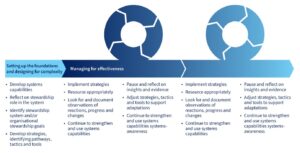
2. Designing for complexity
Designing for complexity recognises the intricate web of system and organisational elements that shape stewardship outcomes directly and indirectly. This design process encompasses three essential practices:
It involves:
- Mapping the landscape through a systems lens. This means understanding organisations and systems in relation to desired goals by identifying key challenges and opportunities, relevant actors, and the relationships and dynamics that connect them and shape how issues emerge and how they might be addressed.
- Uncovering what lies beneath the surface through critical enquiry to reveal known and hidden constraints and opportunities affecting stewardship effectiveness. These factors may relate to organisational culture, business models or market incentives. This deeper exploration exposes the forces that can either catalyse or obstruct meaningful change.
- Developing adaptive strategic approaches that enable organisations to prioritise effectively while remaining responsive to changing conditions. As political, economic, social, and environmental contexts evolve, strategies must flex while maintaining their north star.
3. Managing for effectiveness
Managing for effectiveness demands deliberate attention to both stewardship processes and outcomes. This approach requires three interconnected practices:
- Maintaining clear outcomes orientation while recognising the realities of change. Since outcomes often emerge slowly and numerous factors can disrupt the path from action to impact, effective management tracks not only end results, but also process effectiveness and critical progress milestones that signal movement towards goals.
- Creating robust feedback loops that capture insights about processes, progress, and intended and unintended outcomes. This requires systematic mechanisms to assess changes and test assumptions to refine strategies and tactics.
- Embracing adaptive management to navigate uncertainty and complexity. This uses insights generated through feedback loops, learning from experience, and adjusting course as understanding deepens. Adaptation is not a sign of failure but a mark of mature practice, recognising that what works in one context may not translate directly to another.
Next steps
The intersecting political, environmental, social and economic challenges of the 21st century are driving practitioners, policy makers and researchers to innovate to improve sustainability. This includes recognising the limitations of current approaches and devising new paths. Systems-informed stewardship is one of these, requiring an ongoing journey of learning and experimentation. We don’t have all the answers and our questions about how actors can use stewardship to make a more effective and meaningful contribution to a sustainable future are still evolving. But all actors can make a difference and the research papers on which this series is based offers some pragmatic actions.
Relevant library resources

The future of investor engagement: A call for systematic stewardship to address systemic climate risk
The purpose of investor stewardship

System-level investing: Case studies of investors leading the way
A practitioner's perspective - from obstacles to outcomes: Enhancing effectiveness in stewardship and engagement