
Library | ESG issues
Energy Solutions & Decarbonisation
Energy solutions and decarbonisation refer to strategies and technologies that reduce carbon emissions while ensuring reliable and sustainable energy supply. This includes renewable energy sources like wind, solar, and hydropower, energy efficiency measures, electrification, carbon capture, and clean energy innovations. Decarbonisation is essential for mitigating climate change, enhancing energy security, and transitioning industries toward low-carbon operations.



Refine
450 results
REFINE
SHOW: 16


RIAA policy platform: Sustainable finance for a thriving Aotearoa New Zealand 2023 and beyond
This report outlines RIAA’s policy platform to strengthen sustainable finance in Aotearoa New Zealand. It recommends a national strategy, clearer ESG disclosures, taxonomy alignment with global standards, anti-greenwashing measures, Māori inclusion, human rights protections, and alignment with biodiversity and the Sustainable Development Goals.

GHG protocol scope 2 guidance: An amendment to the GHG protocol corporate standard
This report updates the GHG Protocol Corporate Standard by introducing dual reporting for Scope 2 emissions—requiring both location-based and market-based methods. It defines Scope 2 accounting principles, emission factor hierarchies, and quality criteria for contractual instruments, aiming to improve transparency, accuracy, and comparability across energy markets.

Corporate value chain (scope 3) accounting and reporting standard: Supplement to the GHG protocol corporate accounting and reporting standard
The Corporate Value Chain (Scope 3) Accounting and Reporting Standard provides a consistent framework for measuring and reporting indirect greenhouse gas (GHG) emissions across a company’s value chain. It outlines 15 categories of Scope 3 emissions, offers guidance on boundary setting, data collection, and reporting, and aims to improve transparency, enable emissions reduction, and support strategic decision-making.

Green and intelligent: the role of AI in the climate transition
Artificial intelligence (AI) can support the climate transition by reducing global emissions by up to 5.4 GtCO₂e annually by 2035 in the power, food, and transport sectors, surpassing its own energy footprint. Strategic government action is essential to ensure AI accelerates low-carbon solutions equitably and effectively.

Counterproductive sustainable investing: The impact elasticity of brown and green firms
Sustainable investing strategies that reallocate capital from brown to green firms may unintentionally worsen environmental outcomes. This study finds that green firms show minimal environmental improvement from lower capital costs, while brown firms become more polluting when financially constrained. Current investment approaches offer weak incentives for impactful emissions reductions.

Corporate climate litigation in Australasia: (Re)shaping the private law-climate interface
The report examines how corporate climate litigation in Australia and New Zealand is shaping private law. It highlights legal actions involving directors’ duties, disclosure obligations, consumer protections, and tort law. The analysis shows incremental adaptations in private law to address climate change impacts, especially through anti-greenwashing and climate accountability claims.

The path to a new era for nuclear energy
Nuclear energy is gaining momentum as a reliable, low-emissions electricity source. The report outlines growth drivers, investment needs, emerging technologies such as small modular reactors, and policy frameworks required for scale-up. Financing challenges, supply chain risks, and workforce planning are key to realising nuclear’s role in future energy systems.
Targeting net zero: The need to redesign bank decarbonization targets
This report examines the limitations of current bank decarbonisation targets and proposes design reforms to align with net zero. It analyses scope coverage, target types, and sector alignment, offering practical recommendations for enhancing climate credibility and effectiveness in financial institutions’ transition planning.
Starting up: Responsible investment in venture capital
This report examines how environmental, social, and governance (ESG) factors are being adopted in venture capital. It outlines current practices, challenges, and industry-specific considerations, and highlights the need for tailored guidance, collaboration, and early-stage engagement to advance responsible investment across the venture capital ecosystem.

University of Adelaide
The University of Adelaide, established in 1874, is Australia's third-oldest university and a member of the prestigious Group of Eight. Ranked among the top 100 globally, it offers a diverse range of undergraduate and postgraduate programs. Located in Adelaide, South Australia, the university is renowned for its research excellence and vibrant campus life.

Market Forces
Market Forces works to hold financial institutions accountable for funding environmentally harmful projects. Based in Australia, it campaigns for banks, superannuation funds and governments to align investments with climate goals. Market Forces provides research, advocacy tools and transparency on fossil fuel financing to support climate-conscious financial decision-making.
RIAA Policy Platform 2025: Harnessing sustainable finance for a thriving Australia
The RIAA Policy Platform 2025 outlines nine policy priorities and two principles to align Australia’s finance system with sustainability goals. It recommends regulatory reforms, improved data, Indigenous inclusion, and stronger accountability to mobilise capital for a net zero, nature-positive economy that supports long-term economic resilience and societal wellbeing.

Critical mineral series: Sustainability considerations for investors in copper mining
This report examines copper’s role in the energy transition, highlighting growing demand, environmental and human rights risks, and evolving global regulations. It evaluates mining companies’ sustainability performance using biodiversity, governance, and modern slavery metrics, offering insights for responsible investment aligned with international standards and long-term ESG considerations.
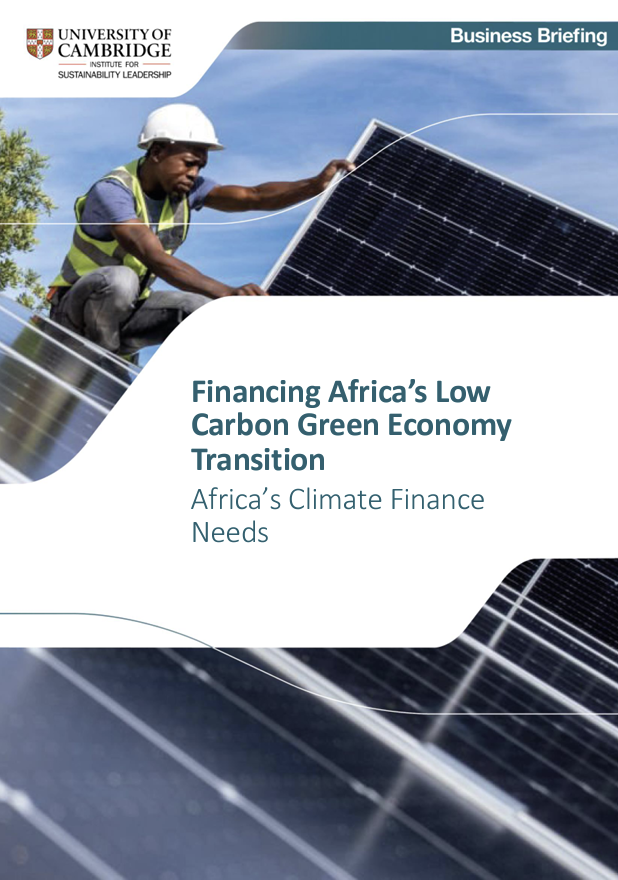
Financing Africa's low carbon green economy transition: Africa's climate finance needs
This report outlines how African states must spend at least US$2.5tn by 2030 to meet climate commitments. It shows that emission reduction makes up close to 80% of spending, with plans for adaptation to climate change costed at US$418 billion.
AIGCC's the state of investor climate transition in Asia benchmark series
This benchmark series examines how Asian investors are approaching net zero and climate-aligned investment, including target setting, portfolio alignment, climate risk assessment, stewardship, investment strategies and barriers to implementation across asset classes and markets in Asia.

Australian Impact Investments (Aii)
Australian Impact Investments (Aii) is a specialist asset consulting firm dedicated to mobilising capital for positive social and environmental impact alongside financial returns. Established in 2014, Aii collaborates with charitable trusts, foundations, family offices, wealth advisors, and institutions, offering bespoke impact strategies, rigorous investment analysis, and comprehensive portfolio management. With a focus on responsible investing, Aii assists clients at every stage of their impact journey.


