
Library | ESG issues
Long-termism
Long-termism prioritises enduring strategies over immediate gains, ensuring sustainable development and resource availability for future generations. Corporations and investors are encouraged to consider the long-term consequences of their decisions, moving beyond short-term profit motives to incorporate sustainability and intergenerational impacts. A long-term approach can enhance financial resilience, mitigate risks, and generate more stable and sustainable returns over time.



Refine
215 results
REFINE
SHOW: 16



United Nations Conference on Trade and Development (UNCTAD)
UN Trade and Development (UNCTAD) is a UN intergovernmental body that supports developing countries in trade, investment, finance and technology. It delivers data-driven policy analysis, technical cooperation and global consensus building to help countries integrate into the world economy and advance sustainable development.

Financial Markets Authority (FMA)
Financial Markets Authority (FMA) is New Zealand’s independent regulator overseeing financial markets. It promotes fair, efficient and transparent markets, ensures quality financial advice and protects investors. FMA develops regulation, supervises licenced entities, enforces compliance, supports innovation and aims to enhance trust in NZ’s financial sector.
The impact of physical and transition climate risk on asset valuation
This report analyses the interaction between physical and transition climate risks, showing their inverse relationship and implications for asset valuation. Using an extended DICE model, it quantifies how abatement policies affect costs and damages, links findings to SSP/RCP scenarios, and highlights valuation headwinds for global equities under varying decarbonisation pathways.

EDHEC Climate Institute
EDHEC Climate Institute (ECI) equips finance professionals and decision-makers with climate risk research, tools and scenario analysis. It focuses on physical risks, transition risks, green assets, resilience technologies and climate policy. ECI bridges academia, industry and public stakeholders to support low-emission investment strategies.

EDHEC Business School
EDHEC Business School is an international, triple-accredited (AACSB, AMBA, EQUIS) business school with campuses in Lille, Nice, Paris, London and Singapore. It offers a broad portfolio of programmes like BBA, master's in management, MSc, MBA, PhD and executive education, emphasising research, global partnerships and real-world impact.

International Resource Panel
International Resource Panel (IRP) is a science-policy platform established by United Nations Environment Programme in 2007. It produces peer-reviewed assessments and data such as the Global Material Flows Database to guide governments, industry and civil society on resource efficiency, sustainable use, circular economy and environmental impact.
Climate finance
This report reviews research on climate finance, focusing on how climate risks affect financial markets. It discusses theoretical models and empirical evidence on pricing climate risk in equities, bonds, housing, and mortgages, and explores portfolio strategies for hedging. Future research directions in modelling, measurement, and financial stability are highlighted.

National Bureau of Economic Research (NBER)
National Bureau of Economic Research (NBER) is a US-based nonpartisan economic research organisation producing working papers, conferences, datasets and publications on macroeconomics, labour markets, health economics and public policy. It supports scholars and policymakers with in-depth empirical research.
Enel: Industry case studies: Electric utility
This report presents Enel’s case study on implementing CFO Principles for the SDGs. It outlines historical drivers, sustainability disruption, strategic responses, and SDG investments, highlighting decarbonisation, electrification, and financial performance assessment. The report details Enel’s renewable energy expansion, SDG alignment, and integration of sustainability outcomes with financial results.
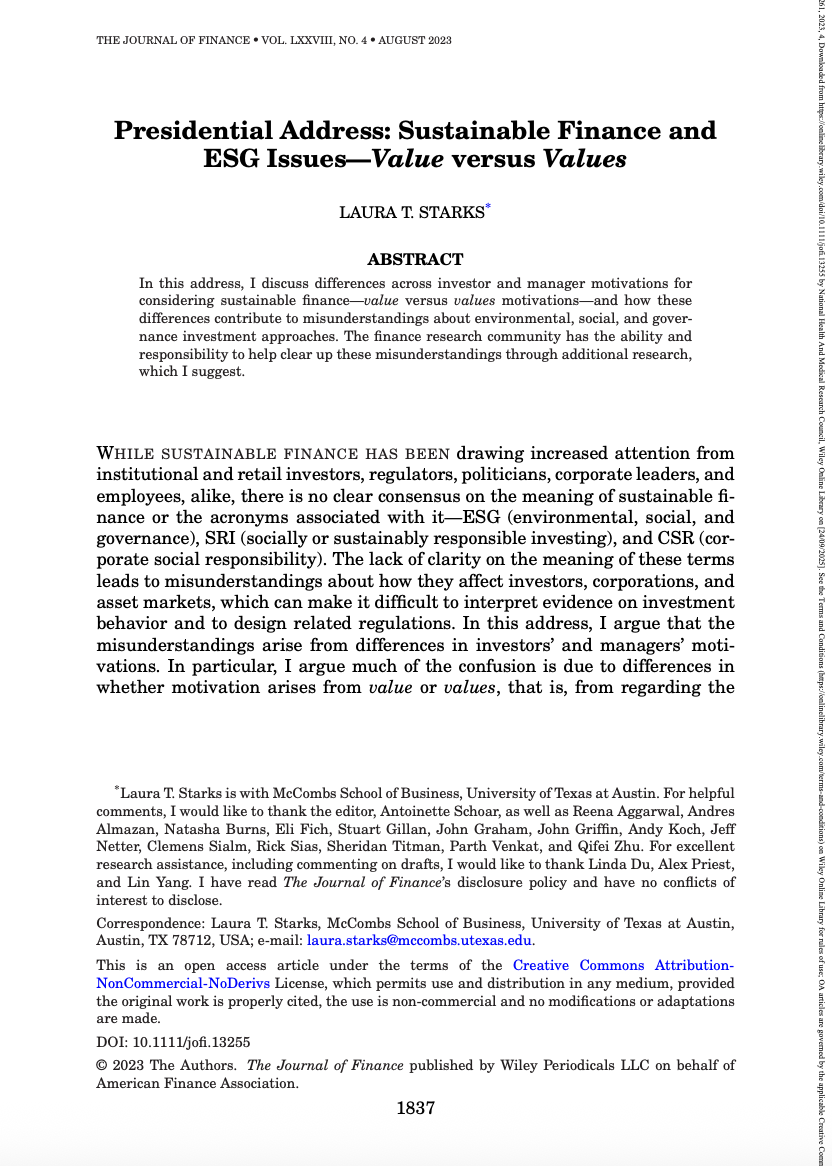
Presidential address: Sustainable finance and ESG issues: Value versus values
This report examines how investor and manager motivations—driven by either financial value or personal values—shape sustainable finance and ESG practices. It highlights definitional ambiguities, performance debates, and cultural differences, calling for clearer research to distinguish pecuniary risk-return considerations from non-pecuniary preferences in ESG investing.
Sustainable investing in practice: Objectives, beliefs, and limits to impact
This paper surveys 509 equity portfolio managers on their treatment of environmental and social factors. Findings show most prioritise financial returns, with limited willingness to sacrifice performance. ES constraints from mandates, policies, and client values strongly influence decisions. Beliefs and constraints outweigh fund labels in shaping sustainable investing practices.
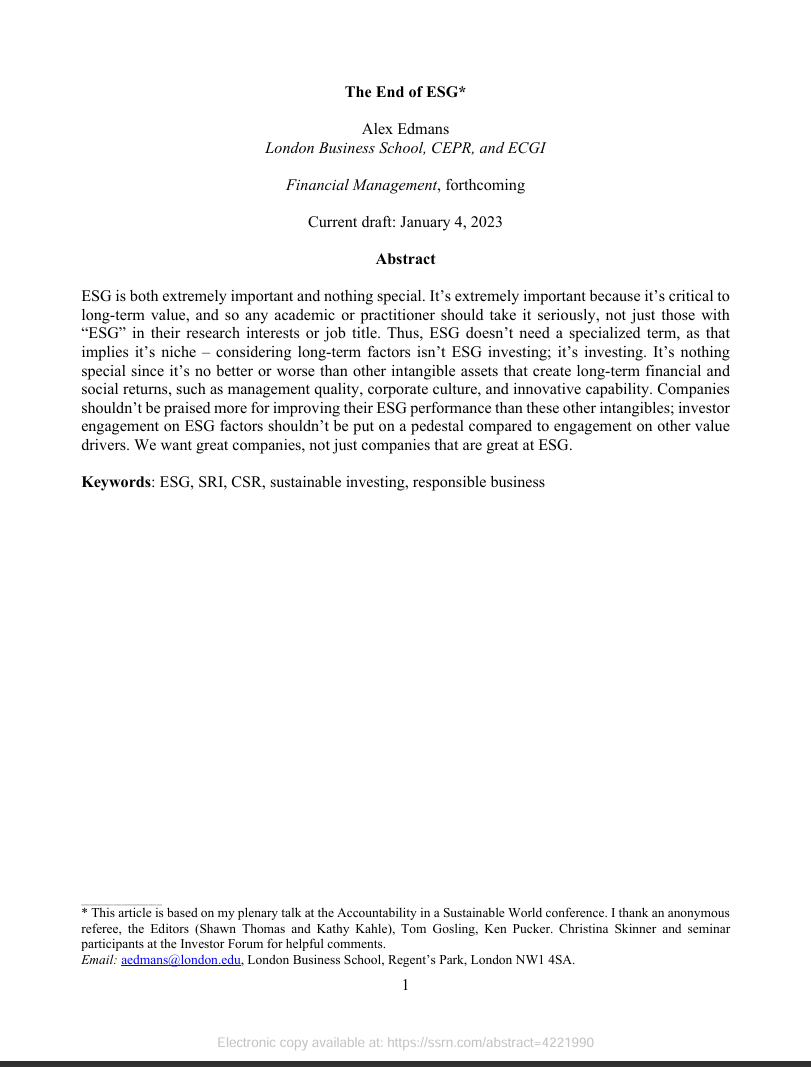
The end of ESG: Financial management, forthcoming
This report argues that ESG is both essential and ordinary: vital as a driver of long-term value but not unique compared to other intangibles such as culture or innovation. It cautions against over-emphasising ESG metrics, politicisation, and superficial classification, advocating instead a broader focus on overall sustainable value creation.
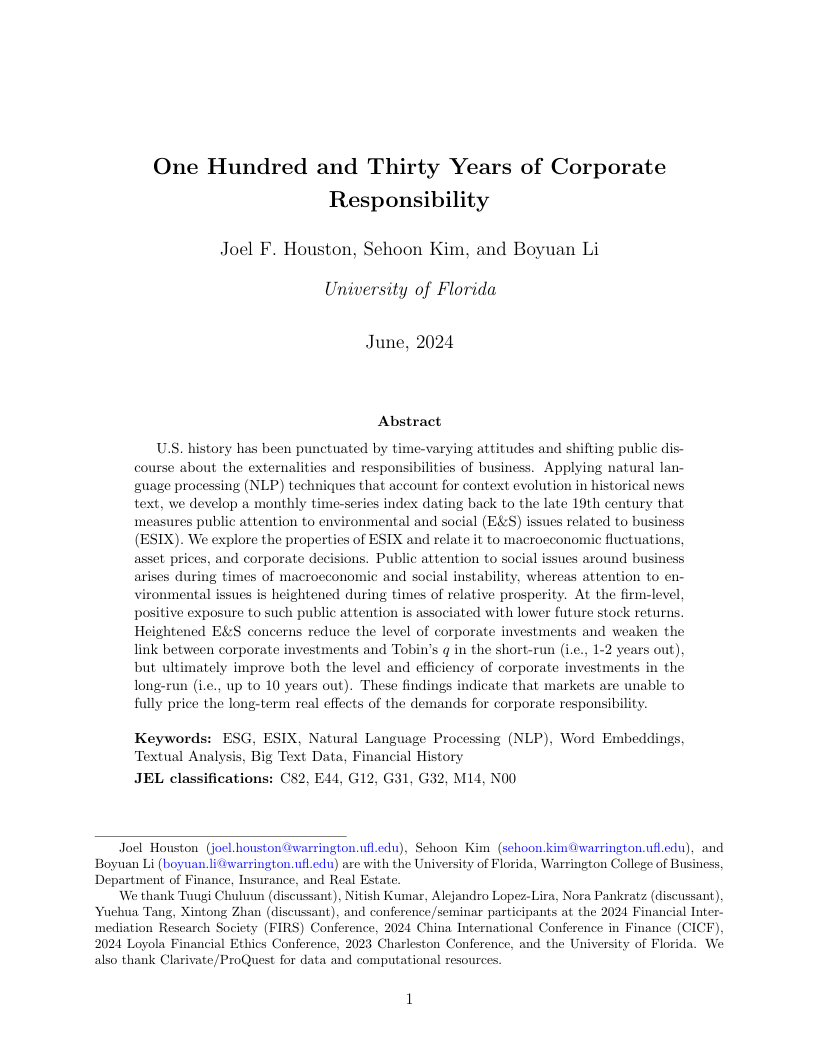
One hundred and thirty years of corporate responsibility
This report develops a 130-year index (ESIX) measuring public attention to environmental and social issues in business using historical news data. Findings show that such attention rises during instability (social) or prosperity (environmental), depresses short-term investment efficiency, but improves investment outcomes over longer horizons.

DBS Bank
DBS Bank India is a digital-led universal bank offering personal, SME, corporate and wealth management services. Features include resident and non-resident (NRI) savings and fixed deposit accounts, remittance, loans, digital payments and credit/debit card solutions. Positions as Asia’s safest bank with a wide India branch network.
ESG and global investor returns study
This report analyses the link between ESG integration and global investor returns, drawing on cross-regional data and sector comparisons. It assesses how environmental, social, and governance factors correlate with performance, highlighting variations across markets and asset classes. The study provides evidence-based insights on ESG’s financial materiality for investors worldwide.
MSCI ESG ratings in global equity markets: A long-term performance review
This MSCI report reviews the long-term performance of ESG ratings in global and developed equity markets. It finds that higher-rated companies outperformed peers, driven by stronger earnings growth and dividend yields rather than valuation effects. MSCI ESG indexes also generally outperformed their benchmarks across regions and during crises.


