
Library | ESG issues
Social
The social pillar in ESG (environmental, social, and governance) assesses a organisation’s impact on people and society. It covers labour practices, diversity and inclusion, human rights and community engagement. Prioritising social responsibility not only benefits society but also mitigates risks, strengthens reputation, and creates long-term value for businesses and investors.
Refine
1300 results
REFINE
SHOW: 16



The Equality Trust
The Equality Trust is a UK charity focused on reducing economic and social inequality. It produces research, policy analysis and advocacy on income, wealth and power distribution, informing public debate and decision-making. Work supports evidence-based policy, social justice and improved wellbeing across the UK.

International Committee of the Red Cross (ICRC)
International Committee of the Red Cross (ICRC) is an independent humanitarian organisation providing protection and assistance to people affected by armed conflict. It promotes international humanitarian law, conducts emergency relief operations, and supports detainees, civilians, and missing persons worldwide through neutral, impartial action, with global reach and sustained operational presence.

McKinsey Health Institute (MHI)
McKinsey Health Institute (MHI) is a global health research institute embedded within McKinsey & Company. It produces public research, data tools and insights on population health, mental health, health systems and workforce productivity, supporting evidence-based decision-making across healthcare, policy and business.

Institute of Health Metrics and Evaluation
Institute for Health Metrics and Evaluation (IHME) is an independent global health research institute based at University of Washington. IHME produces data, metrics and analysis on disease burden, mortality, risk factors and health systems, supporting evidence-based policy, planning and health impact assessment worldwide.

Sustainable Finance Roundup December 2025: Nature, Regulation, and the Hardening of Risk
This month’s sustainable finance roundup traces the shift from ambition to enforcement, as climate and nature risks become financial, regulatory and legal realities. It covers Australia’s environmental law reforms, the embedding of climate and nature risk through prudential supervision, disclosure and shareholder pressure, and insurer warnings on the limits of insurability. It also highlights how markets are responding to deforestation and biodiversity risk, and how litigation and regulation are reshaping governance and long-term financial resilience.

Our predicament: The fundamental flaws of predominant economic systems - and the cultures scaffolding them
This report synthesises interviews with global thinkers to diagnose structural flaws in dominant economic systems. It argues that extractive capitalism, growth imperatives, inequality and ecological overshoot underpin a planetary predicament, and frames the challenge as navigation towards regenerative, responsibility-based economies rather than problem-solving.
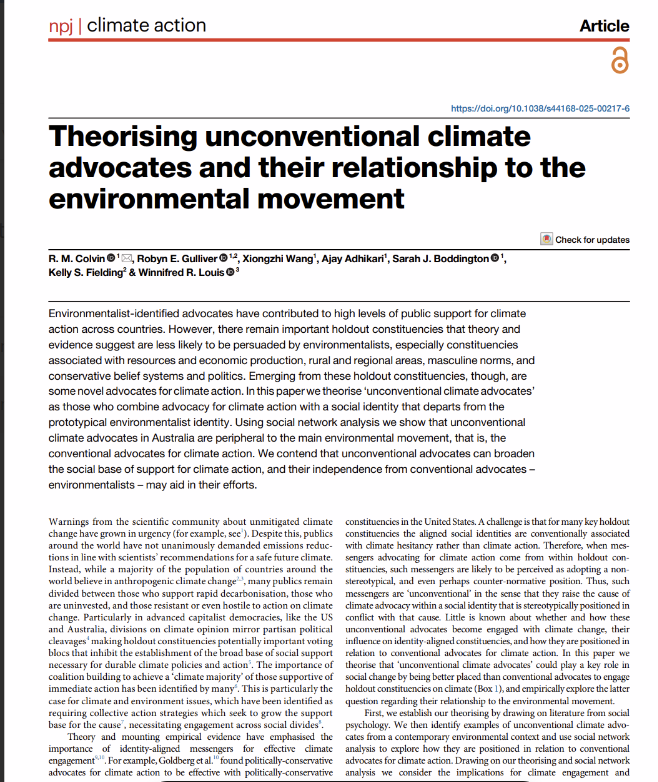
Theorising unconventional climate advocates and their relationship to the environmental movement
This study theorises “unconventional climate advocates” and analyses their position within Australia’s environmental movement using social network analysis. It finds these advocates are peripheral yet potentially effective in engaging climate-hesitant constituencies by operating independently from conventional environmentalists.
Tackling the transformation: The challenges of operationalizing corporate sustainability goals and how to overcome them
ERM’s Transformation Survey analyses global corporate progress in operationalising sustainability goals. It finds stronger performance on social issues than climate or nature, identifies weak sustainability-linked incentives as the main barrier, and highlights underinvestment in training, incentives, and ESG data systems.
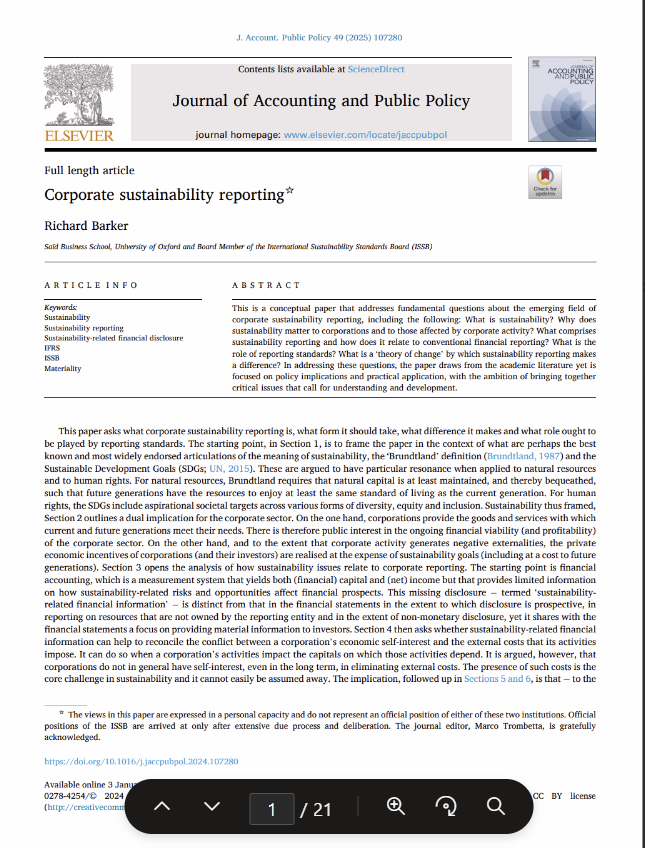
Corporate sustainability reporting
This conceptual paper examines corporate sustainability reporting, distinguishing investor-focused sustainability-related financial disclosure from broader impact reporting. It argues investor interests are imperfectly aligned with societal goals and concludes that complementary financial and impact reporting standards are needed to support accountability, capital allocation and sustainability transition.
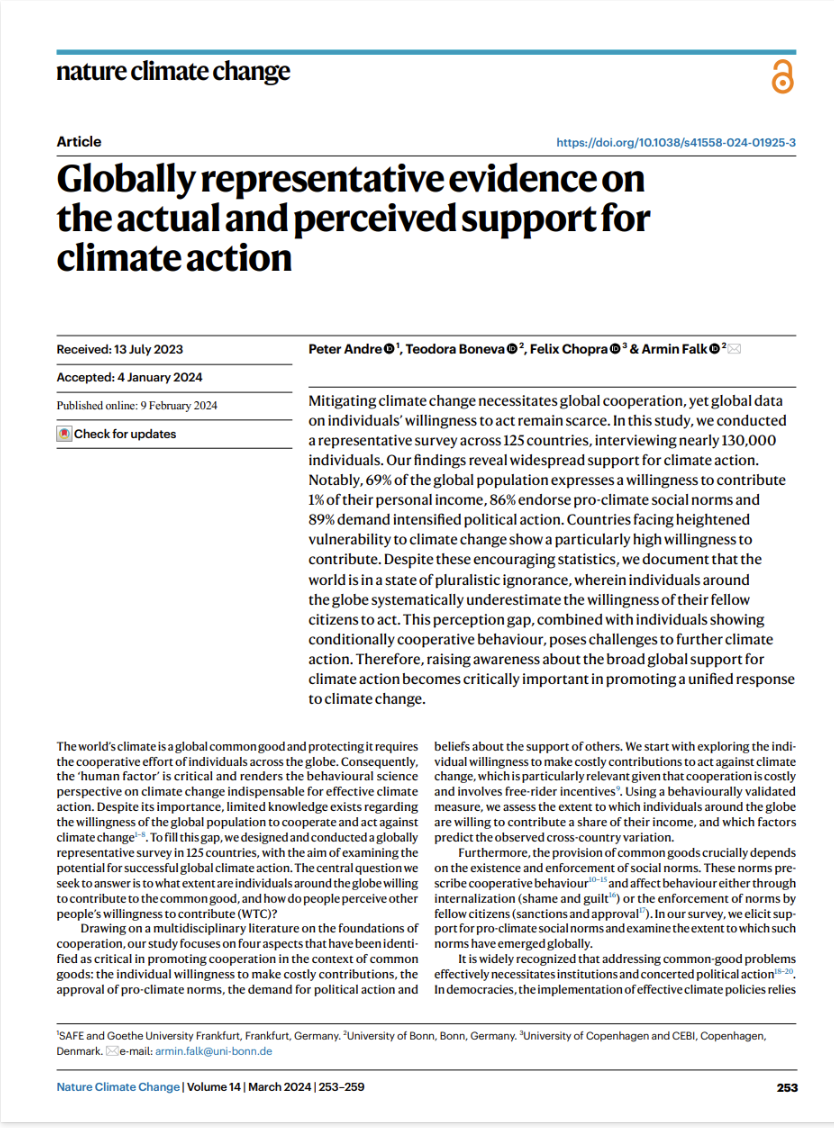
Globally representative evidence on the actual and perceived support for climate action
Using a survey of 130,000 people across 125 countries, the study finds strong global support for climate action, but widespread underestimation of others’ willingness to act. This perception gap may hinder cooperation; correcting it could materially strengthen climate action.
Navigating the corporate ego: Understanding the association between ESG performance and organizational narcissistic rhetoric
This study analyses 1,659 FTSE 350 observations to explore the link between ESG performance and organisational narcissistic rhetoric. Findings indicate that high ESG performance correlates with increased self-promoting language, though greater board gender diversity mitigates this effect. Additionally, strong financial results are positively associated with narcissistic corporate narratives.
Private capital, public good: Building shared prosperity to create a resilient and inclusive economy
The report outlines bipartisan US federal policy recommendations to mobilise private capital for shared prosperity. It focuses on strengthening economic competitiveness, scaling community investing, and improving impact transparency to support inclusive growth, underinvested communities, and long-term economic resilience.

Preparing for next-generation information warfare with generative AI
The report analyses how generative AI reshapes information warfare by enabling scalable manipulation, behavioural influence and dual-use knowledge diffusion. It highlights heightened risks to civilians, military operations and international law, stressing gaps in protection and the need for anticipatory, whole-of-society resilience strategies.
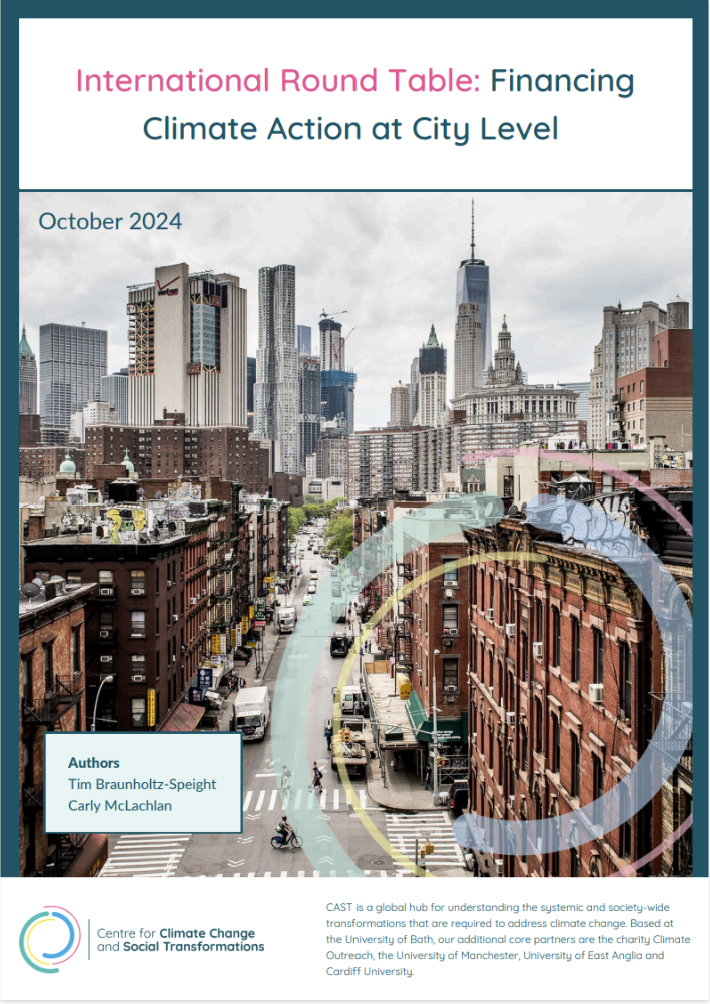
International round table: Financing climate action at city level
This report synthesises discussions from an international round table on financing city-level climate action, highlighting how local governments overcome fiscal constraints through tailored funding scales, partnerships, innovative revenue mechanisms, and long-term approaches to deliver major decarbonisation programmes across Europe and North America.
Good practice case studies in scope 3 data collection
The report presents practical case studies on Scope 3 data collection, covering supplier, upstream, downstream and employee engagement. It outlines hybrid methodologies, use of primary and spend-based data, and emphasises collaboration, pragmatism and incremental improvement to support credible emissions measurement and reduction.
Harmonised framework for impact reporting for social bonds handbook
The handbook provides a harmonised framework for issuers to report social bond impacts, outlining core reporting principles, target population disclosure, and preferred quantitative indicators. It introduces sector guidance—initially affordable housing—and offers templates to support consistent, transparent, and comparable impact reporting across social project categories.


