ASRS first year has landed: Here's what we’re seeing in the market
This article examines how Australian organisations are approaching the first year of mandatory ASRS climate disclosures. It highlights common implementation patterns, areas of misallocated effort, and emerging practices that prioritise financially material, decision-useful climate reporting.

AUTHORS

Disclaimer: This article is republished with permission from the authors. The article was originally published on Canbury’s Substack and can be found here. Any views expressed in this article are those of the original author and do not necessarily reflect the views of Altiorem.
Australia’s Sustainability Reporting Standards (ASRS) are now in force. While formal reports are yet to be released, clear patterns are emerging in how organisations are approaching year one of mandatory climate disclosure.
Five clear patterns stand out.
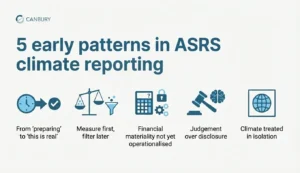
- From “preparing” to “this is real”: the market has shifted decisively from “preparing for ASRS” to “this is now real”. Climate disclosure is no longer treated as a future compliance task but as a near-term board responsibility, with heightened senior engagement and governance attention.
- Measure first, filter later: ASRS is being widely interpreted as a requirement to measure and model everything first, then decide what to disclose. While this reflects caution, it is driving over-scoping, slow progress, and misallocated effort.
- Financial materiality not yet operationalised: the breadth-first approach risks obscuring ASRS’s central principle: disclosure is required for financially material climate information, matters reasonably expected to affect cash flows, access to finance, or cost of capital over relevant time horizons.
- Judgment over disclosure: the strongest early practice is not “more disclosure”, but clear, defensible judgement. Leading organisations are explicit about why certain risks are material, and why others are not, and are prioritising decision-useful insight over completeness.
- Climate in isolation: Australia is largely treating climate in isolation. In contrast, UK and European practice is already moving toward combined climate + nature reporting, reflecting how real-world risk drivers interact. This presents a strategic opportunity for Australian boards to lead rather than simply replicate minimum compliance.
From “preparing” to “this is real”
Boards are more directly engaged. Climate risk has moved from sustainability sub-committees into audit, risk, and full board agendas. Directors increasingly recognise that ASRS disclosures are financial statements in substance, requiring the same level of rigour, oversight, and sign-off discipline. Climate literacy uplift at board level is now common, and climate oversight roles are being formalised within governance structures.
Execution urgency has increased. Many large entities treated 2024 as an informal “dry run”, accelerating climate disclosures in annual reports and investor materials even before ASRS reporting is mandatory. This reflects an understanding that data systems, controls, and internal alignment take time to mature, and that year one tolerance from regulators will not extend indefinitely.
Accountability is sharpening. Climate metrics are increasingly linked to executive accountability mechanisms, including remuneration and performance scorecards. While still uneven, this trend signals that climate considerations are being embedded into mainstream management processes rather than remaining a parallel ESG track.
At the same time, organisations are confronting the complexity of ASRS. The volume of data, judgement required around scenarios and materiality, and the overlay of assurance expectations have surprised many boards. This has contributed to a cautious, often conservative interpretation of requirements, which in turn has shaped how ASRS is being implemented in practice.
How ASRS is being applied
From our work supporting organisations preparing their first climate disclosures, several consistent implementation patterns are emerging. In the absence of published ASRS reports, observable practice comes from preparatory work with clients, advisor methodologies, auditor expectations, and the evolution of voluntary disclosures.
Broad scoping is the default
A dominant pattern is a “measure first, filter later” approach. Organisations are identifying a very broad universe of climate risks, opportunities, metrics, and scenarios, often exceeding what is likely to be financially material.
This manifests in:
- Extensive lists of climate risks without prioritisation
- Multiple scenario variants with limited strategic differentiation
- Large volumes of metrics disclosed “just in case”
- Early inclusion of low-materiality data points because they are easy to measure
The underlying driver is defensiveness: organisations are seeking to avoid the risk of omission in a new regulatory environment. Advisors and internal teams alike often prefer over-inclusion to judgement-based exclusion.
Advisor and auditor influence is significant
External advisors are playing a central role in shaping ASRS interpretation, particularly for organisations with limited internal climate capability. Many advisory tools and readiness frameworks emphasise comprehensive coverage, which can reinforce breadth-first behaviour.
Auditors are also influencing practice well before formal assurance applies. Companies are designing climate reporting processes to be “audit-ready” from day one, including documentation of assumptions, controls, and methodologies. This has improved discipline but has also contributed to over-engineering in some cases.
Financial materiality is acknowledged, but not always operationalised
Most organisations can articulate that ASRS is about financially material climate information. Fewer are demonstrating confidence in applying that threshold decisively.
As a result, materiality assessments are often implicit rather than explicit, with many disclosures presenting information without clearly stating whether, and why, it is considered material. When climate risk is not expressed in comparable financial terms, it is difficult for boards to assess it alongside other strategic and financial risks.
Putting a financial estimate on climate exposure makes the risk more actionable. It allows boards to compare climate risk with other pressures on the business and to incorporate it into strategy, capital allocation, and risk management in a practical way.
Where effort is being misallocated
The combination of urgency, caution, and advisor influence is producing several consistent areas of misallocated effort.
Over-engineered scenario analysis
Some organisations are investing heavily in highly complex climate modelling with limited decision value. Scenario analysis is sometimes treated as a technical exercise rather than a strategic one, producing outputs that are difficult for boards to interpret or use.
Excessive precision over long time horizons can also increase risk: complex models are harder to explain, harder to assure, and rely on assumptions that directors must be comfortable defending.
Disproportionate focus on immaterial metrics
A recurring issue is the significant effort devoted to quantifying metrics that are financially insignificant, particularly where data is readily available. For example, small Scope 3 categories are often measured and disclosed in detail, while much larger drivers of exposure remain estimated or deferred.
This approach dilutes the signal of what truly matters, reduces comparability over time, and expands the surface area for error without improving decision-usefulness.
Process complexity crowding out insight
In some cases, governance and control frameworks around climate reporting have become so elaborate that they slow progress and divert attention from substantive analysis. Extensive documentation, multiple approval layers, and parallel consultant workstreams can consume time without improving outcomes.
The result is a paradox: more process, less clarity.
Why this matters
Misallocated effort is not just inefficient, it increases risk. Over-disclosure creates more opportunities for inconsistency or error. Poor prioritisation can undermine confidence in the report as a whole. And boards may struggle to extract clear strategic insight from dense, unfocused disclosures.
What “good” looks like before reports are published
Despite these challenges, a clear picture is emerging of what proportionate, defensible ASRS preparation looks like.
Decision-useful framing
Stronger organisations start with the question: what would a reasonable investor need to understand our financial exposure to climate risk? Disclosures are framed in business and financial terms, not generic climate language, and are clearly linked to strategy, capital allocation, and risk management.
Explicit materiality judgements
Leading practice involves being transparent about materiality decisions. Organisations document the full universe of climate risks and opportunities considered, then clearly explain why a smaller subset is disclosed as financially material.
Equally important, they explain why other issues are not material. This clarity strengthens defensibility and reduces ambiguity for users of the report.
Proportionate allocation of effort
Effort is aligned with impact. Areas that drive the majority of financial exposure receive deeper analysis; peripheral issues are addressed at a higher level or explicitly deprioritised. Uncertainty is acknowledged rather than masked by false precision.
Governance and assurance readiness
Boards are engaged early, reviewing assumptions and judgements before disclosures are finalised. Internal alignment between sustainability, finance, risk, and legal teams is evident, reducing the risk of inconsistent messaging across reports and disclosures.
Regulation as the floor, not the ceiling
While meeting ASRS requirements is the baseline, stronger organisations are selective about where going beyond compliance adds strategic value. This includes clearer articulation of opportunities, integration with financial planning, and, in some cases, early consideration of adjacent risk areas such as nature.
Looking ahead: climate in isolation vs climate + nature
Australia’s ASRS framework is deliberately climate-focused. Internationally, however, reporting practice is already moving toward integrated climate and nature disclosure.
In Europe, mandatory sustainability reporting encompasses biodiversity, water, and ecosystems alongside climate. In the UK, the Taskforce on Nature-related Financial Disclosures (TNFD) is gaining traction, with growing investor and regulatory attention.
This reflects a simple reality: climate risks rarely operate in isolation. Nature degradation, water stress, and biodiversity loss can amplify climate impacts and directly affect business resilience, supply chains, and asset values.
For Australian organisations, this creates both a risk and an opportunity.
The risk is that climate-only analysis misses key financial drivers. The opportunity is that boards can use the current ASRS implementation phase as a foundation for more integrated environmental risk thinking – without waiting for a regulatory mandate.
Early integration of climate and nature considerations can improve risk identification, reduce duplication of effort over time, and better align disclosures with how investors increasingly assess long-term value and resilience.
Questions coming up in boardrooms now
As first ASRS disclosures approach, sustainability teams are using questions like the following to anchor board and investment committee discussions:
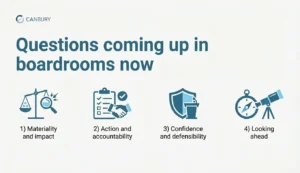
- Materiality and impact
- What are our most material climate-related risks and opportunities, and why?
- How do climate scenarios affect strategy, cash flows, and asset values in practical terms?
- Action and accountability
- Which risks are we actively managing, and how is this reflected in capital allocation and planning?
- Where is accountability for climate outcomes and disclosures clearly assigned?
- Confidence and defensibility
- Do we have confidence in the data, assumptions, and judgements underpinning our disclosures?
- What are we choosing not to disclose, and can we clearly defend those decisions?
- Looking ahead
- How are we preparing for emerging expectations beyond climate, including nature-related risk?
These questions reinforce that ASRS is not about volume, but about judgement, relevance, and financial clarity.
Relevant library resources
Mandatory Climate Reporting in Australia: A Practical Guide for 2026
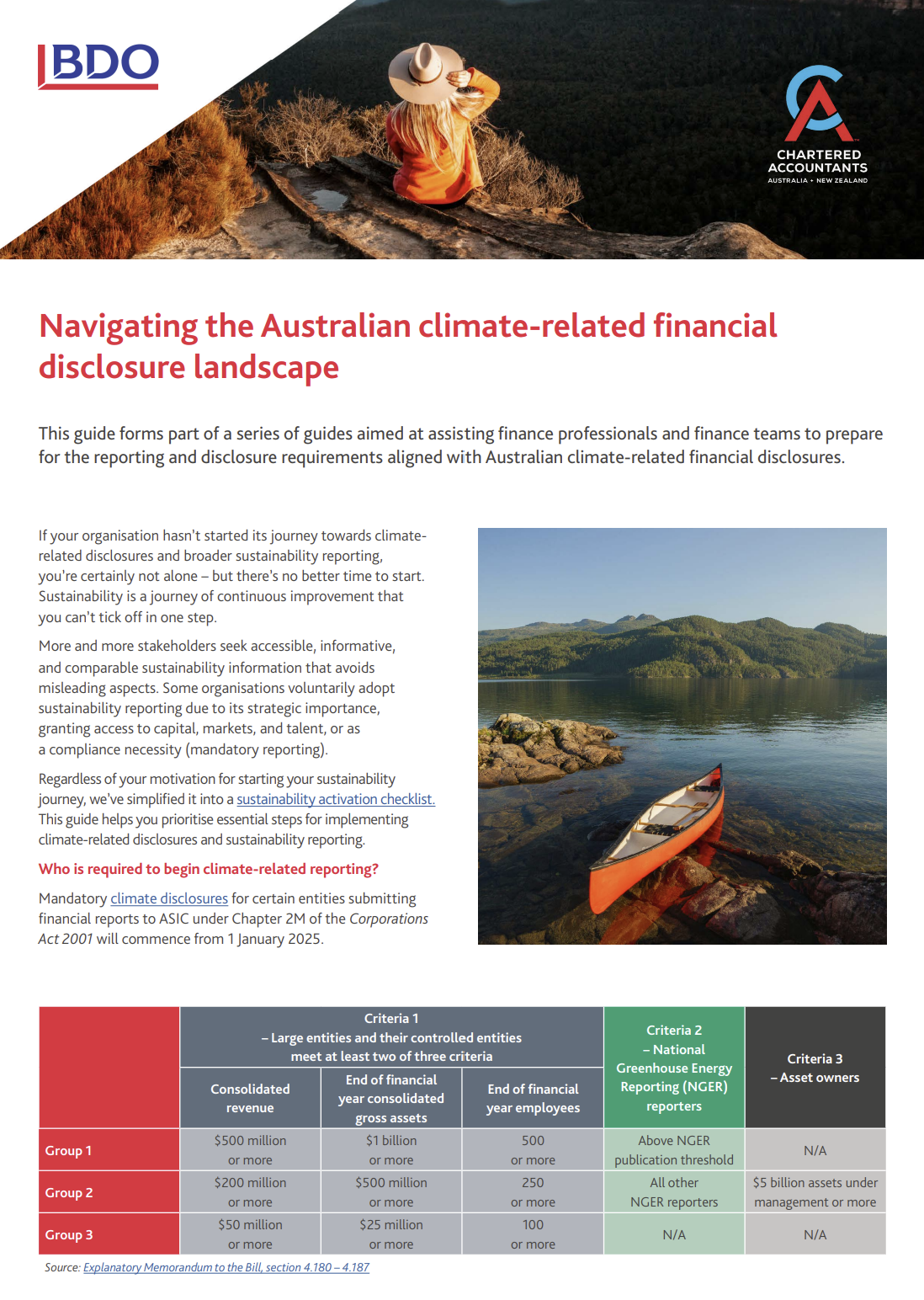
Navigating the Australian climate-related financial disclosure landscape

Australian sustainability reporting standards 2024
Climate-related and other emerging risks disclosures: Assessing financial statement materiality using AASB Practice Statement 2

Nature Enters the Boardroom: Why Directors Are Paying Attention