Private doubts, collective conformity: the Power and fragility of climate narratives
This article examines why current climate frameworks persist despite widespread professional skepticism, highlighting institutional incentives and “preference falsification” as key drivers. It calls for more open, cross-sector dialogue focused on diagnosing real problems and unlocking practical, system-level solutions.

AUTHORS

Disclaimer: This article is republished with permission from the author. The article was originally published on LinkedIn and can be found here. Any views expressed in this article are those of the original author and do not necessarily reflect the views of Altiorem.
“The system’s power comes not from its truth, but from everyone’s willingness to perform as if it were true, and its fragility comes from the same source.” – Mark Carney, 2026
Over the past year, I’ve been trying to, as Carney put it, “[call] out the gaps between rhetoric and reality” in the core assumptions underlying current climate frameworks, including that:
- entity-level net zero does not aggregate to atmospheric net zero
- carbon offsetting is an atmospheric fallacy
- financing adaptation and resilience will face hard limits
- mainstreaming climate risk assessment was a pyrrhic victory;
- carbon accounting has largely become a distraction
- frameworks have obscured real objectives
- fossil fuels are not phased out through pledges
I’ve referred to a confused landscape of misaligned frameworks that create fertile ground for those who seek to obstruct or delay,
And suggested we’ve ‘gotten climate finance all wrong’.
What’s been remarkable is how many wonderful and committed professionals have — both publicly and privately — affirmed their own fatigue, frustration, and discomfort with our most pervasive frameworks.
Individually, I hear from more and more people, eager for authentic discussion and new approaches. But collectively, we continue to pour time and resources into institutionalizing, expanding, and refining our existing ones.
Last month, when describing this dynamic to Ahmed Saeed, he introduced me to the concept of preference falsification from the book Private Truths, Public Lies. I devoured the book just in time for Mark Carney’s summary of the same at Davos.
The book describes dynamics that make social narratives seem widely accepted even when privately, they are not. Public dissent becomes costly, reinforcing the perception of widespread acceptance.
Until Ahmed introduced me to the concept and the book, I found the disconnect bewildering. Thanks to Ahmed, I’ve been thinking more clearly about why our frameworks are so entrenched, even when many recognize their conceptual limitations.
I’m sharing this because the frustrations and doubts that many feel about the target-setting/accounting/compliance/disclosure/reporting/auditing-heavy climate frameworks are more widely held than most realize.
Practically every institution now complies with this regime and requires their stakeholders to do so, maintaining the regime’s public legitimacy. And yet, below the surface, thousands of extraordinary professionals are fatigued and frustrated, and are under-utilized for their constructive, innovative, collaborative thinking and problem-solving.
The persistence of these frameworks is not the result of bad actors or bad faith. It reflects how many institutions operate.
- Institutional mandates, incentives, job roles, budgets, and professional credibility depend on working within, and complying with, the existing system.
- Frameworks, metrics and accounting are institutionally embedded; they fit governance, finance and reporting structures. In many cases, the metrics have substituted for the underlying objective.
- Requirements are collectively reinforced. Expectations that stakeholders set targets, align with SBTI, and report emissions cascade through value/financing chains, flooding the ecosystem, not because they’re decision-useful but because upstream actors require downstream actors to replicate the same expectations, and defection is costly.
Stepping outside the system is genuinely hard and uncertain. It requires:
- asking questions that may not have immediate answers
- engaging actors outside one’s usual institutional circle
- working across disciplines and sectors
- advancing solutions that may not yet be measurable or recognized
Even when individuals recognize the limitations of the system, their response is bound by those system constraints. The most leeway one often has is to engage in the regular and lengthy methodological reviews and revisions of the frameworks we have; questioning whether the frameworks are fit for purpose is very difficult to defend personally and institutionally.
‘Preference falsification’ is not the only explanation for the persistence of these frameworks, of course. The world we are operating in is complex and dynamic. Some people hold genuinely different perspectives or convictions, including about the value of existing approaches. But views are often shaped by personal and institutional incentives, the aperture of one’s expertise, and available tools/instruments.
We too rarely ask ourselves what we might not know beyond what we do know, or think critically about information with which we’re regularly presented. Sometimes we don’t ask certain questions because the answers feel beyond the scope of what we can control.
But here is what gives me optimism: in hundreds of small conversations and convenings, even those practitioners institutionally tied to existing frameworks are energized by the opportunity and space to think critically and pragmatically.
If more people realize how many others crave the same, we can redirect some of our collective energy toward diagnostic, cross-sector conversations, exploring how the opportunity set for systems change has shifted profoundly, where coordination is the missing link to make markets and advance solutions, and how creative institutional design can unlock finance at scale.
In my experience, the most productive conversations bring together actors who rarely share a table and begin not with targets, but with diagnosis: What are we trying to achieve? What has changed in the technology or financing landscape that re-defines what that trajectory looks like? What are the constraints preventing those opportunities from self-realizing? And what institutional redesign would unlock progress?
Those conversations feel very different from accounting and reporting cycles. They reflect the profound joy and fulfillment of being engaged and challenged intellectually, bringing one’s personal and professional perspectives and toolkits to a discussion and learning from others, and being able to collaborate across sectors, boundaries, and disciplines to develop targeted, innovative, and pragmatic solutions to shape our collective future.
Relevant library resources

The Real Tragedy of the Horizon

Green finance was supposed to contribute solutions to climate change. So far, it’s fallen well short
Climate change & the engagement gap: Why investors must do more than move the needle, and how they can
Sustainability disclosure landscape report for risk management: Insights from climate-focused case studies
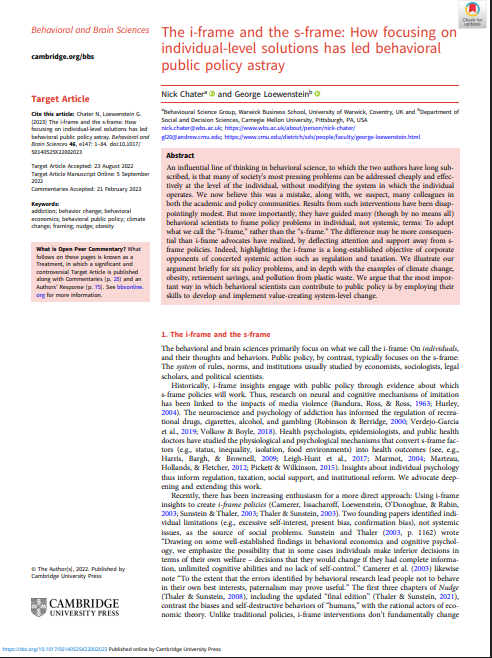
The i-frame and the s-frame: How focusing on individual-level solutions has led behavioral public policy astray