Sustainable Innovations: What Businesses Can Learn from the Intelligence of Nature
The article explores how businesses can draw inspiration from nature’s intelligence to drive sustainable innovation. It clarifies the concept of materiality in climate disclosures, distinguishing key ESG elements and offering practical guidance for reporting. By aligning business strategies with natural systems, organisations can better manage risks, enhance resilience, and create long-term value.

AUTHORS


How might businesses rethink the way they create value if they looked more closely at how nature works?

In ecosystems, resilience emerges through relationships, adaptation, diversity, and cycles of renewal. Dr Emma H. E. Fromberg, research fellow at the Centre for Sustainable Business at King’s College London, has spent the past four years exploring how these ecological principles can inform circular economy innovation and how they can be translated into practical insights for organisations navigating complex sustainability challenges.
The result is Nature’s Playbook: Ecological Design Thinking for a Circular Economy, a research-based tool that turns lessons from the natural world into prompts for business strategy and innovation. Developed from Dr Fromberg’s doctoral research and supported by the Centre for Sustainable Business, the tool features a set of cards that guide individuals and teams through ecological concepts such as interdependency, diversity, and metamorphosis, encouraging new perspectives on circularity and systems thinking.
In this interview, Dr Fromberg shares the story behind Nature’s Playbook, the research that shaped it, and how ecological design thinking can help organisations translate sustainability ambitions into practical and meaningful action.
Q: Can you tell us about the moment when Nature’s Playbook shifted from a research concept to something you knew needed to exist in the hands of practitioners?
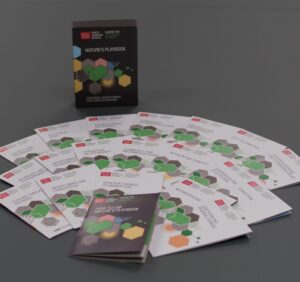
“Nature’s Playbook: Ecological Design Thinking for a Circular Economy, a research-based tool that turns lessons from the natural world into prompts for business strategy and innovation.”
E.F.: “From the beginning, I intended Nature’s Playbook to become an ideation and innovation tool for business professionals. I had been experimenting with workshops where business professionals engaged with ecological metaphors through verbal prompts and small exercises. The discussions were thoughtful and often energising, but they lacked structure. Especially during a workshop that I ran in 2023, the participants were genuinely engaged, but came up with incredibly ambitious ideas, often lofty and slightly unrealistic.
I deeply believe that you don’t need to single-handedly transform the whole economic system to align a business more closely with ecological principles. This is why I went on the hunt for more humble entry points for businesses that are both actionable and realistic.
To identify these, I started interviewing business professionals about how they understood nature, so I could use these intuitive areas of understanding in the tool. This was such an interesting part of the process, because I found that many people understood nature in very different ways: some described it as fundamentally ruthless and competitive, and others saw it as harmonious and collaborative only.
“I found that many people understood nature in very different ways… This is why [Nature’s Playbook] tries to guide the ideation process by using inspirations from nature, but keeps it open enough to allow individual users to interpret it themselves.”
The purpose of Nature’s Playbook is to highlight the nuance. Competition and collaboration coexist in nature. Efficiency sits alongside redundancy and diversity. Growth is inseparable from decay.
I wanted to create something that practically held that complexity without simplifying it. This is why the tool tries to guide the ideation process by using inspirations from nature, but keeps it open enough to allow individual users to interpret it themselves.”
Q: The cards are clustered around three themes: wholeness, response to change, and importance of relationships. Why are these themes particularly relevant for today’s organisations?
“There is an implicit assumption that the system can be engineered and controlled. Natural systems tell a radically different story.”
E.F.: “These three themes emerged from academic literature as well as observing the metaphors currently shaping circular economy discourse.
The second theme, the importance of relationships, responds to the metaphors that we use in circular economy discourse to make sense of the relationship between businesses: competitive metaphors. We are aware that there is collaboration between businesses in the economy, but the underlying metaphors that we use to make sense of their relationships still leans to competition. In ecological systems such as nature, relationships are more varied. There are competitive dynamics, but also mutualistic exchanges, parasitic interactions, temporary alliances, and long-term symbioses. That diversity matters. It expands how we think about supply chains, partnerships, and value networks.
The third theme is response to change, which challenges the way transition is often framed as a linear roadmap. In nature, change is rarely linear. There are seasonal rhythms, gradual evolution, sudden disturbances, and moments of transformation. These processes interact. If organisations approach circular transition as a simple step-by-step implementation plan, they may miss the deeper shifts occurring around them. Adaptive capacity and listening to feedback become much more important than strict adherence to a roadmap.
Together, these themes offer an alternative narrative with a wealth of novel ideas and approaches for businesses to try.”
Q: How can ecological design thinking influence the redesign of business models toward long-term resilience and circular value creation?
E.F.: “What the tool does is shift the conceptual ground on which decisions are made. If we attempt to redesign business models using the same metaphors that shaped the linear economy, we risk perpetuating the same logic. We might close material loops, but still operate through assumptions of control, optimisation, and extraction.
Much of circular economy thinking still relies on what I would call a pipework model. Materials move through controlled channels. The goal is efficiency and predictability. That can improve resource use, but it may not fundamentally change how value is understood.
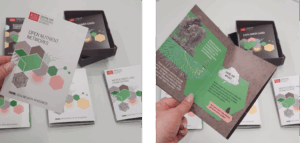
“If we attempt to redesign business models using the same metaphors that shaped the linear economy, we risk perpetuating the same logic… [Nature’s Playbook] helps professionals experiment with different metaphors and see what new possibilities emerge.”
In ecological systems, materials circulate through open nutrient networks. They move across boundaries. They interact with multiple actors. They create unexpected combinations. There is opportunism and unpredictability. Translating that into business terms means thinking of value creation as embedded in relationships and context. It means designing for diversity and feedback rather than only efficiency.
Nature’s Playbook is primarily an ideation tool. It helps professionals experiment with different metaphors and see what new possibilities emerge. The expectation is not certainty, but expansion. Expansion of imagination, of strategic options, of what can be considered viable.”
Q: What kinds of organisational challenges is this tool particularly well suited to address?
E.F.: “The tool is designed for organisations that are engaged in the productive economy. It becomes meaningful where there are tangible material flows, products, infrastructures, and supply chains.
If an organisation’s activity is purely speculative or abstracted from physical systems, ecological metaphors become less grounded. Nature’s Playbook works best when there is something concrete at stake.
During prototyping, we worked with a wide variety of participants representing, for example, pharmaceutical companies, food manufacturers, fast-moving consumer goods businesses, plastics producers, or community makerspaces. Also, the scale of business activity varied significantly.
It is also worth noting that participants didn’t have to be employees of these businesses to complete the exercise. For example, participants investing in venture capital often projected their ideation process onto the specific company they invested in.
It does not necessarily provide technical solutions, but it helps the participant to reframe the discourse in which ideas are generated.”
Q: Many organisations struggle to move from sustainability ambition to action. How does Nature’s Playbook help bridge that gap?
E.F.: “It is genuinely difficult for organisations that are currently successful within a linear model to imagine operating differently. Especially when the broader economy still rewards extraction and short-term optimisation. There is also a tendency to make incremental adjustments. To make a wasteful model slightly more efficient. To close loops within the same underlying logic.
Nature’s Playbook intervenes at the level of perspective. It makes visible the metaphors shaping decision-making. Once those metaphors are visible, they can be talked about.
When leaders begin to see their organisation as part of a living system rather than as a self-contained machine, different ideas become possible. Bridging ambition and action requires more than targets. It requires a shift in how problems are conceptualised.”
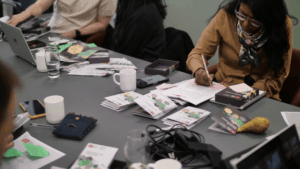
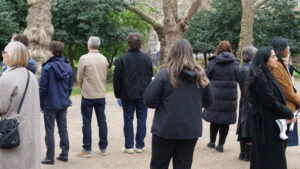
Participants engage in hands-on discussion during a Nature’s Playbook workshop, using ecological insights to explore circular innovation.
Q: If business leaders could take away one core insight from nature, what would you hope it is?
E.F.: “The core insight I would hope for is a shift from control to participation. Many business models are built on the assumption that success comes from control. From positioning oneself at the centre and driving outcomes. In ecological systems, no single actor controls the whole but instead participates within the whole.
Seeing oneself as a participant in a circular economy changes perspective in a profound way and requires attentiveness. I sometimes think of it as closer to gardening than engineering. A gardener cannot force growth. They create conditions, observe carefully, and intervene thoughtfully. They respond to what is emerging rather than imposing a fixed blueprint.
That orientation invites leaders to listen more closely to feedback and always look out for unintended consequences. It also opens space for collaboration that is not purely strategic, but relational.
For me, that shift is fundamental. It moves sustainability away from a deterministic project and toward an ongoing practice of participation.”
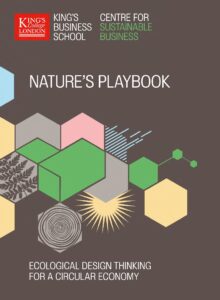
To learn more about Nature’s Playbook and how it can support organisations in applying ecological design thinking, visit naturesplaybook.org.
Relevant library resources
Ecological design thinking for a circular economy: The impact of the forest metaphor for circular business
The circular advantage: Unlocking innovation, environmental resilience, productivity and net zero opportunities through a uniquely Australian circular economy transition
Universal circular economy policy goals: Enabling the transition to scale

Circular economy in the industrial goods sector: A framework for understanding private sector progress and innovation
Circular transformation of industries: The role of partnerships