

Disentangling materiality and climate reporting
This article explains how the concept of materiality applies in AASB S2 climate disclosures and why it is often misunderstood. It distinguishes between material information, climate risks, emissions reporting, and ESG double materiality assessments, offering practical guidance for preparing compliant climate reports.

AUTHORS

Disclaimer: This article is republished with permission from the author. The article was originally published on LinkedIn and can be found here. Any views expressed in this article are those of the original author and do not necessarily reflect the views of Altiorem.
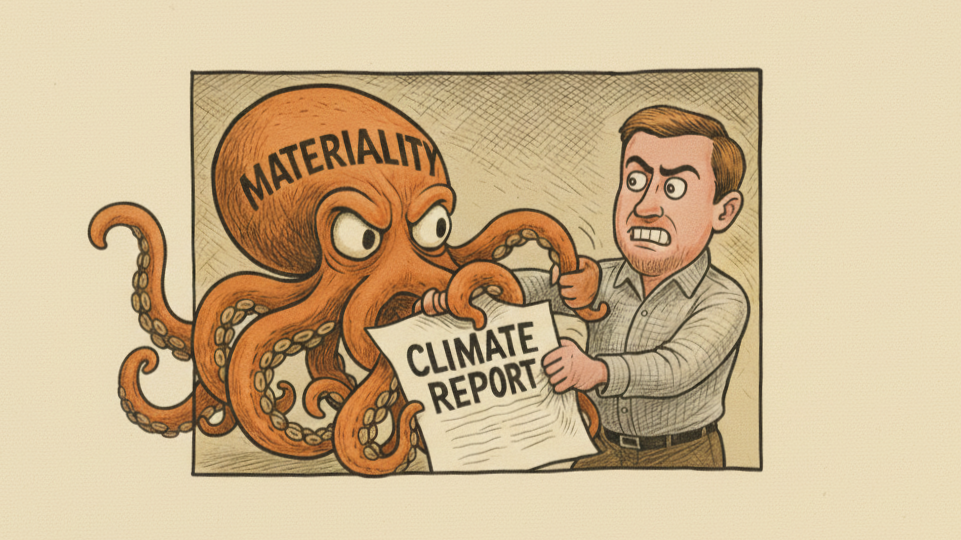
For those tasked with preparing AASB S2-aligned climate reports, there is one word especially capable of throwing a spanner in the works: ‘materiality’. This seemingly simple term is so able to cause confusion because it’s applied to a range of slightly different but related concepts – and it’s far from clear which ones do and don’t apply to climate disclosures.
This article aims to clear that up.
But, before we dive in, a quick warning: In an attempt to cut through the noise, I’ve overstated and oversimplified even more than usual in this article. The most important caveats, nuances and outright contradictions are in the footnotes if you want to get into the weeds.
Material information
The main application of the concept of materiality in AASB S2 is ‘material information’. Here’s the official definition:
“…information is material if omitting, misstating or obscuring that information could reasonably be expected to influence decisions that primary users of general purpose financial reports make on the basis of those reports…” (AASB S2, p.31)
Basically, material information is anything a current or potential shareholder or creditor would want to know. This isn’t about whether a number is big enough; the fact that a number is small could be material information.
In practice, this concept might not be as important as it sounds. Most organisations captured by mandatory climate disclosures already produce annual reports that are supposed to include all material information, and now they’re required to report a lot more information about climate-related factors on top of that. (1) You could argue that the risk of omitting material information is therefore relatively low, but we won’t know for sure until we put it to the test from next year onwards.
This concept mostly pops up when drafting climate disclosures and deciding whether to elaborate on a particular point. For example, AASB S2 requires stating whether executive remuneration is linked to climate, but do you need to elaborate on why or why not? Only if that information could be important to a shareholder or creditor.
Some recommend conducting a formal materiality assessment to determine what information to include, but I suspect most will just make this assessment informally or implicitly as they write or review a draft report. Note such a materiality assessment is completely different to the concept of an ESG Double Materiality Assessment – more on that later.
Material risks
AASB S2 doesn’t officially differentiate between material and immaterial climate-related risks and opportunities (CROs). Instead, it requires information to be disclosed on all CROs that could “reasonably be expected to affect the entity’s prospects”. (2) You can discard far-fetched risks but may want to err on the side of including more rather than less climate risks because what appears highly unlikely to you might seem plausible to others.
Material emissions
One of the requirements of AASB S2 is to calculate and report your scope 1, scope 2, and (from your second year) scope 3 emissions. Calculating these figures, particularly scope 3, is hard work, often involving spending a disproportionate amount of time estimating very small numbers. It’s common to make an argument that such emissions sources aren’t “material” and therefore don’t need to be measured or disclosed, but that’s a mistake.
There is no such thing as immaterial emissions, and no allowance in the standards for excluding an emissions source just because it’s small. (3) Here is a direct quote from the Greenhouse Gas Protocol (GHGP):
“Although it appears useful in theory, the practical implementation of [a materiality] threshold is not compatible with the completeness principle of the GHG Protocol Corporate Standard. In order to utilize a materiality specification, the emissions from a particular source or activity would have to be quantified to ensure they were under the threshold. However, once emissions are quantified, most of the benefit of having a threshold is lost.” (GHGP Corporate Standard p.10)
Relevant emissions
Australia’s Climate Active scheme popularised the concept of a “relevance test”, which lets organisations off the hook if an emissions source doesn’t satisfy at least two of five requirements. Despite Climate Active referencing the GHGP, this test is not aligned with that standard and therefore not compliant with AASB S2. The appearance of the words relevant, relevance and relevancy in your basis of preparation should be treated as a red flag (particularly ‘relevancy’ given it only appears to be in the Climate Active standards as a typo). (4)
Materiality thresholds
Materiality in the auditing and accounting sense is another concept that will likely start coming up more often, particularly as companies obtain limited assurance over their climate reports for the first time. When an auditor audits a thing, they’ll inevitably come up with a long list of errors. Despite impressions to the contrary, they don’t bring every single little issue to you. How do they decide which ones to bother you with? They assess whether the number is above a materiality threshold. (5)
ESG Double Materiality Assessments
‘Materiality assessment’ is often used to refer to an ESG Double Materiality Assessment (DMA). Out of all the environment, social and governance (ESG) topics, a DMA helps you to decide which to focus on (and helps you to justify deprioritising others). It’s a flawed yet valuable process to inform an ESG strategy.
‘Double’ refers to the focus on both an organisation’s impact on people and planet (impact materiality) and the financial impact of ESG topics on your business (financial materiality). These terms aren’t typically used in the binary material/immaterial sense (because why stick your neck out and say an ESG topic doesn’t matter?) but instead helps you rank ESG topics in order of importance.
None of this has anything whatsoever to do with preparing climate-related disclosures; they’re completely different processes that produce completely different outputs. (6)DMAs are about identifying material ESG topics, from both an impact and financial perspective. AASB S2 is intentionally blind to the concept of impact materiality, focusing exclusively on the financial impact of one ESG topic – climate change.
Despite my attempt to keep it simple, that’s still a lot to digest, so I’ll wrap up with some rules of thumb:
- Don’t use the word material if you don’t have to. Save it for special occasions.
- Err on the side of including more climate-related risks rather than less (grouping them together if necessary so the list doesn’t get too long).
- Include all your emissions, even if you think they’re immaterial or irrelevant. If you really must exclude an emissions source, make sure you have solid and documented reasons for doing so.
- Remember that ESG Double Materiality Assessments have (almost) nothing to do with climate reporting, although are still valuable for other reasons.
- Focus on meeting the requirements of the standards. If you somehow have time to spare after that, you may wish to fine-tune your report by taking a material information lens.
The fine print
- Technically, if you don’t think information is material, you can just leave it out, even if it’s required by AASB S2 (check out clause B25 on page 37). I haven’t yet met anyone willing to try that out.
- You could argue I’m being a bit too pedantic here given “reasonably be expected to affect the entity’s prospects” implies materiality. It’s also hypocritical because I’ll often refer to risks as material or immaterial. But the less versions of materiality floating around the better, particularly when other words will do the job just fine.
- The GHGP, which most companies complying with AASB S2 need to align with, doesn’t allow for emissions to be excluded purely on materiality grounds. The concept of immaterial emissions does appear in other standards such as the Climate Active guidance, but their use isn’t allowed for AASB S2 compliance.
- The GHGP does actually contain the concept of relevance, but they go about it from the opposite direction to Climate Active. While Climate Active says you only need to include an emissions source if it ticks enough relevance boxes, the GHGP grudgingly allows you to exclude some emissions sources under very specific conditions. If you really must exclude some scope 3 emissions from your inventory read page 60 of the GHGP Scope 3 standard first.
- There is a lot more nuance to the audit process than this but it’s not important for preparing climate disclosures.
- OK, so there are some tangential connections between a DMA and climate disclosures. For example, if a DMA informs an ESG strategy that includes targets that are related to climate change in some way (such as a target to reduce waste, which also reduces emissions) then it needs to be captured in your climate report. However, there is so much persistent confusion around this point that I think it’s better to ignore any connection, at least at first.
Relevant library resources

Sustainability-related risks and opportunities and the disclosure of material information
Climate-related and other emerging risks disclosures: Assessing financial statement materiality using AASB Practice Statement 2
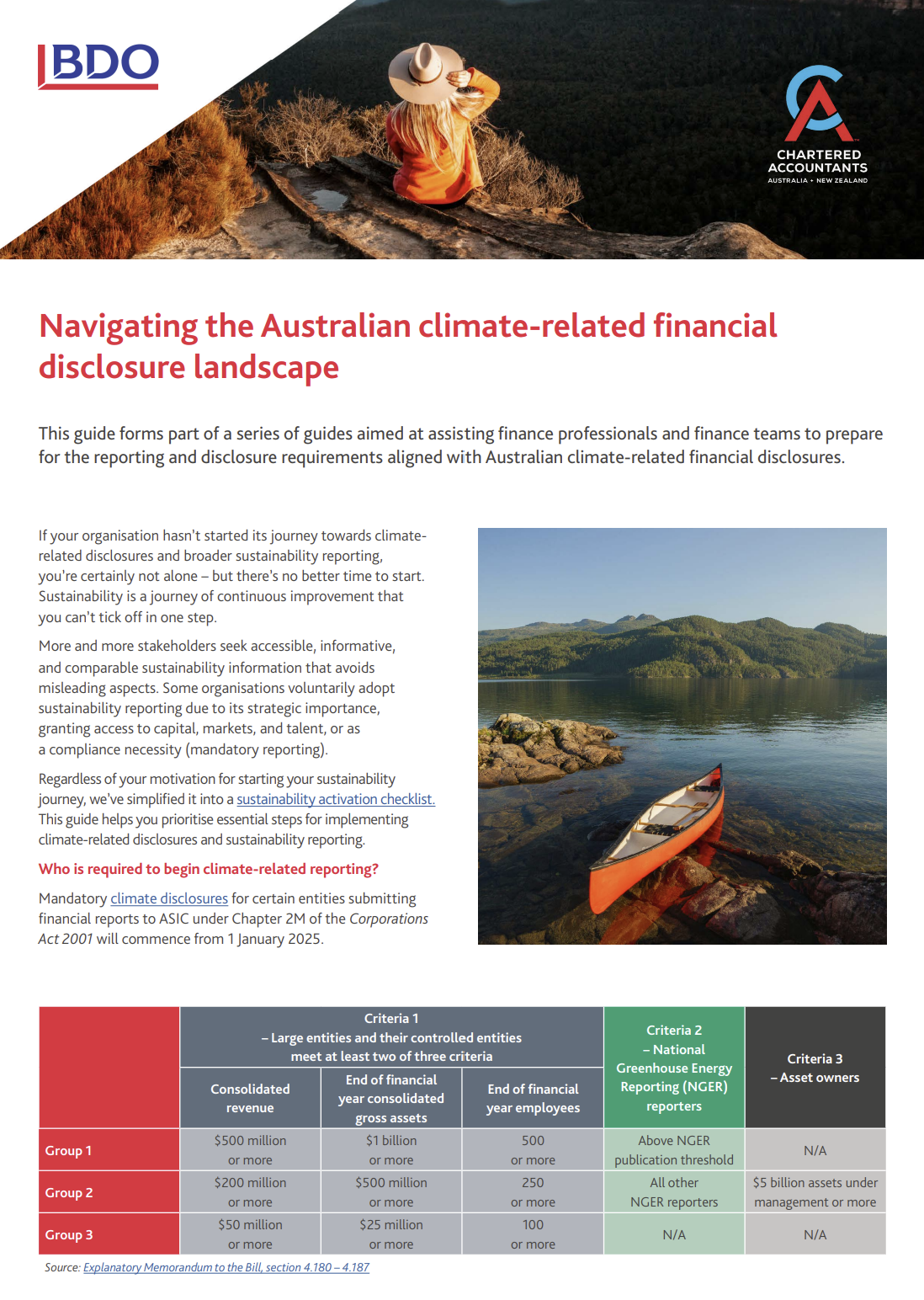
Navigating the Australian climate-related financial disclosure landscape
Regulatory guide (RG) 280: Sustainability reporting

The new disclosure landscape - Comparing sustainability standards and regulations: ESRS, IFRS S1/S2, SEC Climate Rule, and CA SB 253/261


