Sustainable Finance Roundup March 2026: Markets, Climate Risk, and the Transition in Practice
This month’s sustainability roundup captures a shift from framework development to real-world application, where climate and nature risks are increasingly embedded across financial systems, legal accountability, and decision-making. It highlights how intensifying physical climate signals, evolving disclosures, and maturing litigation are converging with insights on sovereign risk, energy systems, and corporate strategy. Together, these developments show how sustainability is moving beyond principle—being tested, priced, and enforced across markets, regulation, and the real economy.

AUTHORS

Each month, we gather standout sustainable finance articles from our favourite writers. This curated selection brings together the most engaging ideas, timely analyses, and fresh perspectives published over the past month, so you can catch up on what mattered most.
Photo by Gautam Krishnan on Unsplash

Top 10 Sustainability Markers – March 2026
Terence Jeyaretnam
In this latest Sustainability Markers roundup, Terence Jeyaretnam maps a sustainability landscape that is rapidly shifting from framework design to real-world application—where climate risk, disclosure, and nature are being embedded into financial systems, legal accountability, and operational decision-making. What’s clear is that sustainability is being tested, priced, and enforced across markets, regulation, and physical systems.
Key points:
Physical climate signals continue to intensify
- Record global temperatures, rising energy imbalance, ocean heat accumulation, and declining ice systems reinforce that climate system instability is accelerating—not stabilising.
Arctic changes signal systemic risk
- Record-low sea ice extent is amplifying warming feedback loops, with implications for global weather patterns and extreme event volatility.
Climate disclosure moves from theory to practice
- Early AASB S2 reporting reveals significant variability in interpretation, particularly around financial quantification, scenario analysis, and materiality—highlighting a steep learning curve for preparers.
Litigation raises the bar for climate claims
- The Santos decision underscores that forward-looking climate statements must be grounded in credible assumptions and evidence, expanding greenwashing risk into strategy and disclosure.
Nature risk enters sovereign balance sheets
- Emerging evidence links ecosystem degradation directly to higher borrowing costs, reframing biodiversity loss as a macroeconomic and credit risk issue.
Climate litigation matures globally
- Courts are increasingly engaging with the substance of climate claims, using human rights frameworks, attribution science, and disclosures to define accountability boundaries.
Energy transition timelines remain fluid
- Australia’s delayed gas shortfall highlights how demand shifts, storage deployment, and system flexibility can materially reshape transition pathways.
Physical disruptions hit real-economy assets
- Cyclone-related impacts on exports demonstrate how climate risks are translating into immediate operational and financial consequences.
ISSB enters next phase of standard-setting
- With S1 and S2 now in force, focus is shifting to implementation challenges and future standards (e.g., nature and social), signalling expansion beyond climate.
Corporate transition strategies recalibrate
- Moves by companies like TotalEnergies reflect growing tension between long-term net-zero ambitions and near-term economic and policy realities.

The First Rule. A Few Thoughts on Sustainability…
Simon Rebbechi
In this edition, Simon Rebbechi brings together a wide-ranging set of signals across energy, transport, geopolitics, and environmental risk—highlighting how economics, infrastructure constraints, and political realities are shaping the pace and direction of the energy transition. At its core, the transition is proving uneven and non-linear, shaped not just by climate ambition, but by underlying economics, system constraints, and implementation realities.
Key points:
EV adoption: slow narrative, strong fundamentals
- Despite negative sentiment, US EV uptake remains resilient given limited model availability. Multi-vehicle households present a major unlock, with a “1 EV + 1 ICE” strategy emerging as the most practical pathway for adoption.
Used EVs + fleet economics shift the equation
- Used EVs are increasingly competitive on price and quality, while fleet operators—focused on total cost of ownership—are driving adoption, with potential savings of 15–40% (or more) accelerating electrification.
Energy shocks expose global inequality
- Fuel price volatility highlights how poorer countries are disproportionately impacted, often being priced out of energy markets—reinforcing energy security as a central transition issue.
Africa: huge renewable potential, structural constraints
- Falling solar costs and massive resource potential could transform energy access, but distributed solutions alone won’t solve the need for large-scale grid infrastructure to support industrialisation.
Politics shapes climate progress more than rhetoric
- In the US, climate is a low voter priority relative to cost-of-living concerns, pushing policymakers to reframe or downplay climate messaging despite underlying public concern.
Deep-sea mining: high stakes, high uncertainty
- Massive resource potential is colliding with environmental unknowns, governance gaps, and operational challenges—suggesting a cautious, incremental approach is more likely than rapid scale-up.
Water stress is accelerating faster than expected
- The worsening outlook in places like Corpus Christi underscores how physical climate risks (e.g., drought) are materialising sooner and more abruptly than anticipated.
Light pollution: overlooked but solvable environmental issue
- Rapid global increases in artificial light are being countered by local policy action, showing how targeted regulation can reverse environmental degradation in specific domains.
Do you write thoughtful commentary on ESG, sustainability, or sustainable finance? We’d love to feature your work.
Contact us and we’ll be in touch.
Relevant library resources

Energy transition risks and opportunities initiative's series
Banking on business as usual: The energy finance imbalance
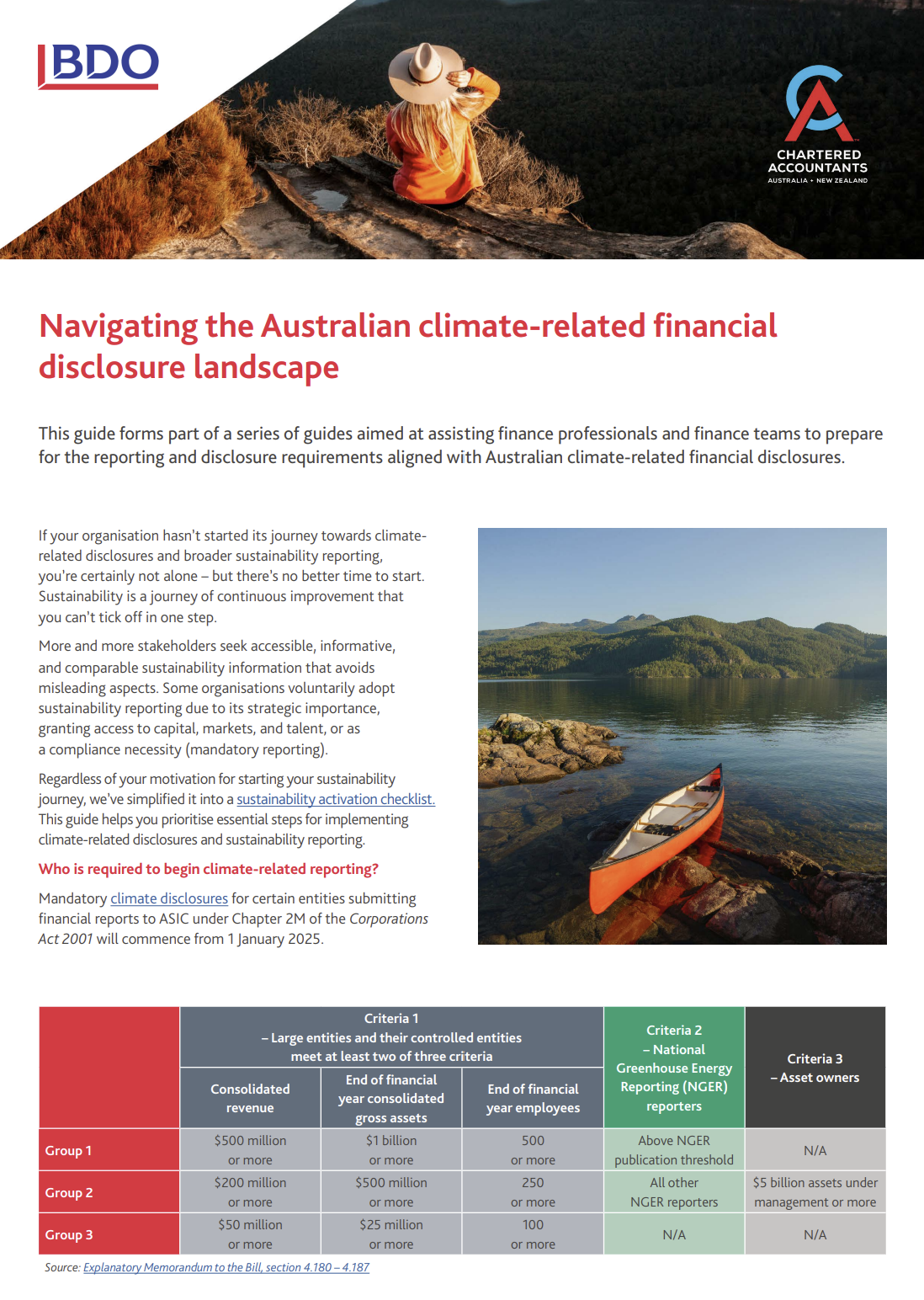
Navigating the Australian climate-related financial disclosure landscape

A director’s guide to mandatory climate reporting