
Time to get real about sustainable finance

What this series is
In 2006 the Principles for Responsible Investment launched with 95 signatories. Today the PRI has more than 5,000 supporters with assets behind them in the tens of trillions. By any measure of adoption it succeeded, completely.
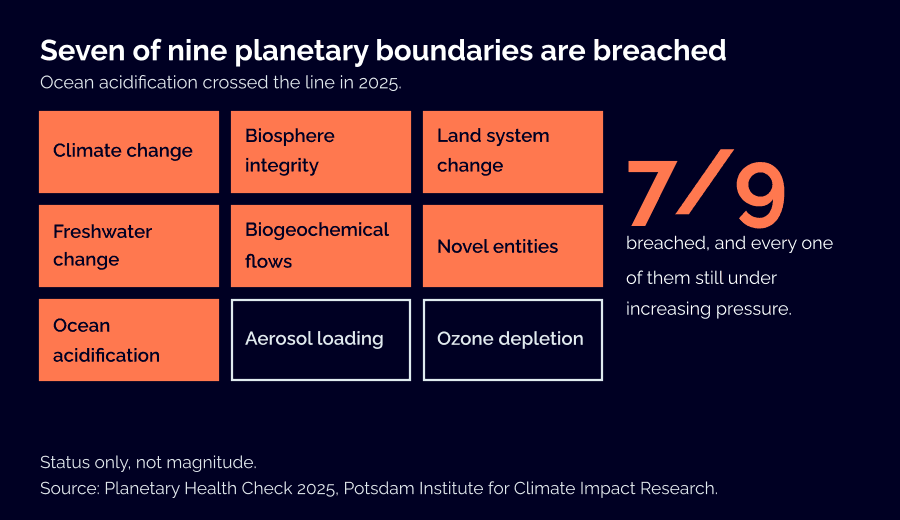
However, the outcomes did not follow. Emissions kept rising, seven of nine planetary boundaries have been crossed, and exceeding 1.5°C of global heating is now inevitable. Meanwhile the political support that sustainable finance assumed would arrive has, in several major markets, gone into reverse.
Over five weeks, this series will explore:
- Why create this series?
- A brief history and what went wrong
- The age of consequences and what it means
- What we must protect and reform, and what is still left to create
- Bringing it all together, a framework for a fit for purpose financial system
Add your voice
How much do you agree with the following statements?
Seven statements, about two minutes. Your answers are stored separately from your name and email, so they cannot be traced back to you. We will publish the results in week four.
1. ESG analysis supports better management of risk and can enhance returns.
0 = strongly disagree. 10 = strongly agree.5
2. Engaging with companies has driven more sustainable outcomes.
0 = strongly disagree. 10 = strongly agree.5
3. Stewardship fails because investors will not escalate, not because escalation does not work.
0 = strongly disagree. 10 = strongly agree.5
4. Managing systemic issues within existing frameworks is enough.
0 = strongly disagree. 10 = strongly agree.5
5. The narrow view of fiduciary duty is a bigger barrier than data, tools and assessment approaches.
0 = strongly disagree. 10 = strongly agree.5
6. Finance cannot serve sustainable development without accepting lower returns somewhere.
0 = strongly disagree. 10 = strongly agree.5
7. Change will come from outside the current sustainable finance community, not from within it.
0 = strongly disagree. 10 = strongly agree.5
Not a member yet? Altiorem is a registered charity and the world’s first community-built sustainable finance library. Joining is what keeps it free to use and independent.
The five parts
Where the series came from and what it will cover. You can contribute your voice to the series by completing the poll, providing a case study or writing 300 to 500 words on any of the topics below.
From the Quaker screens of the eighteenth century to the institutionalisation of responsible investment, the rise of ESG integration, and the moment the field mistook adoption for progress. With an interactive timeline.
Seven of nine planetary boundaries are breached, overshoot of 1.5°C is now inevitable, progress on the Sustainable Development Goals has stalled, and the losses are being felt across society and the economy. With an Earth Overshoot explorer.
What is worth defending, what needs reform, what should be discarded, and what must be built for finance to be a force for good. An interactive mapping exercise will ask you to map proposals for impact and momentum. We will also reveal the results of the survey so far.
The argument drawn together, the results of the poll set against the evidence, and the contributions sent in by readers.
Further reading
Everything the series rests on is in Altiorem’s library. These are the places to start.
Limiting overshoot: Navigating exceedance of 1.5°C and pathways towards return
United Nations Environment Programme, 2026
This report examines the inevitability of exceeding the 1.5°C global warming limit and outlines strategies for navigating this overshoot. It details escalating non-linear risks to ecosystems, food security, and infrastructure, while emphasising that urgent mitigation and transformational adaptation are essential to limit peak temperatures and enable a return.
The race of our lives revisited
Jeremy Grantham, GMO, 2018
GMO’s founder and long-term investment strategist, Jeremy Grantham, offers a wide-ranging analysis of interconnected environmental crises, explores solutions and makes recommendations for investors. The paper covers climate change, population growth, soil erosion and the role of capitalism.
Planetary Boundaries Science, Potsdam Institute for Climate Impact Research
An annual, science-based assessment of the Earth system that applies the Planetary Boundaries framework to track planetary stability, resilience and life-support functions. The 2025 edition is where the seventh breached boundary, ocean acidification, comes from.
Fiduciary duty in the 21st century: Final report
UNEP FI and the Principles for Responsible Investment, 2019
This is the final report from a four-year, multi-stakeholder and multi-jurisdiction research and engagement exercise. It demonstrates that environmental, social and governance integration is a component of investors’ fiduciary duty. In order to fulfil this duty, regulators and policymakers must better understand fiduciaries’ needs and establish policies that support this approach.
ESG and financial performance: aggregating evidence from 1,000 plus studies
NYU Stern Center for Sustainable Business and Rockefeller Capital Management, 2021
This report summarises over 1,000 studies published between 2015 and 2020 and finds that most show a positive relationship between ESG and financial performance. ESG integration and long-term strategies tend to enhance returns and risk management, while disclosure alone has limited financial impact.
Measuring the economic impact of short-termism
McKinsey Global Institute, 2017
Measures corporate long- and short-termism systematically. Assesses and quantifies the effects of each approach on corporate financial performance and microeconomic growth. Findings show that long-term approaches outperform short-term companies on key economic and financial metrics.
Sustainable finance and corporate law: Lessons from the US
European Corporate Governance Institute, 2026
This report analyses the trajectory of sustainable finance and corporate law in the US. It focuses on the SEC’s proposed climate disclosure rule and California’s state-level reporting mandates, examining the political and institutional challenges these initiatives face and the implications of a federalist approach for corporate compliance.
The global rise of index-based ownership of firms
European Corporate Governance Institute, 2026
This research examines the global expansion of index-based ownership from 2004 to 2023. Using a benchmark-free classification model, the study finds global index ownership reached 16.9 per cent by 2023. It highlights significant regional variations, noting that US ownership is highest in mid-caps, whereas European and Asian indexing remains concentrated in large-cap firms.
Change finance for good
Altiorem is a registered charity and the world’s first community-built sustainable finance library.
Earth image: NASA / Apollo 17 crew, 1972. Public domain, via Wikimedia Commons. Planetary boundaries chart: Altiorem, from the Planetary Health Check 2025.


