
Library | Location
Europe (EU)
Refine
493 results
REFINE
SHOW: 16



Life Cycle Initiative
Life Cycle Initiative stewards global standards, tools and training for life-cycle assessment (LCA) and life-cycle thinking. It supports practitioners, policymakers and industry in applying LCA across plastics, textiles, tourism and construction. The initiative develops data networks, e-learning modules and hotspot analysis frameworks to advance sustainable decision making.

The European Space Agency (ESA)
European Space Agency (ESA) is Europe’s intergovernmental organisation dedicated to space exploration, Earth observation, satellite navigation, and technological innovation. ESA collaborates with international partners, coordinates high-profile missions, and supports science, space safety and industry growth across member states.

WorldCover
WorldCover offers free, high-resolution global land cover maps at 10 m resolution for 2020 and 2021, via Sentinel-1 and Sentinel-2 data, under Creative Commons license. It supports environmental monitoring, climate research, land-use planning and biodiversity analysis.
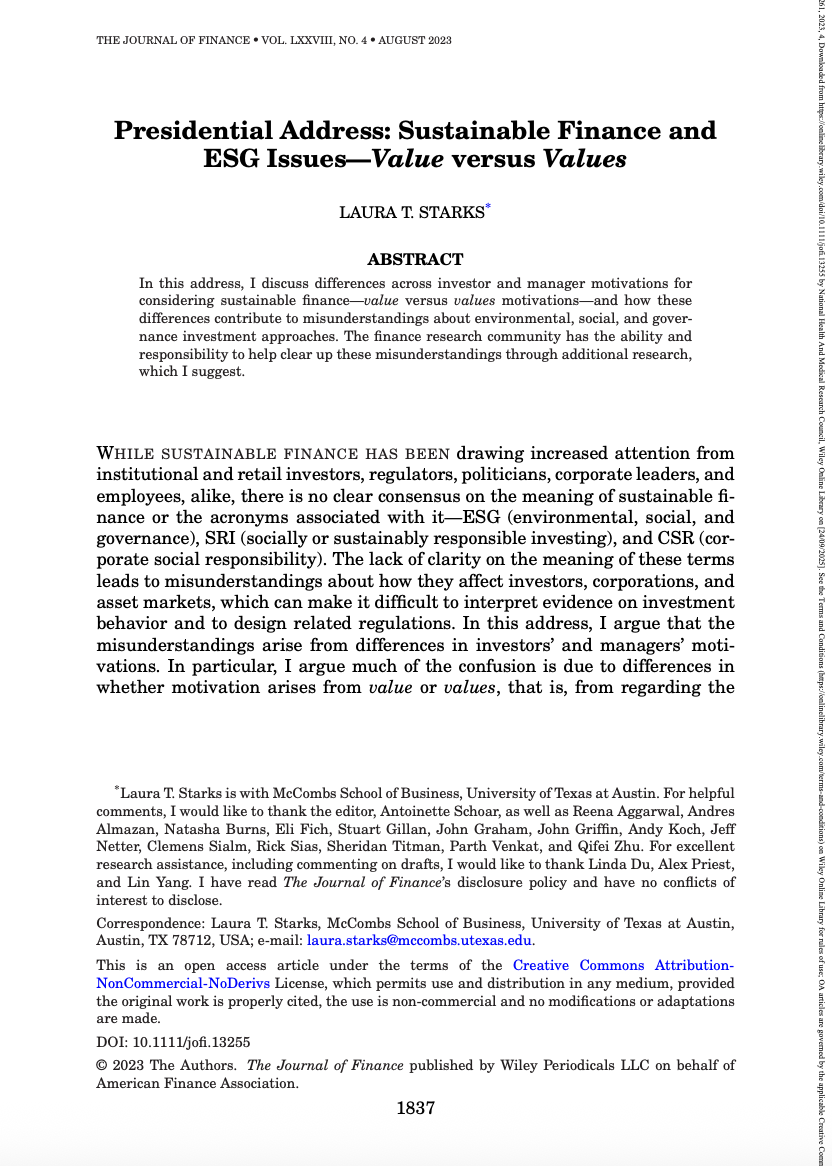
Presidential address: Sustainable finance and ESG issues: Value versus values
This report examines how investor and manager motivations—driven by either financial value or personal values—shape sustainable finance and ESG practices. It highlights definitional ambiguities, performance debates, and cultural differences, calling for clearer research to distinguish pecuniary risk-return considerations from non-pecuniary preferences in ESG investing.
Sustainable investing in practice: Objectives, beliefs, and limits to impact
This paper surveys 509 equity portfolio managers on their treatment of environmental and social factors. Findings show most prioritise financial returns, with limited willingness to sacrifice performance. ES constraints from mandates, policies, and client values strongly influence decisions. Beliefs and constraints outweigh fund labels in shaping sustainable investing practices.
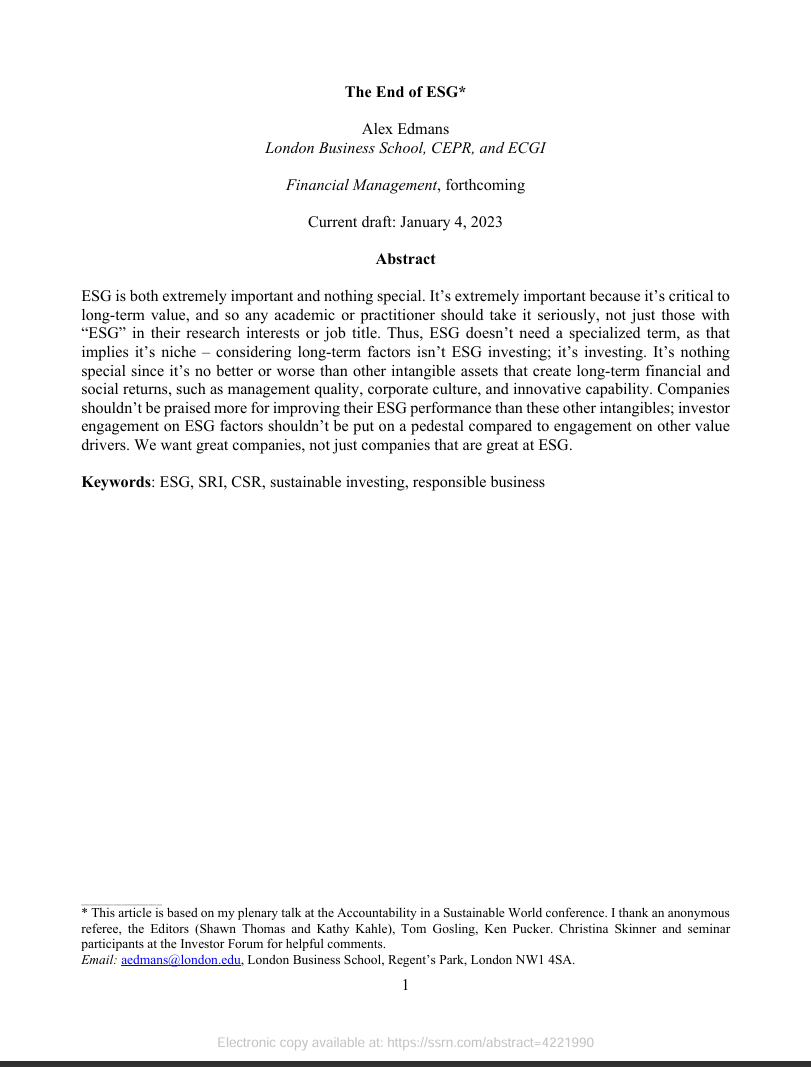
The end of ESG: Financial management, forthcoming
This report argues that ESG is both essential and ordinary: vital as a driver of long-term value but not unique compared to other intangibles such as culture or innovation. It cautions against over-emphasising ESG metrics, politicisation, and superficial classification, advocating instead a broader focus on overall sustainable value creation.
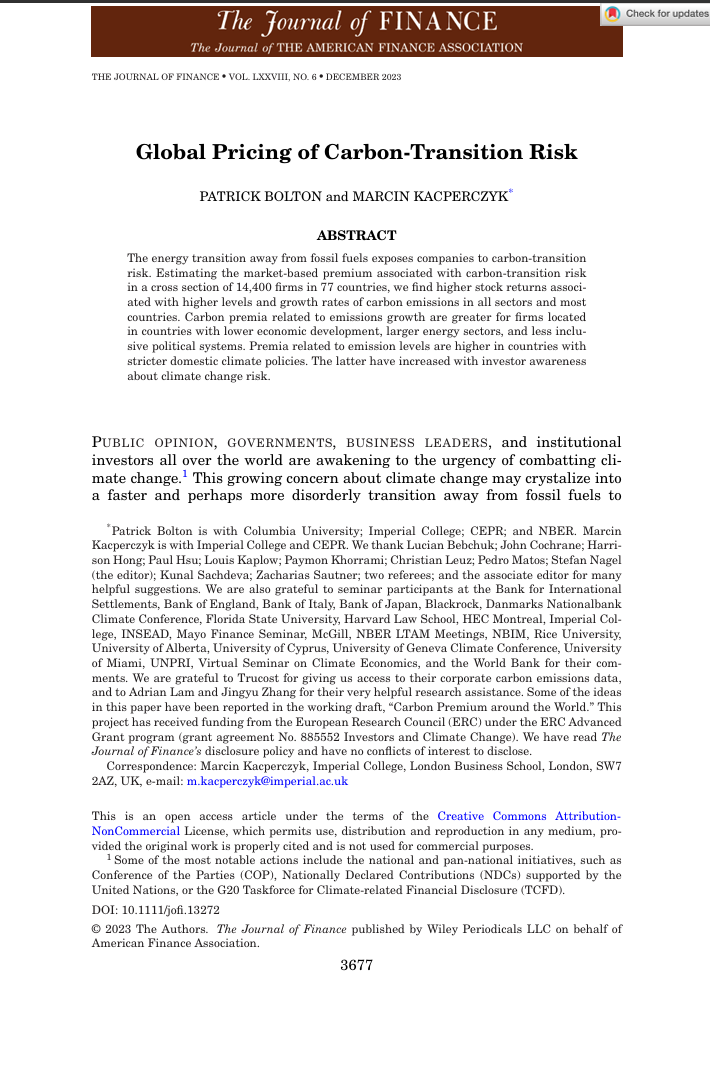
Global pricing of carbon-transition risk
This report examines the global pricing of carbon-transition risk by assessing equity markets’ responses to climate policy and transition exposure. It analyses regional variations, sectoral impacts, and the role of carbon pricing in financial markets, highlighting implications for asset valuation and investment strategies.
Survey of CFA institute members on latest ESG matters
The CFA Institute survey (Nov 2021) captures member views on ESG integration and sustainability reporting. Respondents support flexibility in ESG integration, oppose government mandates, and favour global product disclosure standards. They also prefer mandatory, globally consistent sustainability reporting with regulatory frameworks in place before adoption.
ESG and responsible institutional investing around the world: A critical review
This report reviews global ESG and responsible investing practices, focusing on definitions, regulation, climate finance, and institutional investor roles. It evaluates evidence from academic research and PRI data, highlighting investor influence, governance, and engagement strategies, while noting challenges around ratings, greenwashing, and measuring real outcomes.
ShareAction's point of no return series
The Point of No Returns benchmark series assesses the world’s largest asset managers on responsible investment across climate, biodiversity, social issues, governance, and stewardship. Published by ShareAction, the series provides rankings, sector-wide analysis, and examples of practice to guide improvement and accountability.
How ESG affected corporate credit risk and performance
This report analyses how ESG ratings influence corporate bond risk and performance. It finds that higher ESG-rated issuers show stronger financials, lower systematic and idiosyncratic risks, and better credit quality. ESG ratings provide additional insights beyond credit ratings, especially for high-yield and longer-dated investment-grade bonds.
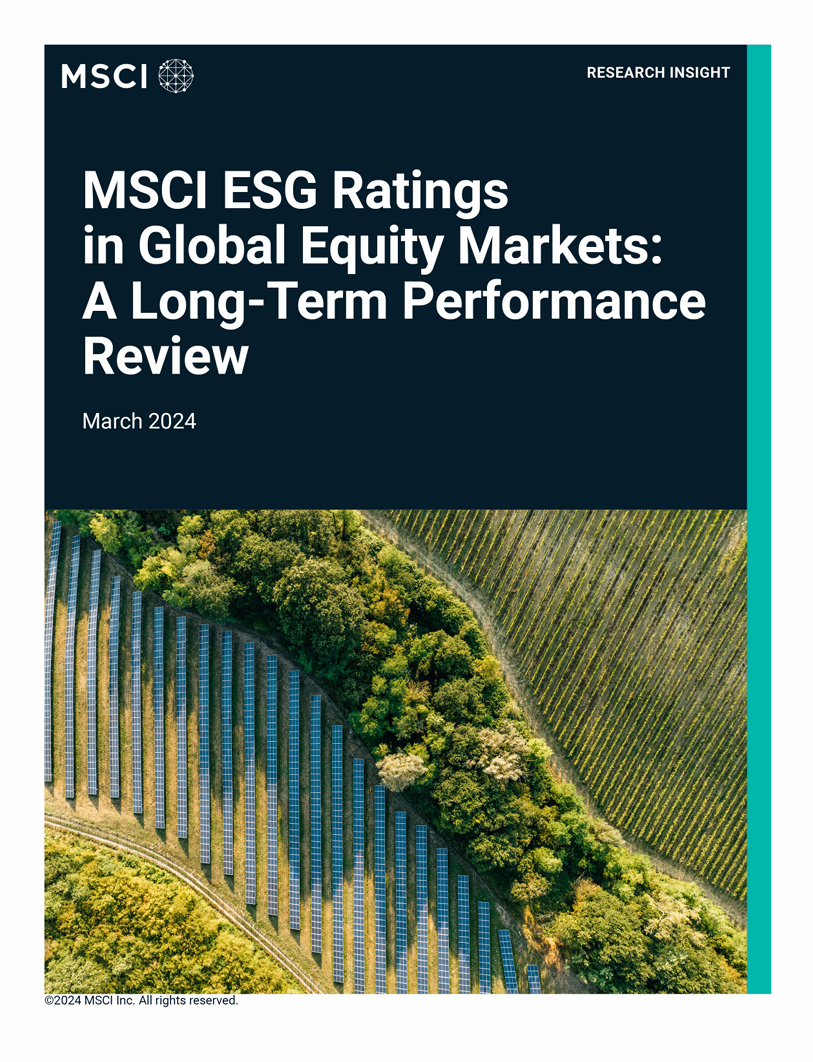
MSCI ESG ratings in global equity markets: A long-term performance review
This MSCI report reviews the long-term performance of ESG ratings in global and developed equity markets. It finds that higher-rated companies outperformed peers, driven by stronger earnings growth and dividend yields rather than valuation effects. MSCI ESG indexes also generally outperformed their benchmarks across regions and during crises.
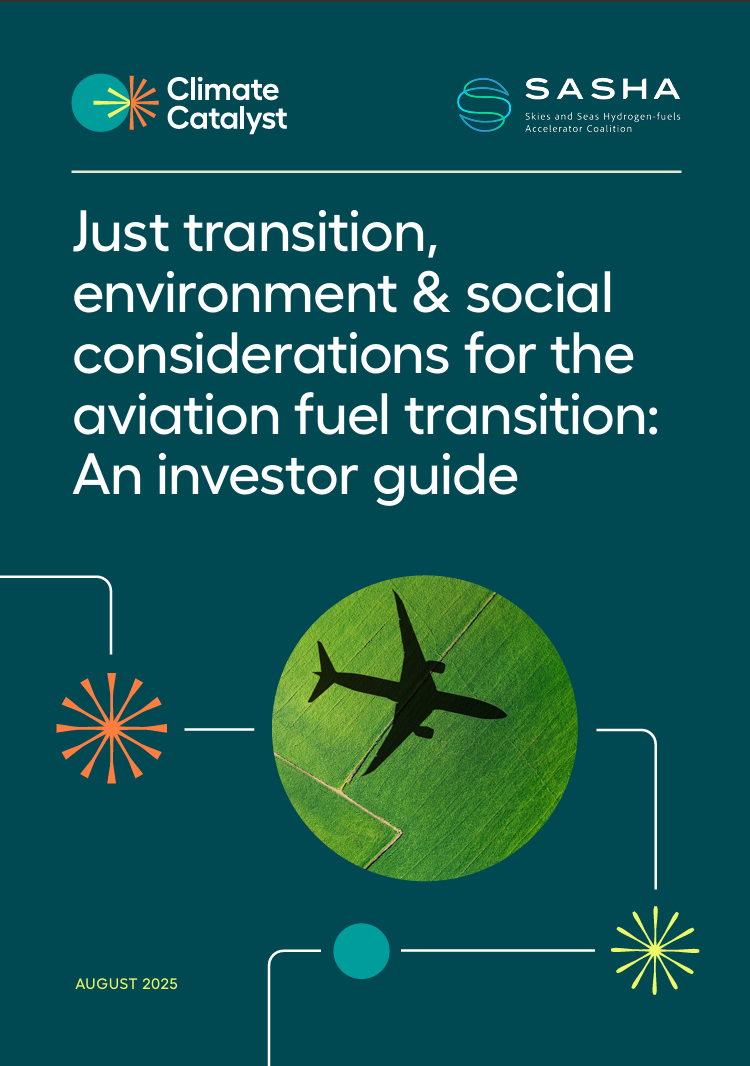
Just transition, environment and social considerations for the aviation fuel transition: An investor guide
This guide outlines environmental, social, and just transition considerations for investors in aviation’s fuel shift. It compares biofuels and e-fuels, highlights regulatory and biodiversity risks, and provides engagement questions to assess companies’ transition strategies, ensuring alignment with climate goals while safeguarding communities and long-term financial stability.

Chatham House
Chatham House, known formally as Royal Institute of International Affairs, is an independent policy institute in London. It delivers rigorous research, analysis and dialogue on global issues—such as international relations, climate change, security and economics. Its mission: help governments and societies build a sustainably secure, prosperous and just world.
How can pharma get the few promising drugs in development to patients battling superbugs?
This report examines the barriers to bringing new antibiotics to market, highlighting funding gaps, regulatory uncertainty, and weak commercial incentives. It outlines policy solutions to improve access and development, aiming to address the growing threat of antimicrobial resistance (AMR) by supporting viable pathways for pharmaceutical innovation.

Climate Service Center Germany (GERICS)
Climate Service Center Germany (GERICS) is a Hamburg-based research institute established in 2009 under Germany’s high-tech strategy. As part of Helmholtz-Zentrum Hereon, GERICS employs an interdisciplinary team of over 80 scientists. It develops prototype climate-service products—such as fact-sheets, city series and signal maps—to support decision-makers adapting to climate change.


