
Library | Location
Germany
Refine
185 results
REFINE
SHOW: 16


WorldCover
WorldCover offers free, high-resolution global land cover maps at 10 m resolution for 2020 and 2021, via Sentinel-1 and Sentinel-2 data, under Creative Commons license. It supports environmental monitoring, climate research, land-use planning and biodiversity analysis.
Deutsche Rohstoffagentur (DERA)
German Mineral Resources Agency (DERA) is Germany’s national information and consultancy platform on mineral raw materials, hosted within the Federal Institute for Geosciences and Natural Resources (BGR).
DERA analyses global commodity markets, assesses supply-chain risks, and advises industry and government on raw material strategy and sustainable sourcing.
DERA analyses global commodity markets, assesses supply-chain risks, and advises industry and government on raw material strategy and sustainable sourcing.
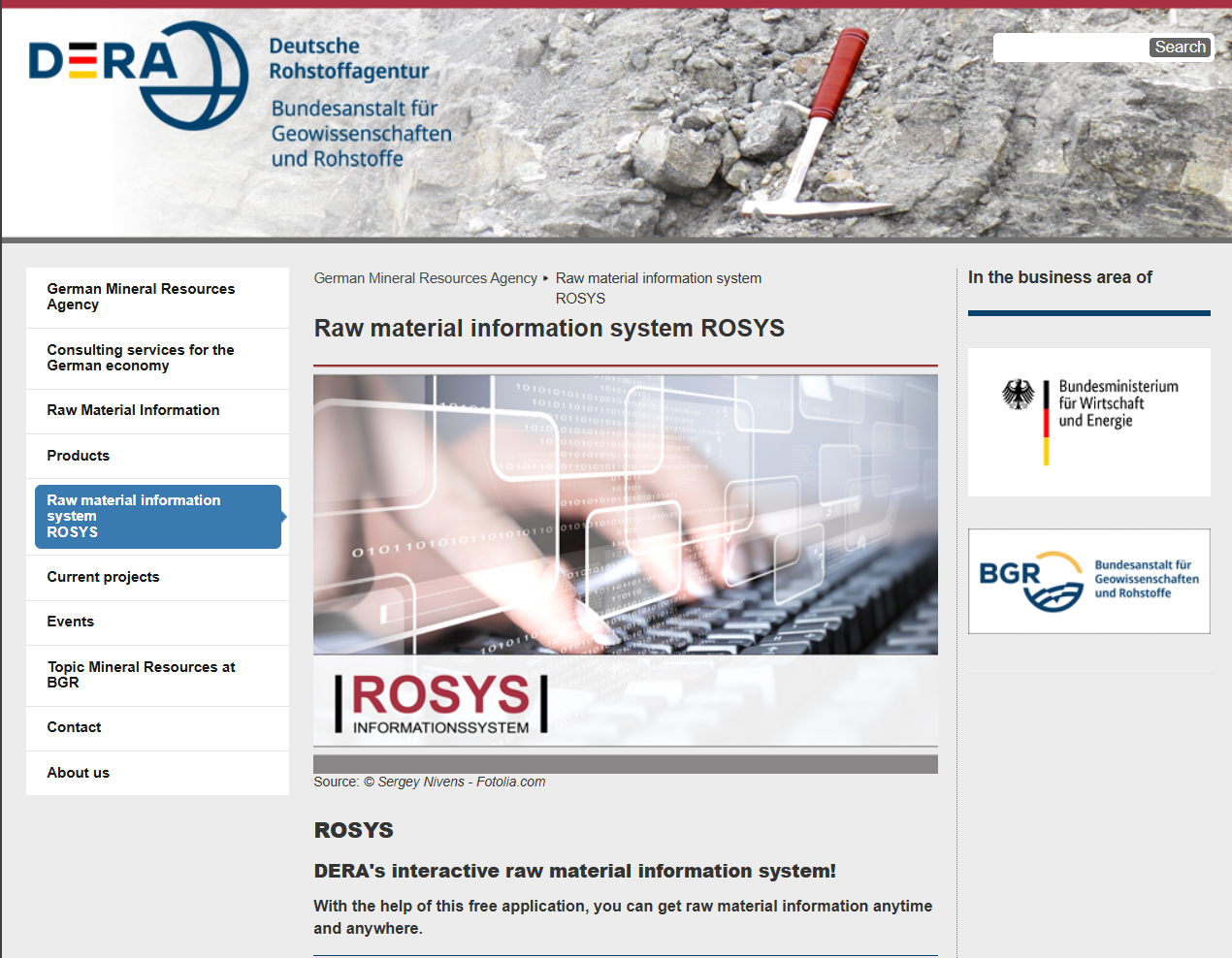
Rohstoffinformationssystem (ROSYS)
ROSYS is a free, interactive raw-materials information system from the German Mineral Resources Agency (DERA). It offers data on around 80 mineral and energy commodities, supported by maps and charts, enabling users to monitor global and German production, consumption, reserves, trade partners and market trends.
Federal Institute for Geosciences and Natural Resources (BGR)
Federal Institute for Geosciences and Natural Resources (BGR) is Germany’s national geological survey, advising the federal government on geoscience and raw materials. It undertakes research in earth sciences, resource management, geodata systems and sustainability. Located in Hannover, BGR coordinates national geoscientific data infrastructure and policy.
Federal Ministry of Economic Affairs and Climate Action (BMWK)
Federal Ministry for Economic Affairs and Climate Action (BMWK) is a German government body responsible for economic policy, industrial strategy, energy transition, digitalisation, and climate action. It develops regulations, promotes innovation, supports businesses, and coordinates international cooperation to strengthen Germany’s economic growth while advancing sustainability and climate neutrality goals.
ShareAction's point of no return series
The Point of No Returns benchmark series assesses the world’s largest asset managers on responsible investment across climate, biodiversity, social issues, governance, and stewardship. Published by ShareAction, the series provides rankings, sector-wide analysis, and examples of practice to guide improvement and accountability.
ESG and global investor returns study
This report analyses the link between ESG integration and global investor returns, drawing on cross-regional data and sector comparisons. It assesses how environmental, social, and governance factors correlate with performance, highlighting variations across markets and asset classes. The study provides evidence-based insights on ESG’s financial materiality for investors worldwide.
Companies should maximize shareholder welfare not market value
This report summarises why firms should maximise shareholder welfare rather than market value, noting that investors often have ethical and social preferences beyond profit. It proposes shareholder voting on corporate policy to better align company decisions with investor welfare, particularly where externalities are inseparable from production.
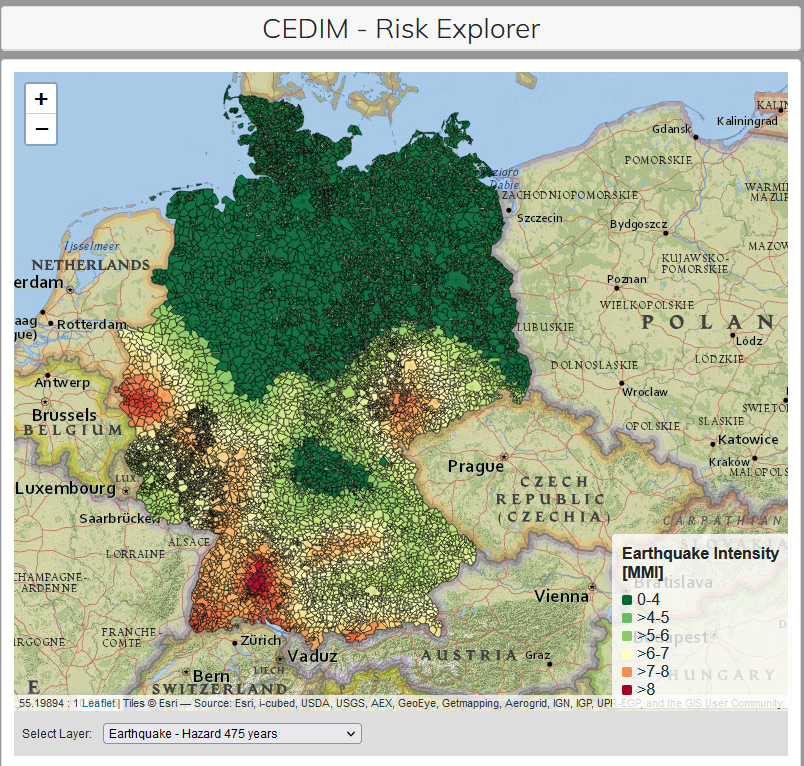
CEDIM Risk Explorer Germany
The CEDIM Risk Explorer Germany is a public, web‑based map viewer that enables interactive visualisation of hazard, vulnerability and risk across Germany—covering phenomena such as earthquakes, winter storms and (in Saxony) floods—for spatial risk assessment and expected monetary loss estimation.
GFZ Helmholtz Centre for Geosciences
GFZ Helmholtz Centre for Geosciences (GFZ) is Germany’s national Earth system research centre. It investigates solid‑Earth processes—including geology, geophysics, geodesy and geochemistry—and operates global observatories, satellite missions and analytical infrastructure. GFZ advances understanding of natural hazards, climate impact and resource management to support sustainable solutions.
Center for disaster management and risk reduction technology
Center for Disaster Management and Risk Reduction Technology (CEDIM) is an interdisciplinary research centre at Karlsruhe Institute of Technology, enhancing disaster resilience. Focusing on natural and human-made hazards—such as earthquakes, droughts, heatwaves and floods—it develops early warning systems, risk mapping and forensic disaster analysis. Ideal for innovators in disaster risk science.
Joint Research Centre
Joint Research Centre (JRC) is the European Commission’s science and knowledge service. It provides independent research and data to support EU policies on climate change, energy, health, food security, digital innovation and safety. JRC delivers scientific evidence to help policymakers address global challenges with reliable analysis and solutions.
How can pharma get the few promising drugs in development to patients battling superbugs?
This report examines the barriers to bringing new antibiotics to market, highlighting funding gaps, regulatory uncertainty, and weak commercial incentives. It outlines policy solutions to improve access and development, aiming to address the growing threat of antimicrobial resistance (AMR) by supporting viable pathways for pharmaceutical innovation.

Climate Service Center Germany (GERICS)
Climate Service Center Germany (GERICS) is a Hamburg-based research institute established in 2009 under Germany’s high-tech strategy. As part of Helmholtz-Zentrum Hereon, GERICS employs an interdisciplinary team of over 80 scientists. It develops prototype climate-service products—such as fact-sheets, city series and signal maps—to support decision-makers adapting to climate change.

IMPACT2C Project Consortium
IMPACT2C provides evidence on impacts of +2 °C global warming across Europe and vulnerable regions (Bangladesh, Nile/Niger basins, Maldives). Using multi‑model climate and sectoral analyses—covering water, energy, infrastructure, coasts, tourism, forestry, agriculture, ecosystems and health—it quantifies risks, economic costs and adaptation uncertainty for policy planning.

WetterOnline
WetterOnline provides reliable weather forecasts, real-time rain and lightning radar, health-weather, sailing and snow-sports insights via app and web. Founded in 1996, it delivers multilingual weather data in over 40 countries. One of Germany’s most visited meteorological platforms.


