
Library | Location
Hong Kong Special Administrative Region of the People's Republic of China
Refine
44 results
REFINE
SHOW: 16


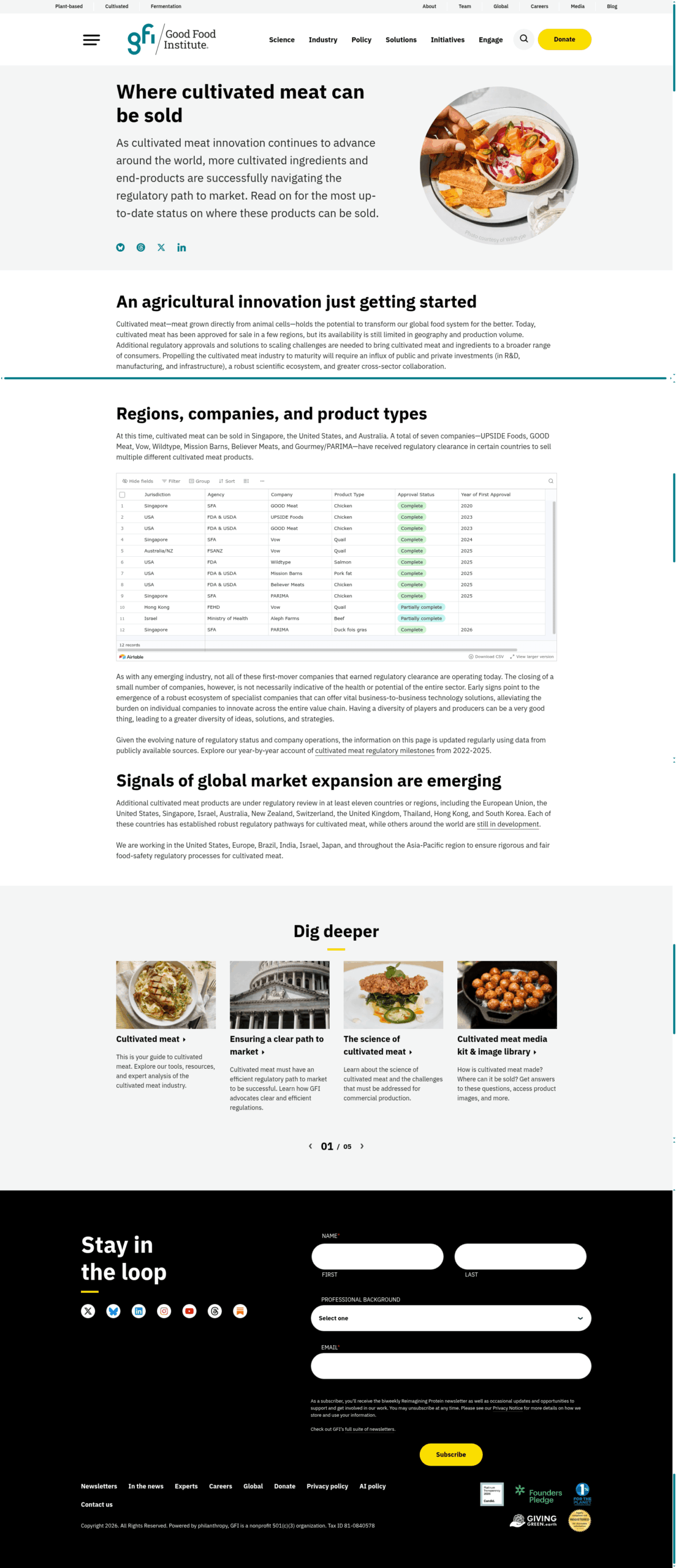
Where cultivated meat can be sold
An interactive tracker by The Good Food Institute mapping global regulatory approvals and market pathways for cultivated meat products.
In focus: Impact investing in Asia
Impact investing in Asia is expanding, with $80 billion allocated and strong investor satisfaction. Returns largely meet or exceed expectations, led by private equity. Capital targets financial services, energy and healthcare, addressing a $1.5 trillion SDG gap, with growing private sector participation and regional variation.

GlobeScan
GlobeScan is a global insights and advisory consultancy specialising in sustainability, trust and stakeholder engagement. It delivers evidence-based research, public opinion data and strategic advice to businesses, NGOs and governments, helping organisations understand societal expectations, manage risk, and develop sustainable strategies that create long-term value and strengthen reputation.

ANREV (Asian Association for Investors in Non-Listed Real Estate Vehicles)
ANREV (Asian Association for Investors in Non-Listed Real Estate Vehicles) is a not-for-profit industry body supporting institutional investors in Asia-Pacific real estate funds. It provides research, indices and market data, promotes transparency and best practice, and enables informed investment decisions across non-listed real estate markets.
Hong Kong taxonomy for sustainable finance (phase 2A)
Phase 2A of the Hong Kong Taxonomy for Sustainable Finance sets out detailed criteria for classifying environmentally sustainable activities, aligned with international taxonomies. It covers additional sectors, technical screening thresholds, and transition activities, aiming to enhance transparency, comparability and capital allocation towards climate mitigation and adaptation in Hong Kong.

Hong Kong Monetary Authority (HKMA)
Hong Kong Monetary Authority (HKMA) is Hong Kong’s central banking institution and de facto central bank, established in 1993. It maintains currency stability under the Linked Exchange Rate System, supervises banking and financial institutions, promotes financial system integrity, manages the Exchange Fund and supports Hong Kong’s role as an international financial centre.
Hong Kong Monetary Authority (HKMA) is Hong Kong’s central banking institution and de facto central bank, established in 1993. It maintains currency stability under the Linked Exchange Rate System, supervises banking regulation and financial infrastructure, manages the Exchange Fund and supports Hong Kong’s role as a leading international financial centre.
Hong Kong Monetary Authority (HKMA) is Hong Kong’s central banking institution and de facto central bank, established in 1993. It maintains currency stability under the Linked Exchange Rate System, supervises banking regulation and financial infrastructure, manages the Exchange Fund and supports Hong Kong’s role as a leading international financial centre.
From risk to resilience: Integrating adaptation into finance
The report outlines practical frameworks for integrating climate adaptation into financial decision-making, linking physical risk assessment to credit, investment, sovereign risk and financial products. It promotes the ABC framework, data transparency and adaptation-inclusive transition plans to improve resilience, pricing and capital allocation.

Greenpeace East Asia
Greenpeace East Asia is a regional environmental campaigning organisation focused on climate change, toxic pollution, sustainable food, forests and ocean protection across East Asia. Active since 1997, it conducts research, advocacy and non-violent campaigns to influence policy and promote renewable energy and environmental sustainability.

CFA Institute Research & Policy Centre
CFA Institute Research and Policy Center (RPC) is a finance research hub turning investment research into insights that strengthen capital markets, advance ethics and improve investor outcomes. RPC publishes policy analysis, research reports and industry perspectives for investment professionals, regulators and policymakers, grounded in CFA Institute expertise and market trends.

Oxford university press
Oxford University Press (OUP) is a global academic and educational publisher. It operates as a department of the University of Oxford, producing textbooks, scholarly works, English language resources and reference works. OUP emphasises digital innovation, sustainability commitments, and broad international reach in research and education.
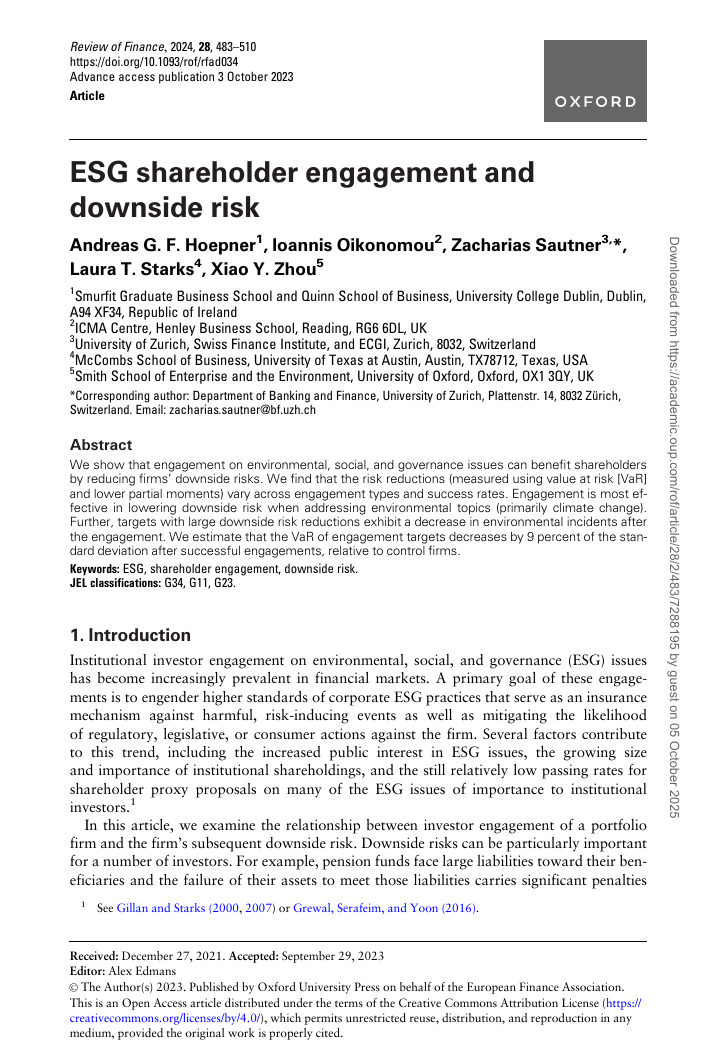
ESG shareholder engagement and downside risk
This study analyses whether investor engagement on environmental, social, and governance (ESG) issues reduces firms’ downside risk. Using data from 1,443 engagements with 485 global firms (2005–2018), it finds that successful engagements, particularly on environmental and climate issues, significantly lower downside risk and related environmental incidents.
ESG and global investor returns study
This report analyses the link between ESG integration and global investor returns, drawing on cross-regional data and sector comparisons. It assesses how environmental, social, and governance factors correlate with performance, highlighting variations across markets and asset classes. The study provides evidence-based insights on ESG’s financial materiality for investors worldwide.
The value of NGO activism
NGO campaigns alleging environmental and social “E&S-washing” lead to negative stock and media responses, especially on financially material issues. Firms reduce direct emissions following climate-related allegations—often shifting them to supply chains. NGOs also prompt investor engagement, suggesting a monitoring role despite unintended consequences such as increased indirect emissions.
Regulating AI in the financial sector: Recent developments and main challenges
The report outlines AI’s growing use in finance—especially in underwriting, fraud detection, and customer support—highlighting regulatory challenges around explainability, governance, and data security. It discusses evolving global guidance and the need for risk-based, proportionate oversight, particularly as generative AI gains traction in high-impact applications.
Pursuing impact within a portfolio: Insights from institutional asset owners
This report explores how institutional asset owners integrate impact goals into portfolio strategy. Through four case studies, it examines aligning financial returns with social and environmental outcomes using an impact lens. It highlights investment approaches addressing climate change, health, regional development and systemic inequality across diverse asset classes and geographies.
A time for change in the sustainable fund market: Reflections and recommendations in a new regulatory environment
The report examines recent regulatory shifts in Europe and the UK affecting sustainable funds. It outlines rebranding impacts, highlights inconsistencies in fund categorisation, and stresses the need for broader sustainability definitions beyond the EU Taxonomy to avoid constraining investment opportunities and to better accommodate transition-related financial products.


