
Library | Location
Japan
Refine
155 results
REFINE
SHOW: 16


The board playbook: Winning strategies for long-term value creation
This report outlines strategies for corporate boards to foster long-term value creation. It highlights the need for tailored governance, alignment between boards and management, and adaptive practices across geographies. Practical toolkits support board effectiveness through strategic focus, risk management, and director development.
Global responsible investment trends: Inside PRI reporting data 2025
The 2025 PRI report analyses data from 3,048 signatories, highlighting trends in climate risk management, stewardship, and human rights. Asset owners show increased engagement, with climate and social issues gaining priority. Investors continue integrating responsible investment into decision-making and oversight, with varied progress across policy, governance, and disclosure practices.

The disability inclusion imperative
Companies excelling in disability inclusion earn higher revenue, profit, and productivity. Despite rising interest, action lags. Barriers include disclosure fears and cost assumptions. The report introduces a five-part “A List” framework—Access, Awareness, Advocacy, Action, Accountability—to guide inclusive practices and improve organisational and financial outcomes.
Disability: IN's disability equality index series
The Disability Equality Index is a benchmark series assessing corporate performance in disability inclusion across multiple markets. It provides organisations with a structured tool to evaluate, compare, and enhance their inclusive practices aligned with sustainability and governance expectations.
Human rights due diligence for private markets investors: A technical guide
This guide outlines how private markets investors can integrate human rights due diligence into investment processes, aligned with the UN Guiding Principles. It covers policy commitments, risk assessment, stakeholder engagement, and remedy provision to address human rights impacts, mitigate risk, and meet evolving legal and societal expectations.
Climate risk and adaptation in global food
The report outlines rising climate risks to global food supply chains, projecting up to $38 trillion in damages by 2050. It explores mitigation and adaptation strategies across crops, livestock, and fisheries, and highlights investor actions to build resilience, support sustainable practices, and adapt to shifting market, environmental, and regulatory conditions.
A time for change in the sustainable fund market: Reflections and recommendations in a new regulatory environment
The report examines recent regulatory shifts in Europe and the UK affecting sustainable funds. It outlines rebranding impacts, highlights inconsistencies in fund categorisation, and stresses the need for broader sustainability definitions beyond the EU Taxonomy to avoid constraining investment opportunities and to better accommodate transition-related financial products.
AIGCC's the state of investor climate transition in Asia benchmark series
This benchmark series examines how Asian investors are approaching net zero and climate-aligned investment, including target setting, portfolio alignment, climate risk assessment, stewardship, investment strategies and barriers to implementation across asset classes and markets in Asia.
The purpose of investor stewardship
This paper critically examines investor stewardship, shifting from traditional shareholder-focused governance towards "enlightened stewardship." It advocates balancing fiduciary duties with broader societal and environmental considerations. Analysing the evolution of the UK Stewardship Code, it highlights a systemic shift to integrate sustainability and stakeholder concerns alongside financial returns for long-term value creation.
Closing the gap: Investing in natural capital to meet the SDGs
The report analyses the investment required to address the natural capital gap for achieving Sustainable Development Goals in 40 countries, finding that investing US$7.4 trillion could generate returns exceeding US$152 trillion, greatly benefiting air quality, human health, ecosystems, and reducing premature deaths and resource depletion globally.
Investing in a pollution free ocean
The report explores how ocean pollution poses financial, legal and reputational risks to businesses, particularly land-based sectors. It identifies data gaps as a barrier to effective decision-making and highlights opportunities in green chemistry, data innovation and sustainable finance. It recommends integrating ocean health into corporate and financial strategies.
Environmental Finance's biodiversity insight series
This series explores the evolving role of biodiversity in sustainable finance, investment strategies, and regulatory developments. It examines biodiversity risk, natural capital investment, reporting frameworks, and financial instruments supporting conservation efforts. The series provides insights into emerging market mechanisms, data challenges, and the integration of biodiversity considerations into financial decision-making.
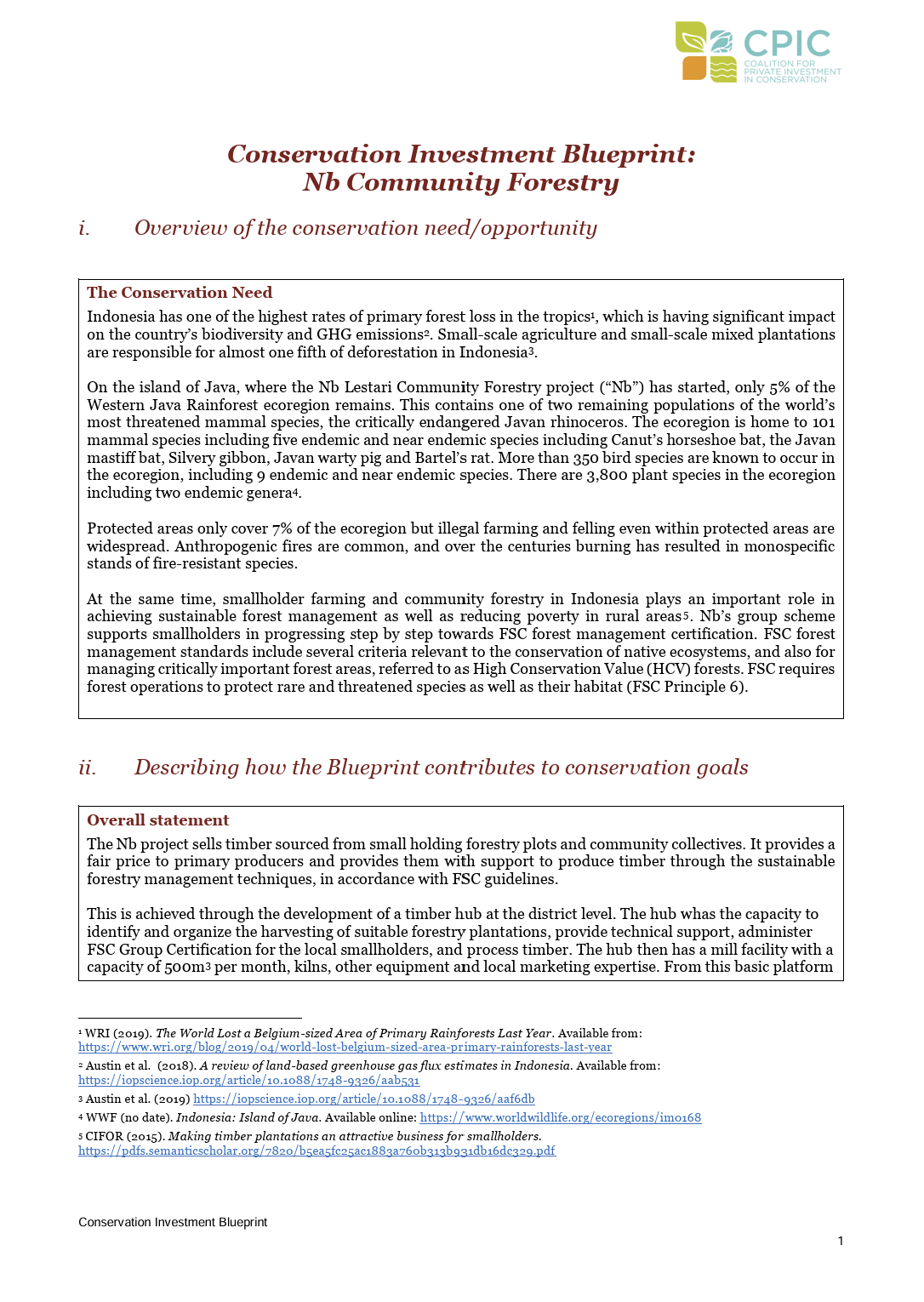
Conservation investment blueprint: Nb community forestry
This blueprint outlines a community forestry project that sells timber sourced from small holding forestry plots and community collectives. It provides a fair price to primary producers and provides them with support to produce timber through the sustainable forestry management techniques, in accordance with FSC guidelines.
Storm clouds and silver linings: Long-term investing in an age of geopolitical uncertainty
The report explores the impact of geopolitical uncertainty on long-term investing, highlighting risks and opportunities for institutional investors. It emphasises the need for integrating geopolitical considerations into investment strategies, governance, and decision-making frameworks. The report provides practical tools for investors to assess geopolitical resilience, manage risks, and engage with stakeholders while balancing short-term pressures with long-term value creation.

The race against time for smarter development: To be smart, the digital revolution will need to be inclusive
The report underscores the need for inclusivity in the digital revolution, highlighting gender disparities in STEM fields. Women are underrepresented in digital and engineering roles, limiting their access to future job opportunities. Policy interventions, improved workplace conditions, and equitable funding are essential to fostering diversity in technological innovation and ensuring sustainable, inclusive development.

Contextualising ESG funds' engagement strategies in Asia
The report examines the engagement strategies of ESG funds in Asia, highlighting the unique challenges posed by regulatory constraints, concentrated ownership, and political influences. Using a structured engagement pyramid, the study categorises ESG fund strategies, ranging from investment screening to direct corporate control. Despite obstacles, notable regional features can support ESG initiatives, such as shareholder voting mechanisms and strategic collaborations. The report provides insights into how ESG funds navigate these challenges to influence corporate governance and sustainability outcomes in Asia.


