
Library | Location
Switzerland
Refine
111 results
REFINE
SHOW: 16



The European Space Agency (ESA)
European Space Agency (ESA) is Europe’s intergovernmental organisation dedicated to space exploration, Earth observation, satellite navigation, and technological innovation. ESA collaborates with international partners, coordinates high-profile missions, and supports science, space safety and industry growth across member states.

WorldCover
WorldCover offers free, high-resolution global land cover maps at 10 m resolution for 2020 and 2021, via Sentinel-1 and Sentinel-2 data, under Creative Commons license. It supports environmental monitoring, climate research, land-use planning and biodiversity analysis.
One hundred and thirty years of corporate responsibility
This report develops a 130-year index (ESIX) measuring public attention to environmental and social issues in business using historical news data. Findings show that such attention rises during instability (social) or prosperity (environmental), depresses short-term investment efficiency, but improves investment outcomes over longer horizons.
ShareAction's point of no return series
The Point of No Returns benchmark series assesses the world’s largest asset managers on responsible investment across climate, biodiversity, social issues, governance, and stewardship. Published by ShareAction, the series provides rankings, sector-wide analysis, and examples of practice to guide improvement and accountability.

IMPACT2C Project Consortium
IMPACT2C provides evidence on impacts of +2 °C global warming across Europe and vulnerable regions (Bangladesh, Nile/Niger basins, Maldives). Using multi‑model climate and sectoral analyses—covering water, energy, infrastructure, coasts, tourism, forestry, agriculture, ecosystems and health—it quantifies risks, economic costs and adaptation uncertainty for policy planning.

Greenhouse gas protocol land sector and removals initiative: Project overview
The greenhouse gas protocol’s land sector and removals initiative aims to develop internationally accepted corporate guidance for accounting and reporting emissions and removals from land use, bioenergy, and carbon removal. It seeks to improve transparency, support target-setting, and align with climate goals through a multi-stakeholder, science-based process.

The greenhouse gas protocol: A corporate accounting and reporting standard
The Greenhouse Gas Protocol Corporate Standard provides a framework for businesses to quantify and report greenhouse gas emissions. It establishes standardised accounting principles, categorises emissions by scope, and offers guidance for setting organisational and operational boundaries. The Standard promotes transparency, consistency, and comparability in corporate GHG inventories.
Targeting net zero: The need to redesign bank decarbonization targets
This report examines the limitations of current bank decarbonisation targets and proposes design reforms to align with net zero. It analyses scope coverage, target types, and sector alignment, offering practical recommendations for enhancing climate credibility and effectiveness in financial institutions’ transition planning.
Kantar
Kantar is a global leader in marketing data, insights and analytics, supporting over 96 of the world’s top 100 advertisers across 90+ markets. It combines behavioural and attitudinal data to inform brand strategy, creative testing, media effectiveness, customer experience and sustainable growth.
The value of NGO activism
NGO campaigns alleging environmental and social “E&S-washing” lead to negative stock and media responses, especially on financially material issues. Firms reduce direct emissions following climate-related allegations—often shifting them to supply chains. NGOs also prompt investor engagement, suggesting a monitoring role despite unintended consequences such as increased indirect emissions.
Artificial intelligence in financial services
AI is reshaping financial services by enhancing efficiency, reducing costs and unlocking new revenue opportunities. With $97 billion in projected investment by 2027, firms must address risks like misinformation and data bias while prioritising governance, regulation and workforce reskilling to ensure responsible, secure and effective AI adoption.
Global responsible investment trends: Inside PRI reporting data 2025
The 2025 PRI report analyses data from 3,048 signatories, highlighting trends in climate risk management, stewardship, and human rights. Asset owners show increased engagement, with climate and social issues gaining priority. Investors continue integrating responsible investment into decision-making and oversight, with varied progress across policy, governance, and disclosure practices.
Human rights due diligence for private markets investors: A technical guide
This guide outlines how private markets investors can integrate human rights due diligence into investment processes, aligned with the UN Guiding Principles. It covers policy commitments, risk assessment, stakeholder engagement, and remedy provision to address human rights impacts, mitigate risk, and meet evolving legal and societal expectations.
Pursuing impact within a portfolio: Insights from institutional asset owners
This report explores how institutional asset owners integrate impact goals into portfolio strategy. Through four case studies, it examines aligning financial returns with social and environmental outcomes using an impact lens. It highlights investment approaches addressing climate change, health, regional development and systemic inequality across diverse asset classes and geographies.
A time for change in the sustainable fund market: Reflections and recommendations in a new regulatory environment
The report examines recent regulatory shifts in Europe and the UK affecting sustainable funds. It outlines rebranding impacts, highlights inconsistencies in fund categorisation, and stresses the need for broader sustainability definitions beyond the EU Taxonomy to avoid constraining investment opportunities and to better accommodate transition-related financial products.
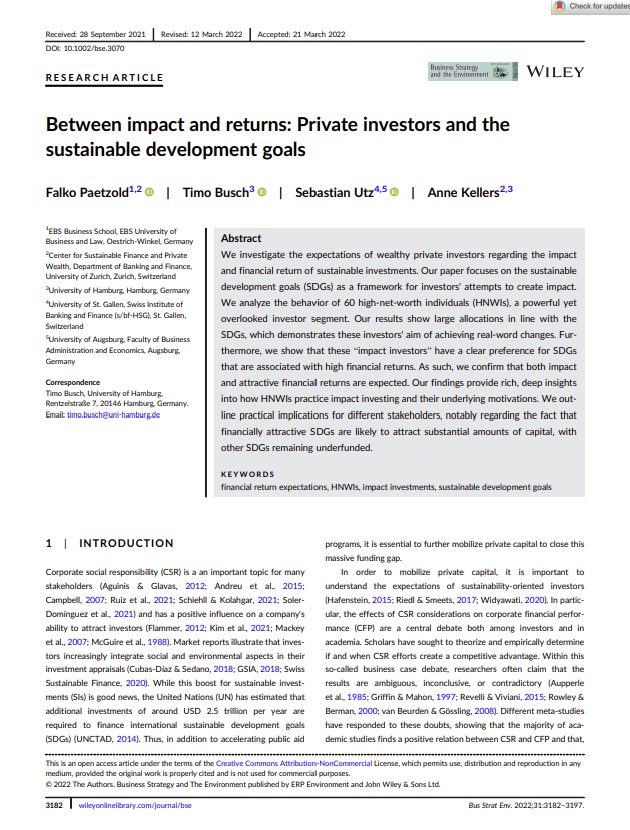
Between impact and returns: Private investors and the sustainable development goals
Wealthy private investors increasingly align their portfolios with the UN Sustainable Development Goals (SDGs), seeking both measurable impact and financial returns. Investors favour SDGs linked to higher expected profits, leading to underinvestment in less profitable goals. Findings are based on portfolio data, surveys, and interviews with 60 high-net-worth individuals.


