
Refine
461 results
REFINE
SHOW: 16


State of transition in sovereigns series
Assessing Sovereign Climate-related Opportunities and Risks (ASCOR) is a benchmark series that provides an investor-led framework to assess how sovereigns manage climate-related risks and opportunities. It supports sovereign bond analysis, engagement, and comparison by evaluating national policies, emissions pathways, and climate finance using transparent, publicly available information.
Transition forecast series
This benchmark series presents forward-looking assessments of global energy, land use and nature transitions. It consolidates expert judgement with structured policy tracking to outline plausible transition pathways across major economies, supporting investors and financial institutions in scenario analysis, risk assessment and strategic planning.

Energy Transition Advisers (ETA)
ET Advisors is a sustainability and climate advisory firm supporting investors, corporates and financial institutions. It provides research-led advice on climate transition, ESG strategy, sustainable finance and long-term value creation, helping organisations manage risk and align with global sustainability and net zero goals.
Indicators of global climate change 2024: Annual update of key indicators of the state of the climate system and human influence series
This series provides annual, peer-reviewed updates on key indicators of the global climate system and human influence. It tracks developments between IPCC assessment cycles, using consistent methods to support comparability, transparency, and evidence-based decision-making for policy and finance audiences.
Net 0 Tracker
Net Zero Tracker is a publicly accessible database tracking net zero targets and progress of countries, regions, cities and companies. It standardises information on pledges, legal status and implementation, supporting comparison, accountability and evidence-based analysis of climate commitments.
Global carbon budget series
The Global Carbon Budget is a recurring research series that synthesises global data on carbon dioxide sources and sinks. It provides a consistent framework for tracking emissions, atmospheric concentrations, and carbon uptake across land and oceans, supporting analysis of climate system dynamics and policy-relevant assessment over time.
National ecological footprint and biocapacity accounts series
This series provides consistent national and global accounts of ecological footprint and biocapacity, tracking resource demand and regenerative capacity over time. It supports comparative analysis across countries and years, using harmonised methods and internationally sourced data to inform sustainability assessment and policy analysis.
Sustainability disclosure landscape report for risk management: Insights from climate-focused case studies
This report reviews sustainability disclosure standards and regulatory uptake, focusing on climate-related risk management. Using case studies, it examines IFRS S1 and S2 implementation, materiality assessments and transition plans, highlighting disclosure gaps, data challenges and practical approaches to improve decision-useful climate risk reporting.

IFRS S2: Climate-related disclosures
IFRS S2 sets mandatory climate-related disclosure requirements for entities, covering governance, strategy, risk management, and metrics and targets. It integrates TCFD recommendations and SASB guidance to improve consistency, comparability and decision-useful information for users of general purpose financial reports.
AASB S2: Climate-related disclosures
AASB S2 establishes mandatory climate-related financial disclosure requirements for Australian entities, aligned with IFRS S2. It requires reporting on governance, strategy, risk management, and metrics and targets, including greenhouse gas emissions, where climate risks and opportunities may affect cash flows, access to finance, or cost of capital.
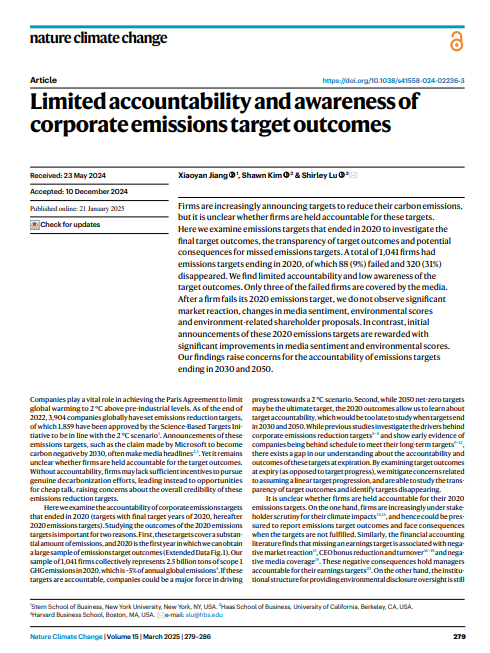
Limited accountability and awareness of corporate emissions target outcomes
The study analyses 1,041 corporate emissions targets ending in 2020, finding limited accountability. Thirty-one per cent of targets disappeared and 9% failed, with minimal disclosure, media attention or market penalties. By contrast, target announcements improved media sentiment and ESG scores, raising concerns for future climate targets.
The visionary CEO’s guide to sustainability series
The Visionary CEO’s Guide to Sustainability is a series of annual research reports examining how senior executives integrate sustainability into core strategy, operations, and decision-making. The series explores leadership responses to evolving environmental, regulatory, technological, and market pressures, with a focus on practical execution and long-term business resilience.
Net Zero Asset Managers' target disclosures series
The Net Zero Asset Managers Target Disclosures is a reporting series that tracks how participating asset managers set, disclose, and update net zero targets over time. It provides a consistent, initiative-wide view of commitments, disclosure practices, governance arrangements, and methodological approaches across reporting years.
Climate change and news audiences report series
This is an annual research series examining how audiences access, trust, and interpret climate change news. It analyses news use, attitudes, and perceptions across multiple countries, tracking changes over time to inform journalism practice, media strategy, and public understanding of climate-related information.

Net Zero Asset Managers Initiative (NZAM)
Net Zero Asset Managers Initiative (NZAM) is a global investor initiative supporting asset managers committed to net zero greenhouse gas emissions. NZAM provides guidance, accountability frameworks, and public target disclosures, helping align investment portfolios with climate goals and support the transition to a net zero economy across global financial markets.

Sustainable Finance Roundup January 2026: Geopolitics, Energy Transitions, and Systemic Risk
This month’s sustainable finance article roundup examines a landscape increasingly shaped by geopolitics and climate risk, as near-term fragmentation, energy security, and affordability pressures collide with intensifying long-term threats from climate change, biodiversity loss, and water stress. The works featured analyse how these dynamics are reshaping capital allocation, disclosure, and resilience planning, demonstrating the growing need for sustainable finance to integrate geopolitical risk with real-economy transition.


