
Library | ESG issues
Lifecycle Management
Lifecycle Management (LCM) involves planning and managing a product or service’s entire lifecycle, from development to disposal, to minimise environmental and social impacts. By promoting sustainable production, recycling, and resource efficiency, LCM aligns with long-term strategies for reducing operational and reputational risks and improving operational efficiency.
Refine
31 results
REFINE
SHOW: 16


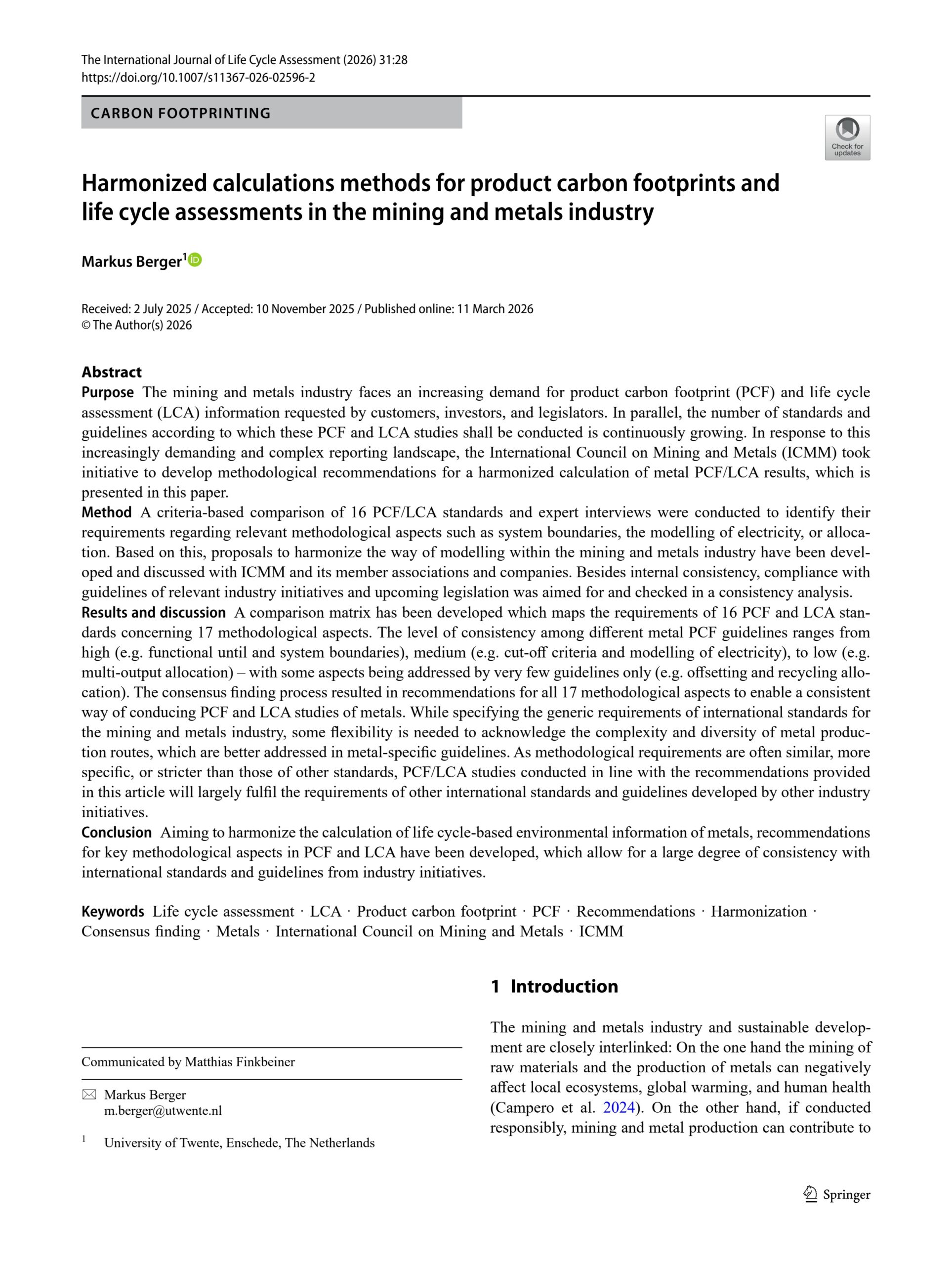
Harmonized calculations methods for product carbon footprints and life cycle assessments in the mining and metals industry
This research presents methodological recommendations for harmonising product carbon footprint and life cycle assessment calculations across the mining and metals industry. Developed with the International Council on Mining and Metals, it establishes consistent guidelines for 17 aspects, including system boundaries, electricity modelling, and multi-output allocation procedures.
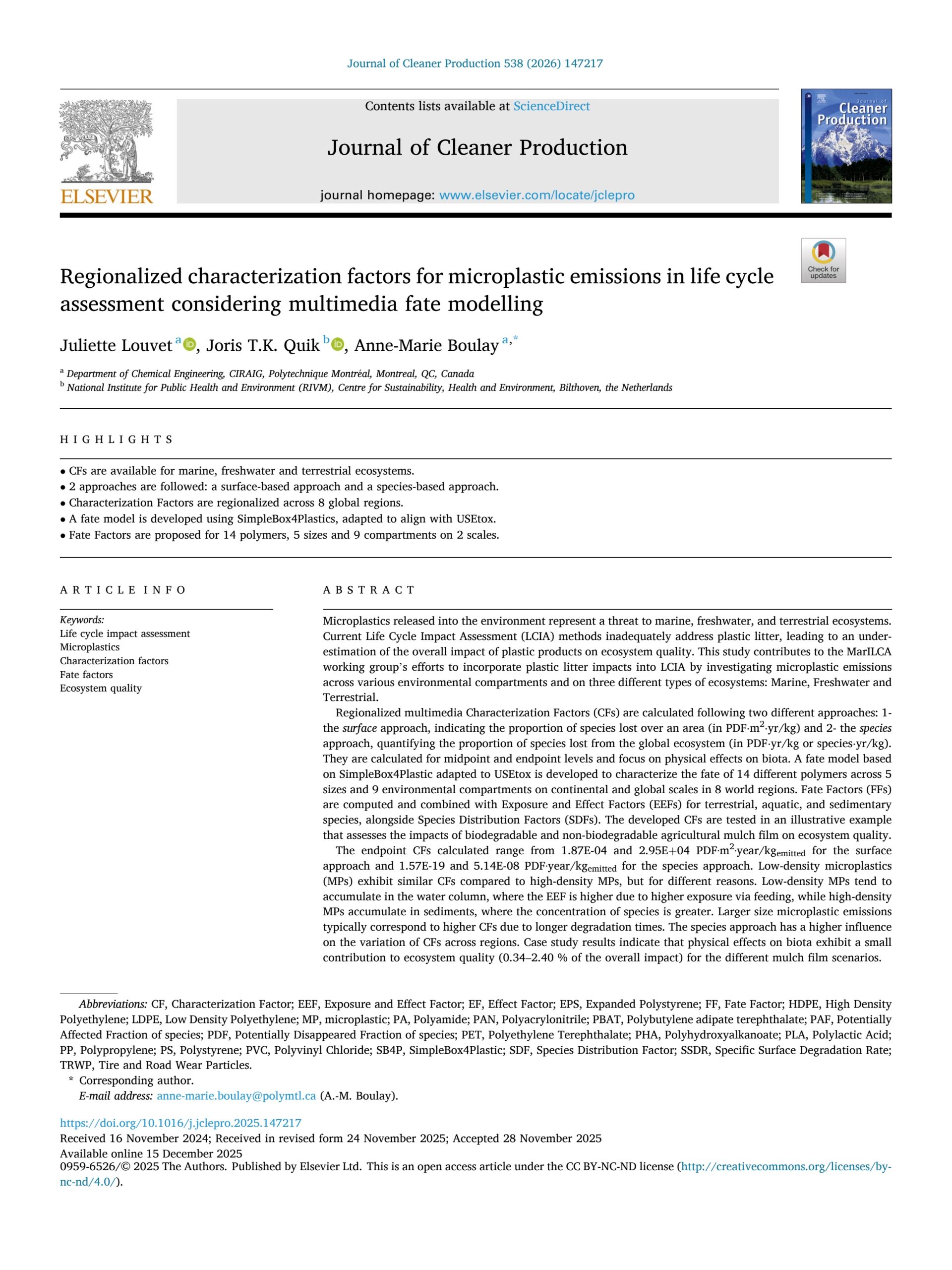
Regionalized characterization factors for microplastic emissions in life cycle assessment considering multimedia fate modelling
This research establishes regionalised characterisation factors for microplastic emissions across marine, freshwater, and terrestrial ecosystems. Using fate modelling aligned with USEtox, it evaluates 14 polymers and five size categories. Findings demonstrate that particle size and density significantly influence environmental persistence and subsequent impacts on global species richness.
Guidance for applying absolute environmental sustainability assessment on activities at different scales (BETA version)
Provides beta guidance for applying Absolute Environmental Sustainability Assessment, comparing activities’ environmental burdens against planetary boundaries. It outlines a three-phase, nine-step framework, supported by case studies (buildings, cement, EU consumption), and aligns with existing accounting standards while addressing methodological gaps in allocating environmental limits.
Impact Thinking Canvas
The Impact Thinking Canva is a simple, printable framework to structure impact valuation projects, helping organisations define objectives, map impact pathways, identify key data needs and align stakeholders early in the process. It guides impact measurement and data collection at the start of an impact valuation exercise.
GHG Protocol Life Cycle Databases
The GHG Protocol Life Cycle Databases page lists third-party life cycle inventory and emissions datasets to support product life cycle and corporate value chain (Scope 3) greenhouse gas accounting. It links to multiple global and sector-specific LCI sources, with summaries of content, formats and accessibility.

Ecoinvent Association
Ecoinvent Association is a Swiss not-for-profit association providing one of the world’s most comprehensive Life Cycle Inventory (LCI) databases for environmental and sustainability assessments. Its transparent, high-quality environmental data supports life cycle assessment (LCA), carbon footprinting and supply chain impact analysis for researchers, companies and policymakers.
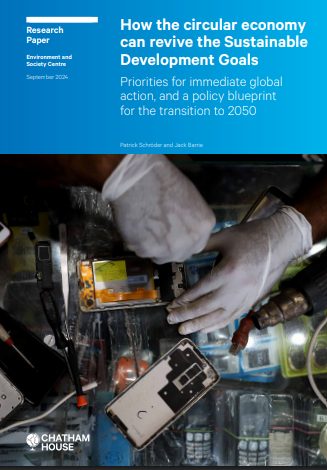
How the circular economy can revive the sustainable development goals: Priorities for immediate global action, and a policy blueprint for the transition to 2050
This report argues that embedding circular economy principles within the Sustainable Development Goals could revive stalled progress. It outlines five global policy priorities and proposes a 2050 blueprint linking circularity, inclusive growth, trade, finance and standards to post-2030 development agendas.
ITI’s sustainable technology policy guide: Understanding AI’s role in the energy transition
The report outlines how AI increases energy demand yet supports sustainability through efficiency gains, improved forecasting, and advanced grid management. It recommends grid modernisation, expanded low-carbon power, enhanced data-centre resource efficiency, and lifecycle carbon management to enable reliable, sustainable deployment of next-generation technologies.

Making money talk nicely: Biodiversity impact assessment for investors
This study compares eight biodiversity impact assessment tools used by investors. It finds low consistency in company rankings due to non-standardised methods, weak transparency and limited validation, concluding that reliance on single tools risks mispricing nature-related financial risk and calling for improved disclosures and spatially explicit approaches.
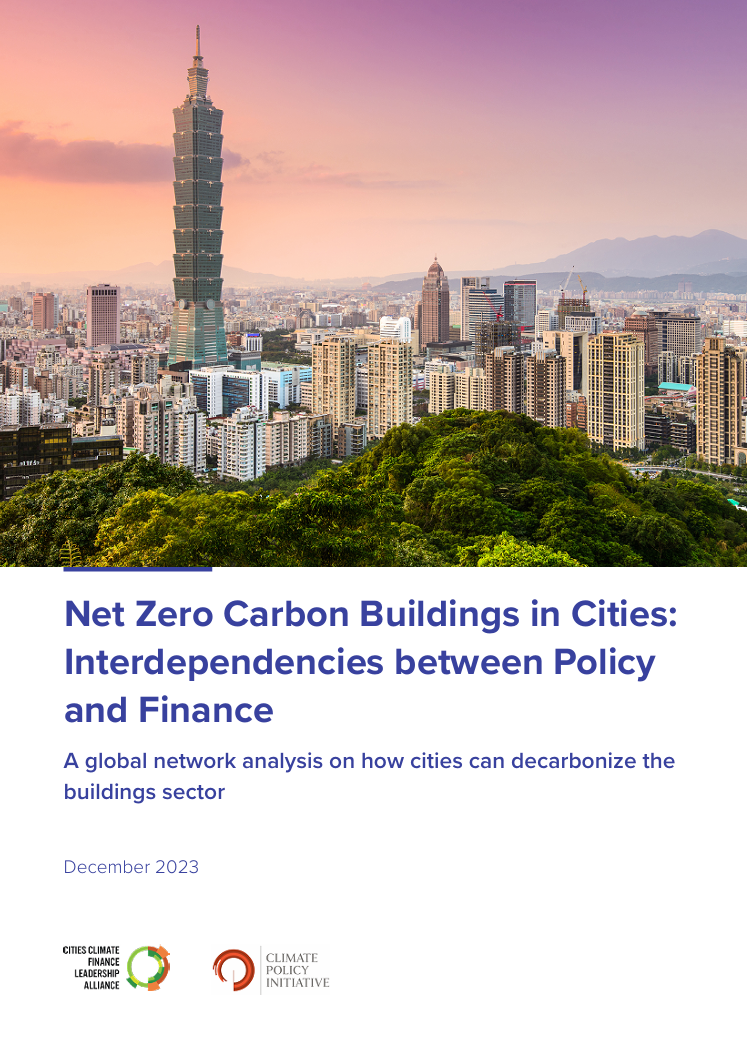
Net zero carbon buildings in cities: Interdependencies between policy and finance
This report analyses how cities can decarbonise buildings by mapping the interdependencies between policy and financial instruments and the barriers they address. It highlights priority actions for cooling, embodied carbon, adaptation and a just transition, outlining pathways that help cities sequence measures to accelerate net zero building outcomes.

One Planet Network
One Planet Network is a global multi-stakeholder partnership advancing sustainable consumption and production (SCP). It implements the 10-Year Framework of Programmes (10YFP) through six thematic programmes. The network acts as a knowledge hub and convenes governments, businesses, civil society and experts on SCP and SDG 12.
Federal Institute for Geosciences and Natural Resources (BGR)
Federal Institute for Geosciences and Natural Resources (BGR) is Germany’s national geological survey, advising the federal government on geoscience and raw materials. It undertakes research in earth sciences, resource management, geodata systems and sustainability. Located in Hannover, BGR coordinates national geoscientific data infrastructure and policy.
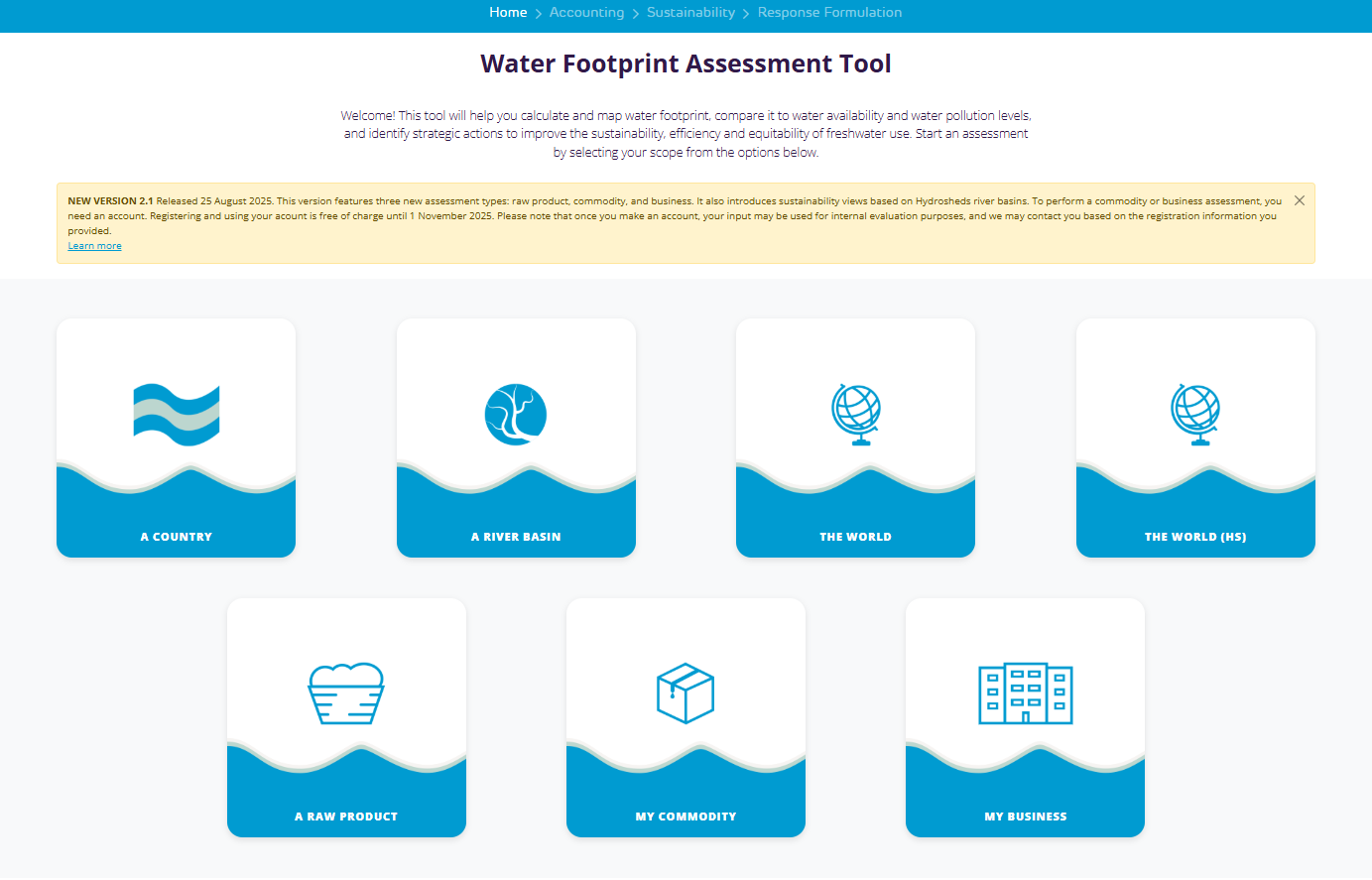
Water footprint assessment tool
The Water Footprint Assessment Tool is a free online application that enables businesses, governments, investors, NGOs and researchers to calculate and map green, blue and grey water footprints, assess sustainability, efficiency and equitable water use, and identify strategic actions to improve water management.
Water footprint implementation
Water Footprint Implementation supports companies and governments with water accounting, sustainability assessment and water-footprint compensation. A spin-off of Water Footprint Network research, it delivers actionable insights for ESG reporting, water stewardship, water-footprint benchmarking and tailored reduction strategies to enhance resilience, reduce risk and foster sustainable water management.

Greenhouse Gas Protocol
GHG Protocol (Greenhouse Gas Protocol) sets globally recognised greenhouse-gas accounting standards and guidance. Developed by World Resources Institute and World Business Council for Sustainable Development, it enables businesses, governments and cities to measure, report and manage emissions—covering operations, value chains and mitigation actions across Scopes 1, 2 and 3.

Estimating and reporting the comparative emissions impacts of products
This report outlines a neutral framework for estimating and reporting the greenhouse gas impacts of products, both positive and negative. It advocates the use of consequential methods for decision-making, highlights methodological challenges in attributional approaches, and recommends transparency and completeness in emissions assessments and corporate reporting.


