
Library | SASB Sustainability Sector
All industries
Refine
624 results
REFINE
SHOW: 16


Safety by design: Model clauses for due diligence arrangements and funding agreements
This document provides model clauses for due diligence arrangements and funding agreements related to eSafety for startups. It includes pre-conditions for funding agreements, covering policies, staffing, training, and external communication. Additionally, the document urges startups to complete the eSafety assessment tool and implement safety by design measures.

Safety by design: Investment checklist
This investment checklist is a concise guidance document, aimed at investors and venture capitalists considering whether to invest in tech companies. The checklist presents a 12-point criteria touching on design and provision of services, community guidance, safety reviews, user tools, and proactive steps to inform users about safety policies.

Report of COMEST on robotics ethics
COMEST has released a report on robotics ethics which covers the history, development, and social impact of robots. It also offers recommendations for the ethical use of robotics.

Montreal declaration for a responsible development of artificial intelligence
This report outlines a framework for responsible development of artificial intelligence. It provides principles that should guide ethical use of AI for the well-being of sentient beings, respect for autonomy, protection of privacy and intimacy, solidarity, democratic participation, equity, diversity inclusion, caution, responsibility, and sustainable development.

Investors' expectations on responsible artificial intelligence and data governance
This report outlines responsible AI and data governance principles and engagement framework for investors across multiple sectors. The six core principles aim to enhance machine learning, auditability, explainability, and transparency, while taking into account legal, regulatory, ethical, and reputational risks.

Generative artificial intelligence in finance: Risk considerations
Generative AI is a subset of AI/ML that creates new content. It offers enhancements to efficiency and customer experience, as well as advantages to risk management and compliance reporting. However, the deployment of GenAI in the financial sector requires the industry to recognise and mitigate the technology's risks comprehensively; financial institutions must strengthen their cybersecurity and regulatory oversight capacities.

Ethics guidelines for trustworthy AI
The European Commission's AI High-Level Expert Group has released their Ethics Guidelines for Trustworthy AI. The report provides a framework for creating lawful, ethical, and robust AI systems throughout the system's life cycle. The guidelines focus on respect for human autonomy, prevention of harm, fairness, and explicability.

Ethically aligned design: A vision for prioritising human well-being with autonomous and intelligent systems
This report is a call-to-action for technologists to align creation of autonomous and intelligent systems to defined values and ethical principles prioritising human well-being. Emphasising the importance of embedding values and morals into these systems, it discusses a range of topics, including job automation, personal data protection, A/IS education, law, and more.

Engaging the ICT sector on human rights: Child rights
This briefing explores the risks and opportunities Information and Communication Technologies (ICT) companies face in relation to children's rights. It highlights the importance of adhering to international standards and implementing internal policies and practices that prioritise the most severe impacts on children. Investors are encouraged to hold companies accountable.

Beyond explainability: A practical guide to managing risk in machine learning models
This report offers a comprehensive guide for effectively managing risk in machine learning models. It presents a framework that enables data science and compliance teams to create better, more accurate, and more compliant models. The report stresses the importance of understanding the data used by models and implementing three lines of defence to assess and ensure their safety.
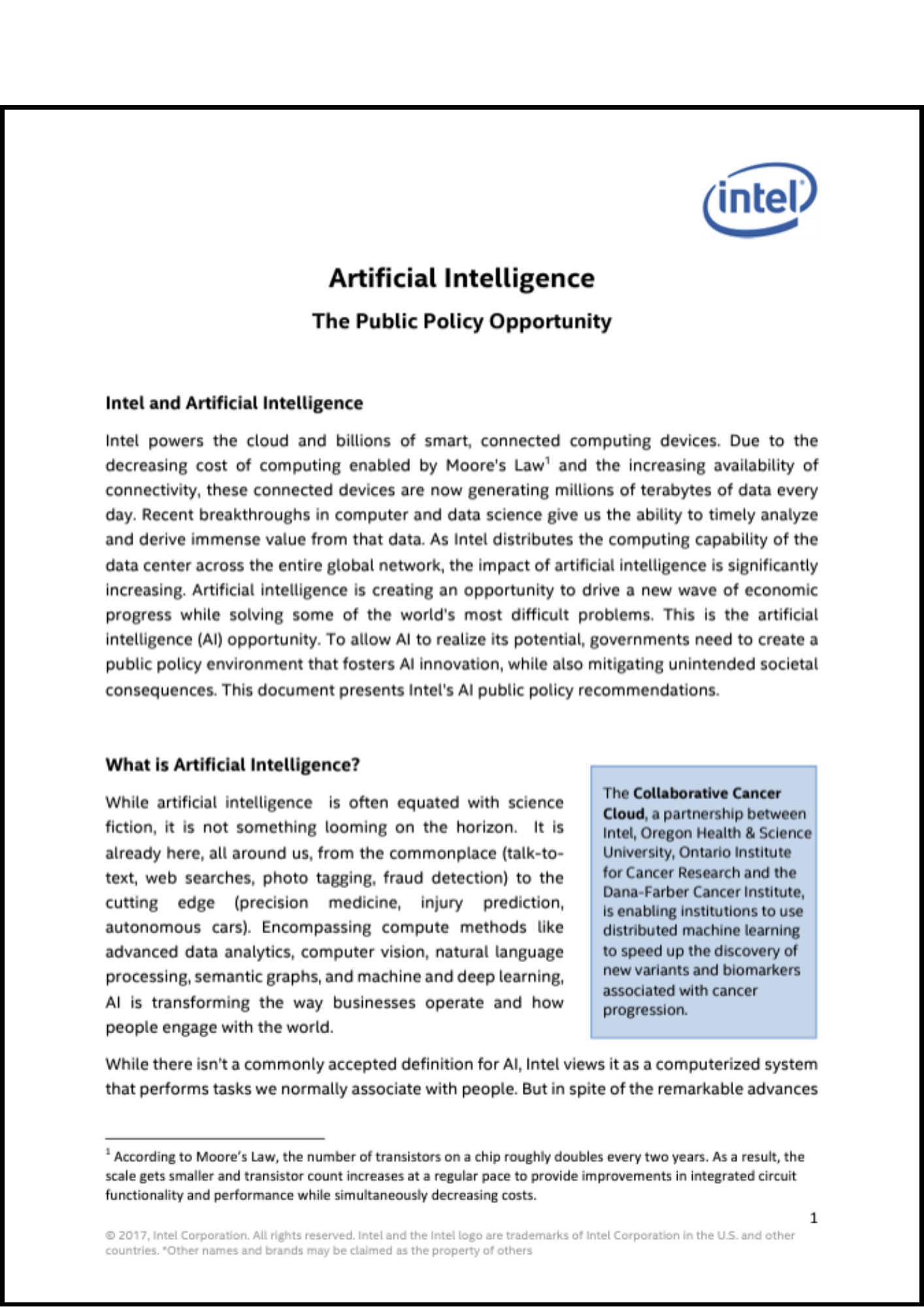
Artificial intelligence: The public policy opportunity
The artificial intelligence (AI) opportunity is here, and it's transforming industry and society. Governments must create public policy environments that encourage AI innovation, while mitigating negative consequences. This report by Intel outlines several key recommendations necessary to realise the potential of AI and to prepare for this transformative technology.

AI policy principles
This report outlines the responsibility of industry and governments in promoting responsible development and use of artificial intelligence. The policy principles focus on the integration of principles into the design of AI technologies, investment in AI research and development, and collaboration through public-private partnerships.

AI act: Laying down harmonised rules on artificial intelligence and amending certain union legislative acts
The EU Commission has published a regulation that establishes harmonized rules on artificial intelligence (AI) while amending certain union laws. Stakeholders mostly agree on the need for action in the field of AI, but warn the Commission to avoid duplication and overregulation. The regulation will require an appropriate level of human and financial resources.
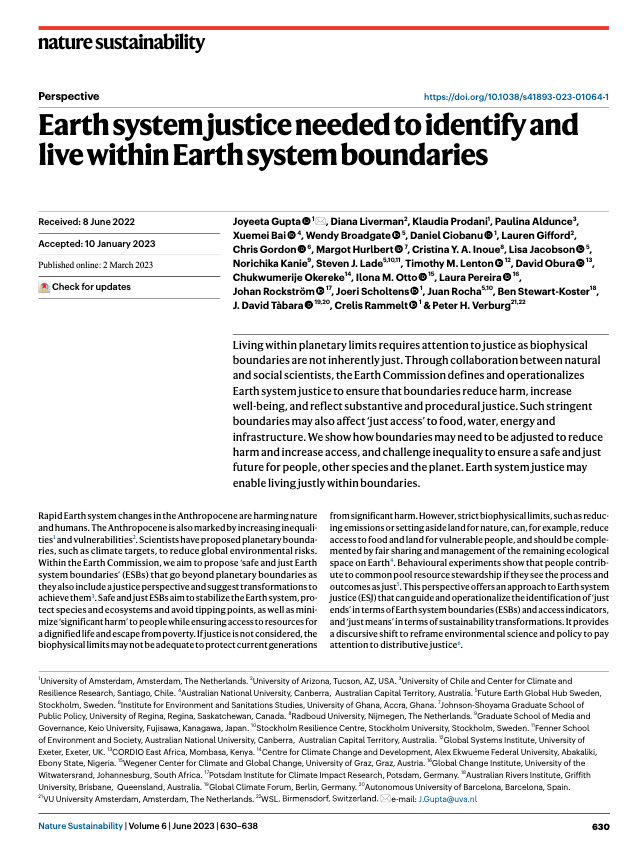
Earth system justice needed to identify and live within Earth system boundaries
This article considers how to integrate principles of justice within Earth’s system boundaries, specifically for climate, the biosphere, water and nutrient cycles, and aerosols. Using the Earth system justice approach, it discusses living within planetary limits whilst minimising significant harm to all people and ensuring equitable access to resources.

Towards a systemic understanding of sustainable well-being for all in cities: A conceptual framework
The purpose of this framework is to guide the design and evaluation of public policies, as well as provide tools for conducting thorough assessments and monitoring progress across various socio-ecological dimensions of sustainable well-being in different urban settings on a universal scale.
Climate impacts at work: Supporting a climate ready workforce
Demonstrates empirical evidence of varied climate change impacts and their effects on workers and organisations across a range of industries, working mostly in Victoria. Workers are being affected in many compounding ways. With climate change impacts continuing to worsen, workers and industry must be supported to adapt to climate change.


