
Library | SASB Sustainability Sector
Corporate & Retail Banking
Refine
440 results
REFINE
SHOW: 16


A risk professional’s guide to physical risk assessments: A GARP benchmarking study of 13 vendors
GARP benchmarks 13 vendors’ asset-level climate physical risk models, finding wide dispersion in hazard and damage estimates due to differing data, assumptions and methods. The report stresses due diligence, transparency and improved asset data when selecting vendors.
Banking on business as usual: The energy finance imbalance
The report assesses energy financing by 65 major banks (2021–2024), finding fossil fuel finance more than double sustainable power supply. The energy supply financing ratio stagnates around 0.42:1, far below net-zero benchmarks, with regional disparities and weak translation of climate commitments into financing shifts.
Climate data in the investment process: Challenges, resources, and considerations
The report examines how climate-related data are used in investment decision-making, highlighting limitations in availability, consistency, and comparability. It reviews greenhouse gas metrics, evolving global disclosure standards, and regulatory milestones, and outlines practical strategies for investors managing imperfect climate data.
Distinguishing among climate change-related risks
The report distinguishes planetary, economic and financial climate risks, clarifying their differing scopes, timeframes and responsible actors. It argues that conflating these risks weakens policy and investment responses, and calls for clearer delineation to improve risk assessment, accountability and targeted climate action.

Still or sparkling?: Approaches to changing portfolio compositions in long-term stress-tests and scenario analyses
The report reviews approaches to modelling portfolio changes in long-term climate stress tests, comparing static portfolios with macro, ex ante, and ex post adjustments. It outlines trade-offs, shows results are sensitive to assumptions, and argues approach choice should match supervisory objectives.
The insurability imperative: Using insurance to navigate the climate transition
This report argues that insurability is a strategic indicator of financial viability in a climate-disrupted economy. It explains how insurance, risk modelling, resilience investment, and policy alignment shape access to capital, asset values, and transition finance, urging leaders to embed insurability into decision-making.
Moving away from mass destruction:109 exclusions of nuclear weapon producers
The report reviews 109 financial institutions with policies excluding nuclear weapon producers, assessing policy scope and implementation. It finds 55 institutions apply comprehensive exclusions, while others retain gaps or exposures, reflecting growing financial-sector alignment with the Treaty on the Prohibition of Nuclear Weapons.

Green finance was supposed to contribute solutions to climate change. So far, it’s fallen well short
The article argues that while climate disclosure and green finance initiatives have expanded since Mark Carney’s “tragedy of the horizon” speech, they have failed to shift capital at the scale required to address climate and nature risks. It contends that deeper structural reforms to financial valuation, incentives and capital allocation are needed to move beyond managing symptoms toward financing real-world solutions.

Climate X
Climate X is a climate risk analytics company providing asset-level physical climate risk data and scenario analysis. It supports financial institutions, insurers and corporates with decision-making, stress testing and regulatory alignment using proprietary climate models and geospatial intelligence.
Sustainable Finance Roundup December 2025: Nature, Regulation, and the Hardening of Risk
This month’s sustainable finance roundup traces the shift from ambition to enforcement, as climate and nature risks become financial, regulatory and legal realities. It covers Australia’s environmental law reforms, the embedding of climate and nature risk through prudential supervision, disclosure and shareholder pressure, and insurer warnings on the limits of insurability. It also highlights how markets are responding to deforestation and biodiversity risk, and how litigation and regulation are reshaping governance and long-term financial resilience.
Combined climate stress testing of supply-chain networks and the financial system with nation-wide firm-level emission estimates
This study utilises comprehensive Hungarian firm-level data to stress-test the economy and banking system against carbon pricing shocks. While direct impacts at €45/t appear minimal, supply chain contagion significantly amplifies losses, potentially by 4000% if essential inputs cannot be substituted. This highlights critical risks in systemic supply network dependencies.
The transition finance playbook: A practical guide for financial institutions
A practical guide outlining how financial institutions can scale transition finance through governance, eligibility criteria, portfolio segmentation, due-diligence enhancements and engagement. It highlights Canadian market context, barriers, and actionable “top tips” to support credible decarbonisation, stewardship and collaboration across the financial system.
Responsible banking blueprint: A roadmap for action on climate, nature and biodiversity, healthy and inclusive economies and human rights
This report outlines a blueprint for responsible banking, detailing how banks can embed climate, nature, human rights, and inclusive economy considerations into strategy, governance, client engagement, capital allocation and disclosure. It provides guidance on setting and implementing targets to align portfolios and practices with global sustainability frameworks.
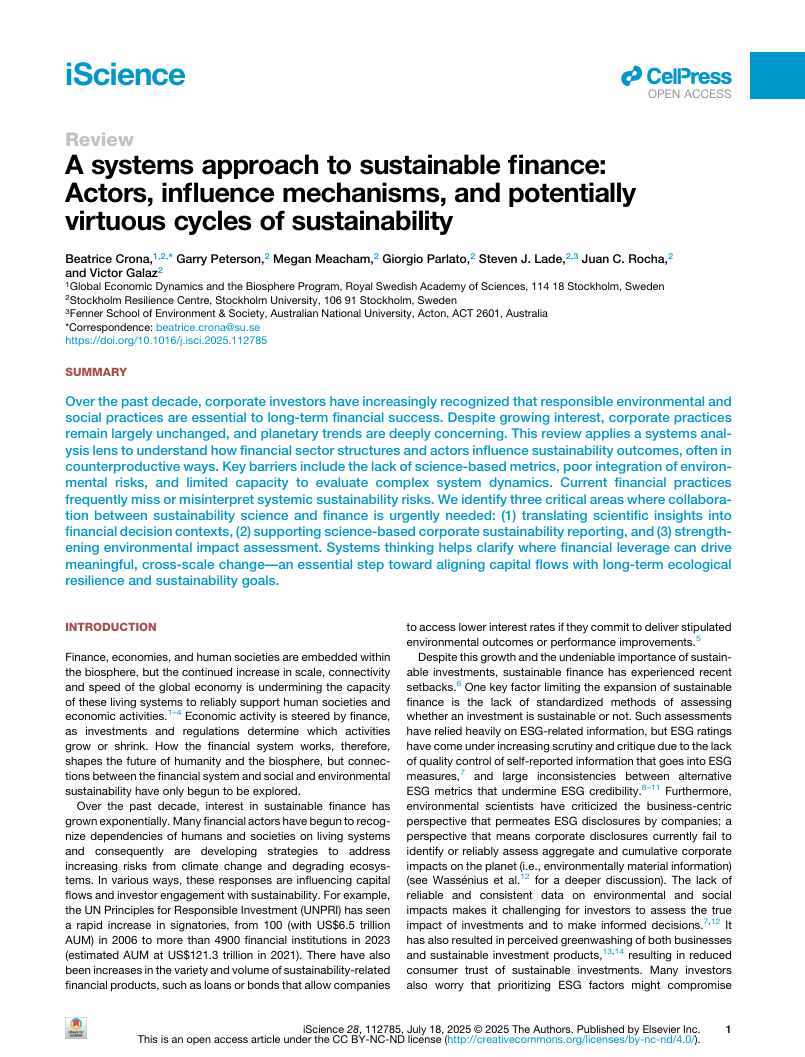
A systems approach to sustainable finance: Actors, influence mechanisms, and potentially virtuous cycles of sustainability
This review examines how financial sector structures and actors influence sustainability outcomes through a systems lens. It identifies barriers such as inadequate metrics, poor risk integration, and limited understanding of complex dynamics, while highlighting collaboration opportunities between finance and science to align capital flows with long-term ecological resilience.
Assessing the materiality of nature-related financial risks for the UK
The report, Assessing the Materiality of Nature-Related Financial Risks for the UK (April 2024), quantifies how biodiversity loss and environmental degradation could materially affect the UK economy and finance sector. It finds nature-related risks—especially from water scarcity, soil decline, and biodiversity loss—could reduce GDP by up to 12% by the 2030s, exceeding impacts from the Global Financial Crisis or COVID-19.
Sustainable Finance Roundup October 2025: Carbon Markets, Targets, and the Cost of Resilience
This month’s sustainability roundup traces a rapidly evolving landscape in climate finance and accountability, spotlighting the weaknesses exposed by Hurricane Melissa’s disaster-risk finance system alongside new policy frameworks now reshaping sustainable investment. It highlights how vulnerable nations continue to bear the costs of climate impacts, how regulatory reforms such as Australia’s 2035 emissions target and global disclosure regimes are embedding accountability, and how renewed scrutiny of carbon markets is driving the search for credible, incentive-based pathways to real decarbonisation.


