
Library | SASB Sustainability Sector
Financials
Refine
668 results
REFINE
SHOW: 16


The 13th national risk assessment: Climate, The 6th “C” of Credit
The report analyses US climate-driven mortgage risk, showing floods as the dominant driver of post-disaster foreclosures. Rising insurance costs, coverage gaps and falling property values create hidden credit losses. It argues climate risk should be treated as a sixth core credit assessment factor.
Global investor commission on mining 2030
The report outlines an investor-led 10-year vision for a responsible, resilient mining sector. It sets goals to align capital, governance and stewardship with social and environmental standards, supporting mineral supply for the low-carbon transition while managing risk and long-term value.
Notice on the application of the sustainable finance framework and the Corporate Sustainability Due Diligence Directive to the defence sector
The European Commission clarifies that the EU sustainable finance framework and Corporate Sustainability Due Diligence Directive apply neutrally to the defence sector. Defence investments are permitted, assessed case by case, with disclosure and due diligence obligations focused on risk mitigation and exclusion limited to internationally prohibited weapons.
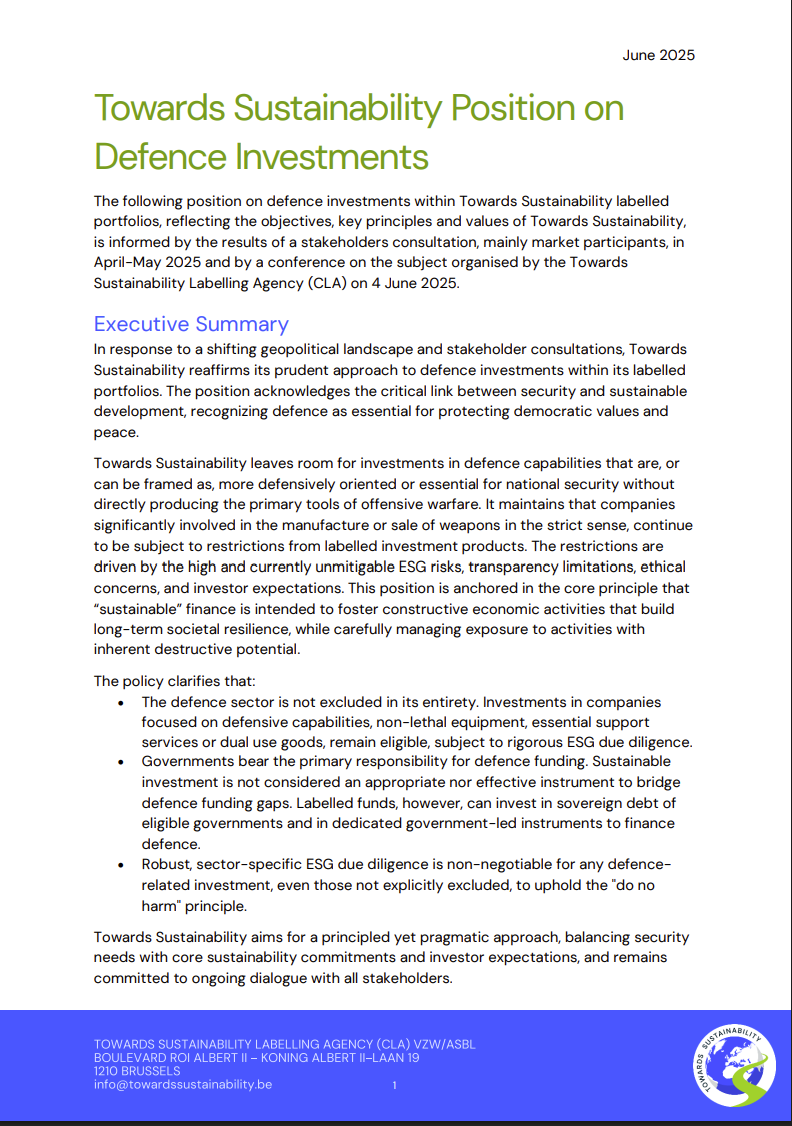
Towards sustainability position on defence investments
The report sets a pragmatic policy on defence investments for Towards Sustainability-labelled funds, permitting defensive, non-lethal and dual-use activities with strict ESG due diligence, while excluding weapons producers. It affirms defence funding as primarily a government responsibility.
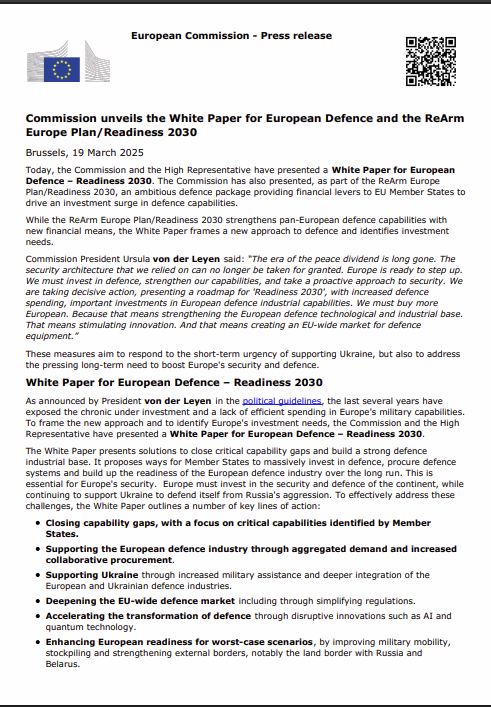
Commission unveils the white paper for european defence and the rearm europe plan readiness 2030
The report outlines the EU’s White Paper on European Defence and the ReArm Europe Plan, targeting defence readiness by 2030 through closing capability gaps, strengthening the defence industrial base, and mobilising over €800 billion via public, EU, and private funding mechanisms.
BPI France: European Defence Bond Framework
Bpifrance’s European Defence Bond Framework defines principles for issuing use-of-proceeds bonds financing eligible defence-sector projects, mainly SMEs, to support European sovereignty. It details eligibility criteria, exclusions, ESG safeguards, governance, reporting, and proceeds management, while stating the bonds are not ICMA-aligned sustainable instruments.
Agreement on international responsible investment in the insurance sector: ESG investment framework for the theme: Controversial weapons and the trade in weapons with high risk countries
The 2021 Agreement on International Humane Trapping Standards establishes technical requirements and testing procedures for restraining and killing traps used to capture specific wild mammal species. It aims to ensure humane trapping practices through standardised certification, testing methodologies, and threshold injury scores, whilst providing for periodic review and multilateral cooperation amongst signatory nations.
Finance for war: Finance for peace: How values based banks foster peace in a world of increasing conflict
The report analyses global financial links to arms production, showing significant funding for weapons despite rising conflict. It contrasts this with values-based banks, particularly GABV members, which largely exclude arms financing, arguing divestment supports peace, reduces risk, and aligns finance with social and environmental objectives.

Integrating nature & biodiversity into investment: An asset owner perspective
The report examines how asset owners integrate nature and biodiversity into investment. Based on interviews with 20 global asset owners and managers, it finds growing recognition of financial materiality, limited governance and data maturity, early TNFD adoption, and reliance on climate-aligned ESG processes.
From risk to resilience: Integrating adaptation into finance
The report outlines practical frameworks for integrating climate adaptation into financial decision-making, linking physical risk assessment to credit, investment, sovereign risk and financial products. It promotes the ABC framework, data transparency and adaptation-inclusive transition plans to improve resilience, pricing and capital allocation.
A risk professional’s guide to physical risk assessments: A GARP benchmarking study of 13 vendors
GARP benchmarks 13 vendors’ asset-level climate physical risk models, finding wide dispersion in hazard and damage estimates due to differing data, assumptions and methods. The report stresses due diligence, transparency and improved asset data when selecting vendors.
Banking on business as usual: The energy finance imbalance
The report assesses energy financing by 65 major banks (2021–2024), finding fossil fuel finance more than double sustainable power supply. The energy supply financing ratio stagnates around 0.42:1, far below net-zero benchmarks, with regional disparities and weak translation of climate commitments into financing shifts.
Climate data in the investment process: Challenges, resources, and considerations
The report examines how climate-related data are used in investment decision-making, highlighting limitations in availability, consistency, and comparability. It reviews greenhouse gas metrics, evolving global disclosure standards, and regulatory milestones, and outlines practical strategies for investors managing imperfect climate data.
Distinguishing among climate change-related risks
The report distinguishes planetary, economic and financial climate risks, clarifying their differing scopes, timeframes and responsible actors. It argues that conflating these risks weakens policy and investment responses, and calls for clearer delineation to improve risk assessment, accountability and targeted climate action.

Still or sparkling?: Approaches to changing portfolio compositions in long-term stress-tests and scenario analyses
The report reviews approaches to modelling portfolio changes in long-term climate stress tests, comparing static portfolios with macro, ex ante, and ex post adjustments. It outlines trade-offs, shows results are sensitive to assumptions, and argues approach choice should match supervisory objectives.
Nature-related risks and the duties of directors of Canadian corporations
This legal opinion examines whether nature-related risks are foreseeable and material for Canadian companies. It concludes directors must consider, manage and, where material, disclose such risks to meet fiduciary and care duties under Canadian corporate and securities law.


