
Library | Finance relevance
Investment managers / asset managers
Refine
1421 results
REFINE
SHOW: 16



AXA Research Lab on Gender Equality
AXA Research Lab on Gender Equality (Gender Lab) at Bocconi University in Milan advances empirical research and education on gender economics, diversity and policy impact. The lab publishes reports, hosts events and fosters academic-industry collaboration to promote gender equality across labour markets, fertility dynamics, culture and political representation.

Phenix Capital Group
Phenix Capital Group is an Amsterdam-based impact investing intelligence and advisory firm. It helps institutional investors and fund managers access curated impact fund data, conduct impact due diligence, and develop financial-first impact strategies tied to the United Nations’ Sustainable Development Goals (SDGs).
Show me the (sustainable) money II: Investors that allocate capital to sustainability transitions
This report summarises asset managers allocating capital to sustainability and transition-focused investments. Published by the World Business Council for Sustainable Development and SRI-Connect, it profiles firms investing in environmental, social and economic transition strategies to help companies attract sustainability-oriented investors.

Sustainable Finance Roundup September 2025: Policy, Markets, and Momentum
This month’s sustainability roundup covers Australia’s new 2035 emissions target, ASIC’s final climate disclosure guidance, and Fortescue’s revised transition plan. It also examines global developments, from ISSB reporting updates and TNFD nature disclosures to Woodside’s gas extension, rising physical climate risks, and evolving ESG policy debates shaping corporate and investor responses.

Lazard
Lazard offers global financial advisory and asset management services, specialising in mergers and acquisitions, restructuring, capital markets and investment strategy. Founded in 1848, it serves institutional clients, corporations, governments and high-net-worth individuals across 40+ cities worldwide.
Final report of the expert panel on sustainable finance: Mobilizing finance for sustainable growth
This report summarises recommendations from Canada’s Expert Panel on Sustainable Finance to mobilise private capital for low-carbon, resilient growth: improve market clarity and standards (incl. TCFD), build national climate data (C3IA), and develop financing solutions such as green and transition instruments, infrastructure investment, and building retrofits, supported by enabling policy.
Global fossil fuel divestment commitments database
Global Fossil Fuel Divestment Database: a comprehensive, publicly accessible tracker of institutional fossil-fuel divestment commitments worldwide, maintained by Stand.earth. Lists institutions, commitment types (full, partial, coal/tar sands), and total assets committed, supporting benchmarking and verification of announcements.
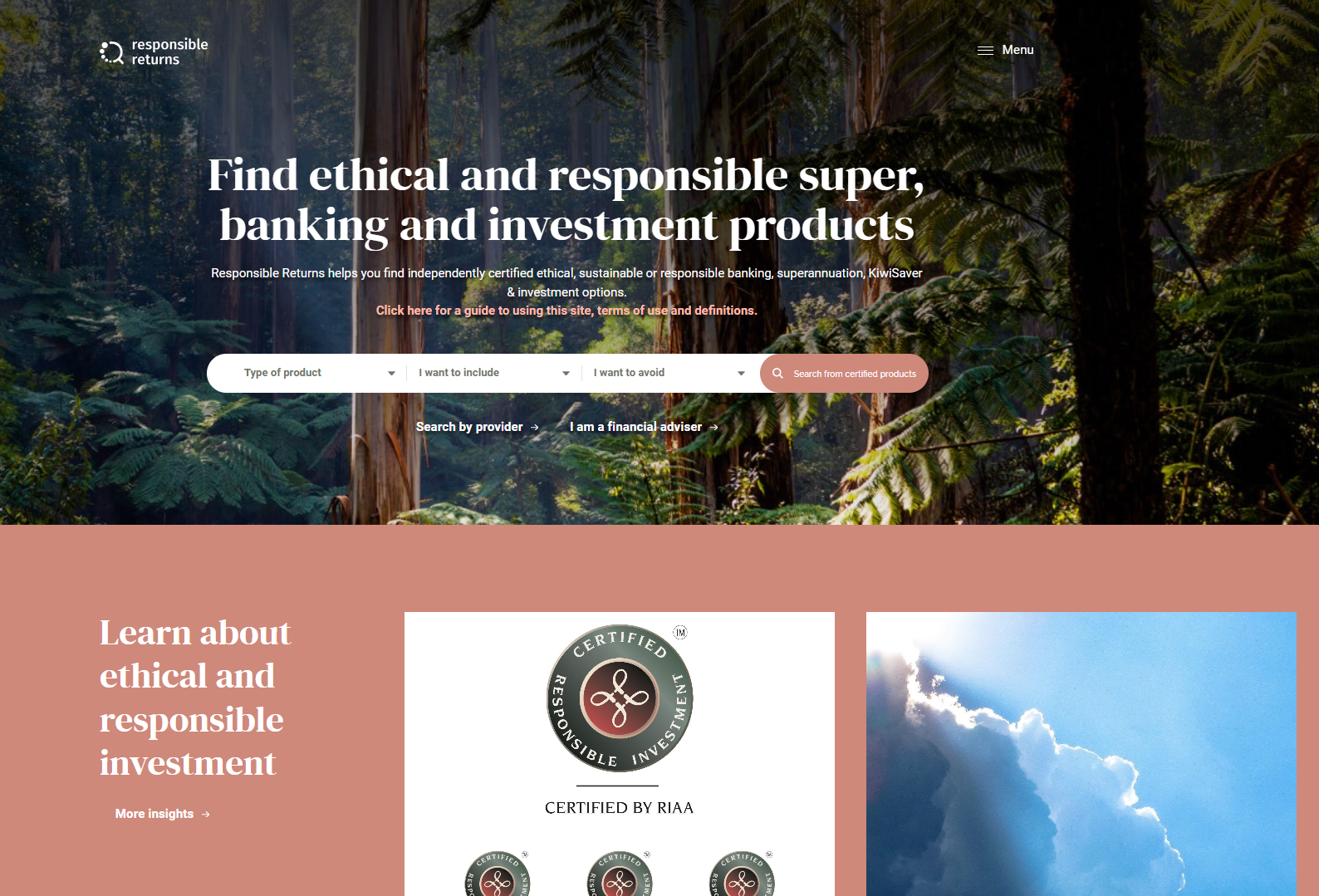
Responsible Returns
ResponsibleReturns is a directory that enables users to find independently certified ethical, sustainable or responsible banking, superannuation and investment products.

The Real Tragedy of the Horizon
Mark Carney’s “tragedy of the horizon” warned that markets would act too late on climate risks. A decade later, this article argues that framing climate change as a financial risk has misdirected efforts—what’s needed now is coordinated action to create investable markets, especially in emerging economies.
The future of emissions
This report proposes using firm-level emission futures contracts to better measure and incentivise real environmental impact from ESG investing. It finds that current backward-looking ESG ratings fail to predict emission reductions and may misallocate capital to higher-polluting firms. Market-based, forward-looking emission futures could improve measurement, incentives, and investment impact.
Impact-linked finance: Learning from eight years and ideas for the future
This report by Roots of Impact (2024) reviews eight years of experience implementing Impact-Linked Finance (ILF), a structuring approach that rewards measurable social or environmental outcomes by linking financial terms to impact performance. It outlines ILF’s evolution, design principles, effectiveness benchmarks, and opportunities to scale through collaboration and new impact-linked instruments.

European Finance Association
European Finance Association (EFA) is an international non-profit professional body for finance academics and practitioners. EFA brings together over 2,500 members globally. It organises annual conferences, doctoral events, and publishes the peer-reviewed Review of Finance journal.

Oxford university press
Oxford University Press (OUP) is a global academic and educational publisher. It operates as a department of the University of Oxford, producing textbooks, scholarly works, English language resources and reference works. OUP emphasises digital innovation, sustainability commitments, and broad international reach in research and education.
How the concept of “Regenerative Good Growth” could help increase public and policy engagement and speed transitions to Net Zero and nature recovery
The report introduces the concept of Regenerative Good Growth (RGG) as an alternative to extractive GDP-focused models. It argues that economic progress should regenerate five renewable capitals, natural, social, human, cultural, and sustainable physical, while ensuring fairness, engagement, and reduced environmental harm. RGG promotes inclusive, low-carbon, and nature-positive transitions through diverse public participation.

MDPI
MDPI (Multidisciplinary Digital Publishing Institute) is a Swiss-based publisher of open access, peer-reviewed journals, established in 1996. MDPI publishes over 470 academic journals across science, technology and medicine, with authors covering article processing charges to enable unrestricted global access.
ESG and financial performance: Uncovering the relationship by aggregating evidence from 1,000 plus studies published between 2015 – 2020
This report summarises over 1,000 studies (2015–2020) and finds that most show a positive relationship between ESG and financial performance. ESG integration and long-term strategies tend to enhance returns and risk management, while disclosure alone has limited financial impact.


