
Library | Sustainable Finance Practices
ESG Integration and analysis
Tools, methodologies, and frameworks for embedding ESG factors into financial analysis, valuation, credit assessment, underwriting, and portfolio management, while separating out broader strategic elements.
Refine
537 results
REFINE
SHOW: 16


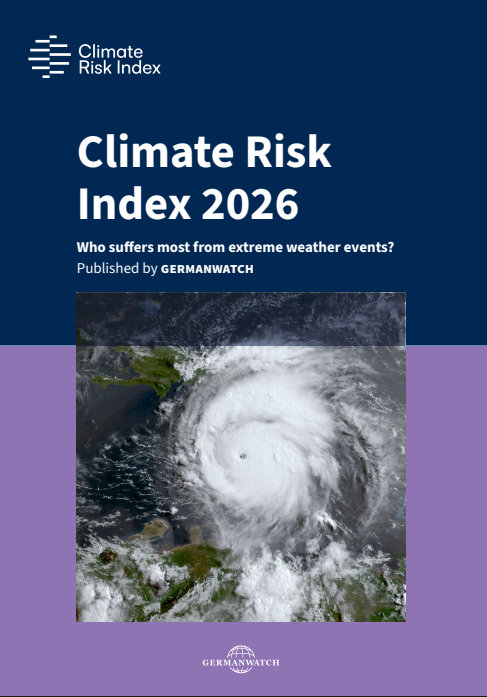
Climate risk index series
The Climate Risk Index is an annual benchmark series that compares countries’ exposure and vulnerability to extreme weather events using a consistent, historical, data-driven framework. Across all editions, it supports comparative assessment of physical climate risk over time and informs policy, risk analysis, and climate-aware financial decision-making.
Scaling finance for nature: Barrier breakdown
This report analyses barriers to scaling private finance for nature, highlighting a US$700 billion annual biodiversity finance gap. It clarifies nature-positive finance, assesses risk–return challenges, regulatory gaps and data issues, and outlines instruments to redirect capital from harmful activities towards halting and reversing nature loss.
Assessing the credibility of a company’s transition plan: framework and guidance
This report presents a harmonised framework to assess the credibility of corporate climate transition plans. It defines core plan elements, assessment principles, and a four-step process to evaluate ambition, feasibility, consistency, governance, and financial alignment with Paris-aligned decarbonisation pathways.

Doing business within planetary boundaries
This report argues that corporate reporting must incorporate absolute, location-specific environmental impacts aligned with planetary boundaries. It proposes science-based disclosures and the Earth System Impact score to improve assessment of cumulative nature-related risks, support credible investment decisions, and enhance comparability beyond carbon-focused metrics.
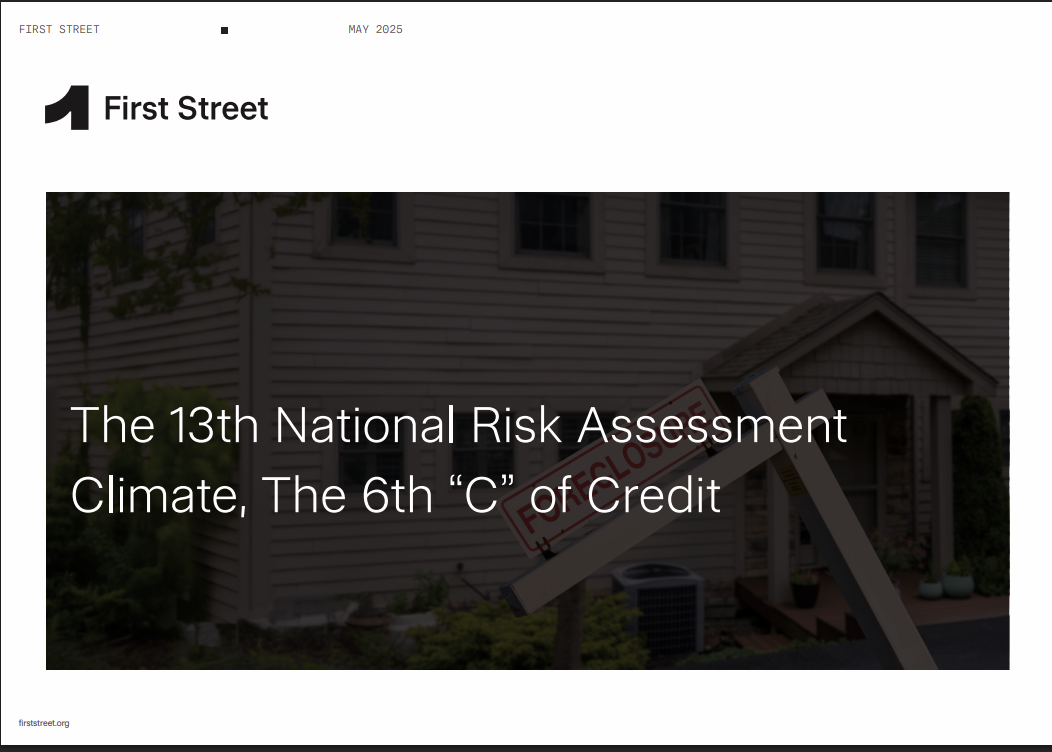
The 13th national risk assessment: Climate, The 6th “C” of Credit
The report analyses US climate-driven mortgage risk, showing floods as the dominant driver of post-disaster foreclosures. Rising insurance costs, coverage gaps and falling property values create hidden credit losses. It argues climate risk should be treated as a sixth core credit assessment factor.

IQAir
IQAir is a commercial air quality technology company providing real-time air pollution data, analytics and monitoring solutions. It operates a global air quality platform, publishes World Air Quality Reports, and supplies air monitoring hardware. IQAir data supports public health, environmental research, urban planning and policy decision-making worldwide across multiple regions.

Integrated Carbon Observation System (ICOS)
Integrated Carbon Observation System (ICOS) is a European research infrastructure providing long-term, high-precision observations of greenhouse gases. ICOS delivers open, standardised climate and carbon cycle data through its Carbon Portal, supporting climate science, modelling, and evidence-based policy across Europe and neighbouring regions.
The impact of sustainable investing: A multidisciplinary review
This multidisciplinary review examines how sustainable investing affects environmental and social outcomes. It identifies three investor impact strategies—portfolio screening, shareholder engagement, and field building—and 15 mechanisms producing direct and indirect effects. The study argues impact emerges gradually through coordinated actions by diverse shareholders.
BPI France: European Defence Bond Framework
Bpifrance’s European Defence Bond Framework defines principles for issuing use-of-proceeds bonds financing eligible defence-sector projects, mainly SMEs, to support European sovereignty. It details eligibility criteria, exclusions, ESG safeguards, governance, reporting, and proceeds management, while stating the bonds are not ICMA-aligned sustainable instruments.

Council on ethics for the norwegian government pension fund global
The report outlines the Council on Ethics’ 2018 work advising Norges Bank on exclusions and observation under ethical guidelines. It covers assessments of human rights, environment, climate, corruption and weapons sales, resulting in multiple company exclusions, observations and revocations, alongside ongoing sectoral investigations.
Responsible investing in defence, security and resilience
The NATO Innovation Fund advocates removing financial exclusions on defence to bolster European security. The report recommends reforming procurement for rapid dual-use technology adoption and implementing a ‘Responsible Use Framework’ to ensure ethical development of emerging capabilities like AI and autonomous systems.
Integrating nature & biodiversity into investment: An asset owner perspective
The report examines how asset owners integrate nature and biodiversity into investment. Based on interviews with 20 global asset owners and managers, it finds growing recognition of financial materiality, limited governance and data maturity, early TNFD adoption, and reliance on climate-aligned ESG processes.

A roadmap for upgrading market access to decision-useful nature-related data
The TNFD roadmap outlines actions to improve market access to decision-useful nature-related data. It proposes data principles, pilot testing and a potential Nature Data Public Facility to address data quality, comparability, cost and accessibility for corporate reporting, target setting and transition planning.
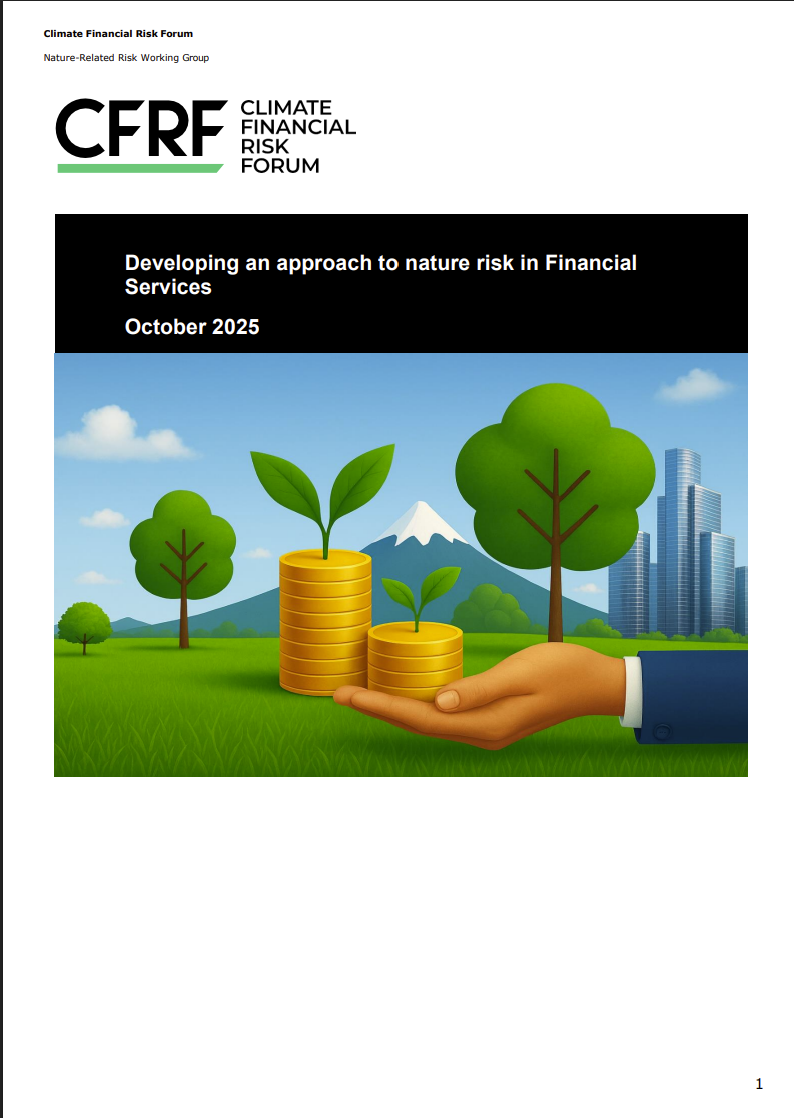
Developing an approach to nature risk in financial services
The report outlines how financial institutions can assess and manage nature-related risks by integrating climate–nature interactions, systemic risk concepts and TNFD-aligned approaches. It highlights data gaps, tipping points, and scenario analysis to support prudent risk management and strategic decision-making.
From risk to resilience: Integrating adaptation into finance
The report outlines practical frameworks for integrating climate adaptation into financial decision-making, linking physical risk assessment to credit, investment, sovereign risk and financial products. It promotes the ABC framework, data transparency and adaptation-inclusive transition plans to improve resilience, pricing and capital allocation.
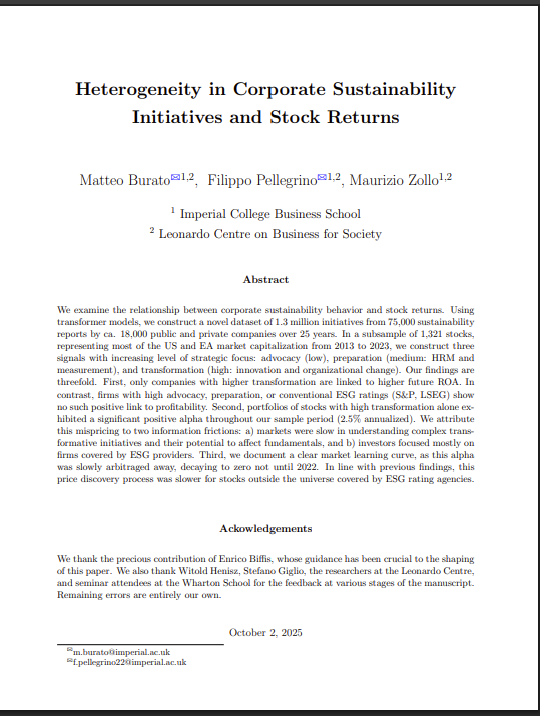
Heterogeneity in corporate sustainability initiatives and stock returns
The study shows only transformative sustainability initiatives predict higher future profitability and generate positive abnormal stock returns. Advocacy, preparation and standard ESG ratings do not. Markets initially mispriced transformative actions, but learning gradually eliminated the alpha by 2022.


