
Library | Sustainable Finance Practices
Laws and regulations
Government policies, legislation, and regulatory frameworks that shape sustainable finance practice, including mandatory disclosure rules, climate law, financial regulation, and ESG-related requirements.
Refine
190 results
REFINE
SHOW: 16


Activating place-based circular economy in Australia: Circular precincts
The report by Circular Australia and Aurecon outlines how place-based circular precincts can drive Australia’s transition to a circular economy by 2030. It presents frameworks, principles, and policy recommendations for governments, industry, and investors to create sustainable, resource-efficient, and collaborative precincts that support economic, environmental, and social outcomes.
The circular advantage: Unlocking innovation, environmental resilience, productivity and net zero opportunities through a uniquely Australian circular economy transition
The report the Circular Advantage outlines how Australia can harness a circular economy to drive innovation, productivity, and progress towards net zero. It recommends a National Circular Economy Policy Framework, harmonised regulations, sustainable finance integration, and collaboration with First Nations peoples, industries, and communities to build resilience and long-term economic opportunities.
Circular Economy Ministerial Advisory Group (CEMAG)
Circular Economy Ministerial Advisory Group (CEMAG) advises the Australian Government on accelerating the transition to a circular economy. Established in February 2023, it delivered a final report in December 2024 with 14 core and 12 sector-specific recommendations covering built environment, food, agriculture, resources and water.
Assessing the materiality of nature-related financial risks for the UK
The report, Assessing the Materiality of Nature-Related Financial Risks for the UK (April 2024), quantifies how biodiversity loss and environmental degradation could materially affect the UK economy and finance sector. It finds nature-related risks—especially from water scarcity, soil decline, and biodiversity loss—could reduce GDP by up to 12% by the 2030s, exceeding impacts from the Global Financial Crisis or COVID-19.
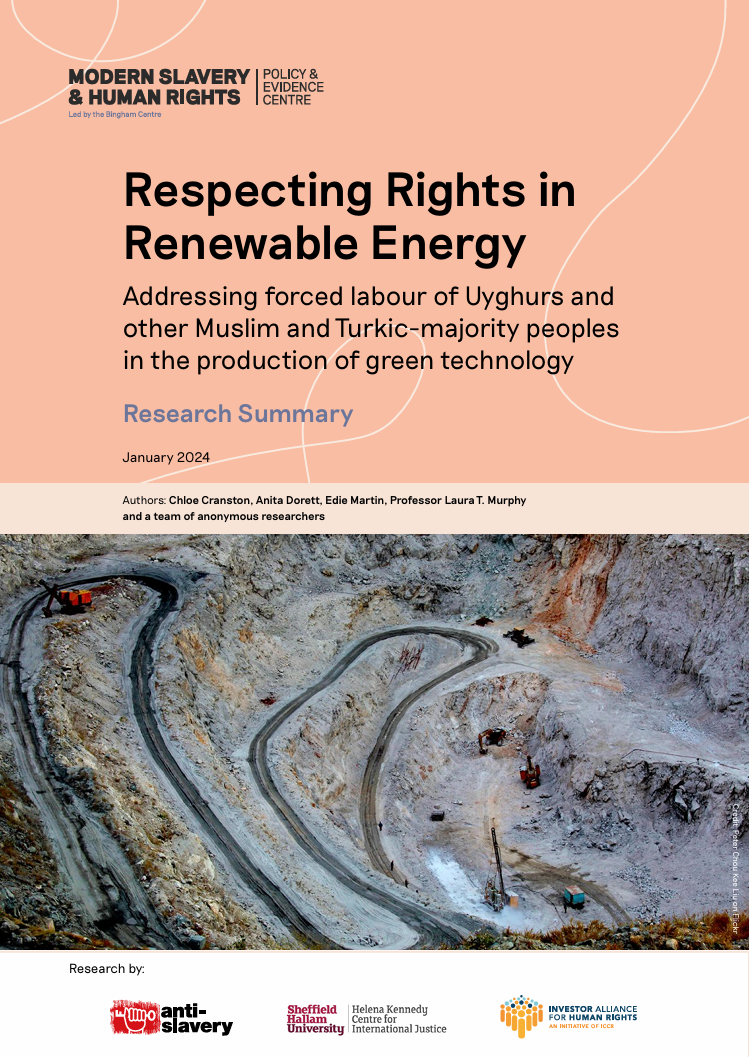
Respecting rights in renewable energy: Addressing forced labour of Uyghurs and other Muslim and Turkic-majority peoples in the production of green technology
This report examines the use of forced labour involving Uyghur and other Turkic Muslim peoples in green technology supply chains, particularly solar and electric vehicle sectors. It outlines investor and policy gaps, highlighting opaque supply chains, limited regulatory action, and recommends divestment, due diligence, and global collaboration to address human rights risks.
Sustainable Finance Roundup October 2025: Carbon Markets, Targets, and the Cost of Resilience
This month’s sustainability roundup traces a rapidly evolving landscape in climate finance and accountability, spotlighting the weaknesses exposed by Hurricane Melissa’s disaster-risk finance system alongside new policy frameworks now reshaping sustainable investment. It highlights how vulnerable nations continue to bear the costs of climate impacts, how regulatory reforms such as Australia’s 2035 emissions target and global disclosure regimes are embedding accountability, and how renewed scrutiny of carbon markets is driving the search for credible, incentive-based pathways to real decarbonisation.
System of environmental-economic accounting ecosystem accounting series
The System of Environmental-Economic Accounting (SEEA) is an international benchmark series that integrates economic and environmental data to measure the interdependence between nature and the economy. It provides a consistent statistical framework for assessing natural assets, ecosystem services, and environmental impacts to support sustainable policy and decision-making across nations.

International Organization for Migration (IOM)
International Organization for Migration (IOM) is a United Nations-related intergovernmental organisation founded in 1951, dedicated to promoting humane and orderly migration worldwide. With over 170 member states and offices in 171 countries, it provides policy advice, operational assistance and humanitarian support to migrants and governments.
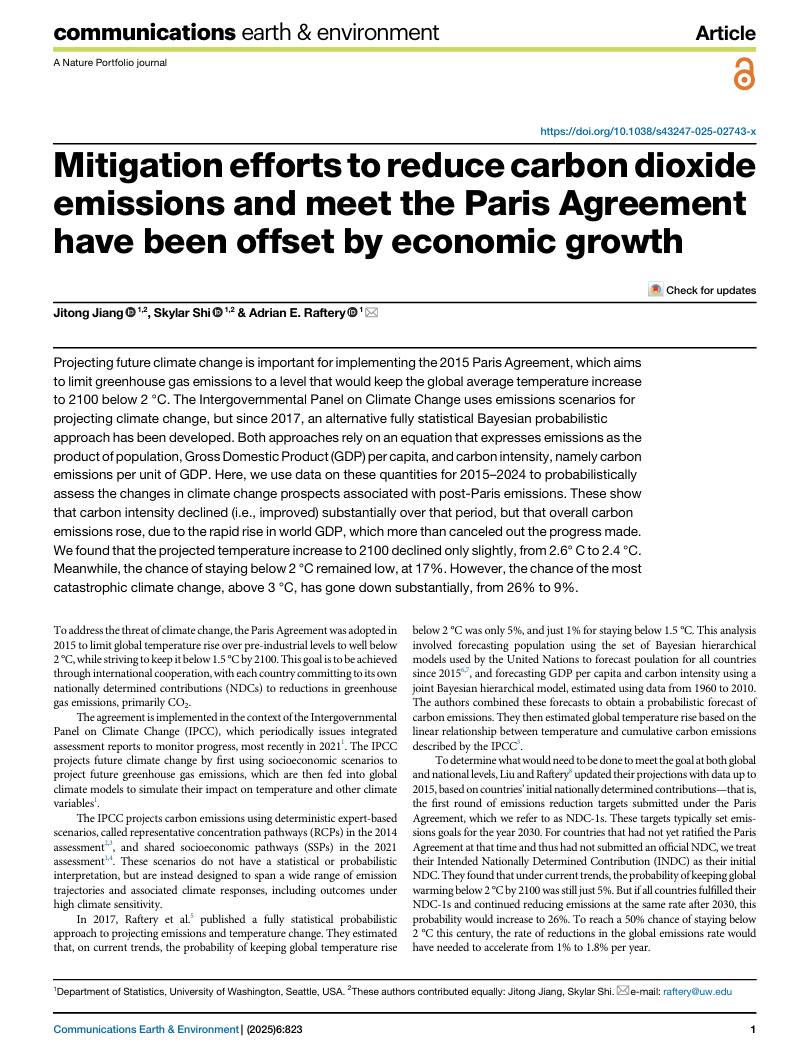
Mitigation efforts to reduce carbon dioxide emissions and meet the Paris Agreement have been offset by economic growth
The report analyses post-2015 trends in carbon dioxide emissions using Bayesian probabilistic models. Despite a 25% drop in global carbon intensity since the Paris Agreement, economic growth offset these gains, increasing total emissions by 5.6%. Projections indicate a 2.4 °C temperature rise by 2100 and only a 17% chance of staying below 2 °C.
Sustainable Finance Roundup September 2025: Policy, Markets, and Momentum
This month’s sustainability roundup covers Australia’s new 2035 emissions target, ASIC’s final climate disclosure guidance, and Fortescue’s revised transition plan. It also examines global developments, from ISSB reporting updates and TNFD nature disclosures to Woodside’s gas extension, rising physical climate risks, and evolving ESG policy debates shaping corporate and investor responses.
Climate-related and other emerging risks disclosures: Assessing financial statement materiality using AASB Practice Statement 2
This report summarises guidance from the AASB and AUASB on applying AASB Practice Statement 2 to climate-related and other emerging risks. It explains how such risks may be material to financial statements, outlines related accounting and auditing considerations, and emphasises the need for transparent disclosure and investor-relevant information.
Australian Accounting Standards Board (AASB)
Australian Accounting Standards Board (AASB) is a government agency that develops, issues and maintains accounting and external reporting standards across Australia. It aligns Australian standards with International Financial Reporting Standards (IFRS) and contributes to global standard-setting.

Auditing and Assurance Standards Board (AUASB)
Auditing and Assurance Standards Board (AUASB) is an independent statutory agency of the Australian Government, responsible for developing, issuing and maintaining high-quality auditing, assurance and sustainability assurance standards. Its standards are legally enforceable under Corporations Act 2001 for audits and reviews of financial reports in Australia.
Final report of the expert panel on sustainable finance: Mobilizing finance for sustainable growth
This report summarises recommendations from Canada’s Expert Panel on Sustainable Finance to mobilise private capital for low-carbon, resilient growth: improve market clarity and standards (incl. TCFD), build national climate data (C3IA), and develop financing solutions such as green and transition instruments, infrastructure investment, and building retrofits, supported by enabling policy.
2019 Hutley opinion: Climate change and directors’ duties
This report summarises legal opinions by Noel Hutley SC and Sebastian Hartford Davis for the Centre for Policy Development, concluding that Australian company directors must assess, disclose and manage foreseeable climate risks. It highlights growing regulatory and investor expectations, making climate oversight a key element of directors’ duties and liability exposure.

Principles for an effective wellbeing budget
This report summarises principles for developing a wellbeing-focused federal budget in Australia. It recommends integrating wellbeing goals into policy and budgeting, strengthening data and accountability, investing in long-term and preventative analysis, enhancing public service capability, and ensuring ongoing community engagement to guide decision-making and measure progress.


