Nature Enters the Boardroom: Why Directors Are Paying Attention
Drawing on Australia’s first national study of board-level engagement with nature, this article shows how directors are treating nature as a material governance and financial issue. It highlights how boards are extending climate governance systems to manage nature-related risks, adopt frameworks like TNFD, and build resilience and long-term value despite policy uncertainty.

AUTHORS


Key Takeaways:
-
Nature is becoming a core governance issue, with directors recognising its material impact on resilience, value and long-term competitiveness.
-
Nature-related risks are already on board agendas, even if not labelled as such. Water, land use, deforestation and supply-chain stability all signal deeper ecological dependencies.
-
Boards are extending climate governance systems to include nature, using existing risk, strategy and disclosure structures and turning to frameworks like TNFD.
-
Early movers are gaining strategic advantage, embedding nature into procurement, capital planning and operations, and building internal capability faster than their peers.
-
Despite policy uncertainty, boards that map and manage their nature dependencies now will be more resilient and better positioned for emerging regulation and market expectations.
What do a telecommunications giant, a mining company and a government financier have in common? According to Australia’s first national study of board-level engagement with nature, they are all quietly integrating nature into risk, strategy and disclosure.
As climate pressures intensify and ecosystem degradation accelerates, a new study by the Australian Institute of Company Directors and Sydney University, Nature Enters the Boardroom, reveals a clear shift: directors increasingly view nature as a material governance concern and a financial issue shaping resilience, value creation and long-term organisational competitiveness.
The key message is that nature has become inseparable from modern governance, and boards that build capability now will be better positioned to manage risk, meet stakeholder expectations, and unlock emerging opportunities across the sustainable finance landscape.
A growing recognition of risk
More than four in five directors surveyed for the report agree that nature-related risks matter to their organisations. Many boards still don’t use the term “nature” itself, but they are talking about its component parts: water security, land disturbance, pollution, invasive species, deforestation and supply chain stability. These may sound like operational issues, yet each one reflects a deeper dependency on natural systems. Without clean water or stable soils, without functioning ecosystems or reliable climate patterns, the foundations of economic activity start to weaken.
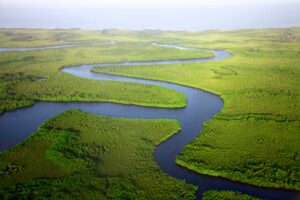
Photo by Dan Roizer on Unsplash
This dependency is particularly visible in sectors such as primary industries, agriculture, infrastructure and manufacturing. But even organisations that seem distant from nature are more exposed than they may realise. The report notes that data centres rely on water and land access, telecommunications infrastructure intersects with fragile ecosystems, and financial institutions depend on the resilience of their real-economy clients. Nature runs through every industry; some dependencies are simply more visible than others.
From climate governance to nature governance
One of the most striking findings of the study is how boards are extending their existing climate governance systems to cover nature-related issues. While directors are beginning to understand emissions, physical climate impacts and net-zero strategies, the study finds that some boards have begun applying those same tools—scenario analysis, oversight committees, risk registers and disclosure practices—to the nature agenda.
Among listed companies surveyed in the report, almost a quarter have already integrated nature into their climate strategy, and more than half plan to do the same in the coming years. Directors are recognising that climate and nature are two sides of the same coin. Heat stress, water scarcity and land degradation all undermine resilience and reveal how closely climate pressures and ecological decline are intertwined. Treating them separately risks fragmented governance; approaching them together allows for more coherent decision-making.
Disclosure frameworks are also nudging boards in this direction. Although nature reporting is still voluntary in Australia, global momentum is increasing. The Taskforce on Nature-related Financial Disclosures (TNFD) is rapidly becoming a reference point for organisations wanting to understand and communicate their exposure to nature-related risk. Its LEAP framework offers a clear method for identifying where a business depends on nature and where it may be impacting ecosystems in ways that create financial or operational risk. The study shows that adoption is already underway, with 13 per cent of surveyed organisations aligning with TNFD and 7 per cent reporting against the EU’s CSRD.
Early movers are showing what this looks like in practice
Several organisations featured in the report demonstrate how nature governance is already shaping operational and strategic choices. AirTrunk, which operates data centres, used spatial datasets and the TNFD approach to map its proximity to waterways and protected areas, helping the company adjust its site planning and strengthen environmental safeguards. Telstra has begun integrating nature into procurement systems, working with suppliers and ecological experts to protect sensitive areas while also exploring how digital technologies can support large-scale restoration. Fortescue has embedded oversight of biodiversity and water into a dedicated board committee, supported by global partnerships and updated environmental management systems.
These examples illustrate how nature ambition, when anchored at board level, cascades through the organisation and informs practice on the ground. It is becoming embedded in capital planning, risk management, procurement, disclosure and day-to-day operations. This is no longer just about conservation; it is about resilience, cost avoidance and competitive advantage.

Photo by Dylan Gillis on Unsplash
About one in five directors in the study stand out as especially active on nature issues, and their boards behave differently from the rest. These directors push for more action: they are 22 times more likely to ask for a nature strategy and 21 times more likely to bring people with relevant nature expertise into senior roles. They also invest more in building capability, often seeking specialist advice or training far more frequently than other boards. In the boardroom, they consider a wider range of nature topics, from threatened and invasive species to nature-based solutions, and they are about five times more likely to feel ready to report on nature. This group demonstrates what is possible when boards treat nature as a governance priority.
What’s standing in the way?
Despite this momentum, the study reveals that many boards still face substantial barriers. The most significant is policy uncertainty. More than half of surveyed directors point to the lack of clear national environmental standards and slow or inconsistent approval processes. Directors worry that without predictable rules, investment decisions become harder and compliance burdens multiply.
Internal constraints compound these challenges. Some of the surveyed boards feel they do not yet have the skills, time or experience to engage deeply with nature-related risks. Others face financial pressures that make new investments difficult. Younger directors are much more likely to identify gaps in board capability, suggesting that expectations around environmental governance are rising with each new generation of board leaders.
Yet the report’s interviews deliver a clear message: waiting for perfect certainty is a mistake. Nature-related risks are already present, and regulators, investors and communities increasingly expect organisations to act, even in the absence of fully settled rules.
A practical path forward
So what can boards do today? The report suggests that the most effective starting point is simply to identify the organisation’s biggest nature dependencies. For some, it will be water. For others, it may be land use, supply chains or material sourcing. Directors often already have much of the necessary data and they just haven’t yet connected it to nature. Once those dependencies are visible, boards can begin integrating nature into existing climate and resilience structures, expanding risk frameworks, commissioning expert advice, and building literacy through director training.
A helpful and practical step is to treat nature as a core business consideration rather than a compliance or reputational issue. This means explicitly considering nature related dependencies, impacts, risks and opportunities in strategy, investment decisions and risk management processes. Professionals can act by integrating nature into existing governance and management systems such as enterprise risk registers, capital allocation and board oversight, rather than isolating it within sustainability functions. Clear accountability at executive and board level is essential. As nature related risks intensify, those that understand and manage their relationship with nature will be more resilient and competitive than those that continue to treat nature as an externality.
What it all means
The findings from Nature Enters the Boardroom mark a turning point in Australian governance. Directors are beginning to see that nature is not a backdrop to economic activity; it is the operating system. As ecosystems weaken, the risks to business grow. But as boards build capability, integrate nature with climate oversight, and embrace emerging frameworks like TNFD, they also open the door to new strategic pathways and longer-term value.
Further Reading
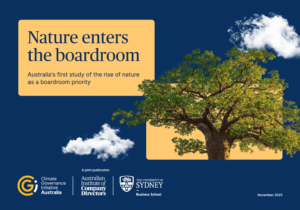
This article is based on a joint report by the Australian Institute of Company Directors and University of Sydney Business School. Explore the full report to learn more about how Australian boards are identifying and managing nature-related risks, integrating nature into governance and strategy, and preparing for emerging regulatory and market expectations.
Relevant library resources

Nature enters the boardroom

Nature strategy handbook: A practical guide for businesses

Insights into UNEP FI’s TNFD pilots: Insights into deep-dive UNEP FI pilots to ensure effective uptake of the final TNFD framework

Nature starter: Practical steps to integrate nature into business strategy (By CEOs, for CEOs)

Managing nature risks and investing in the opportunities: Top tips for pension fund chairs and trustees