

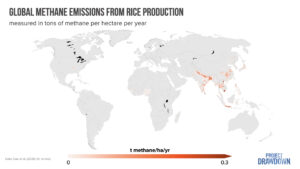
We used this dataset in a recent deep dive into emissions in Southeast Asia, and found that some of the highest-emitting rice fields are in the river deltas of Vietnam. Continuous flooding and triple cropping of fields in these deltas drive 10% of global rice methane emissions, yet Vietnam produces just 5% of the world’s rice. Moreover, we found that 20% of Vietnam’s rice fields were suitable for draining once or more per year – a practice called non-continuous flooding – which could cut rice-related emissions by 60% without reducing crop yields. The Improve Rice solution on the Drawdown Explorer provides estimates of emissions savings from switching to non-continuous flooding and improving fertilizer management on rice fields.
Insights | | We can’t ignore the largest source of methane

We can’t ignore the largest source of methane
13 February 2026
This article argues the global food system is the largest source of human-caused methane and deserves far more policy and funding attention. It maps key emission “hot spots”—ruminant livestock, food waste in landfills, biomass burning, and flooded rice fields—and outlines practical mitigation options from dietary shifts to landfill capture and improved rice management.

AUTHORS
Disclaimer: This article is republished with permission from the authors. The article was originally published on Project Drawdown’s website and can be found here. Any views expressed in this article are those of the original authors and do not necessarily reflect the views of Altiorem.
Our global food system is the largest source of human-caused methane – we ignore it at our peril
Methane was in the spotlight at COP30, the major climate conference held in early November in Belém, Brazil. Since the creation of the Global Methane Pledge in 2021, many countries have set targets to reduce methane emissions by 30% from 2020 levels. At a methane summit convened at the conference, the United Kingdom and 10 other countries endorsed a commitment to achieve near-zero methane emissions across the fossil fuel sector.
It’s fitting that methane is finally getting more attention. About one third of Earth’s warming to date has been from methane – a climate super pollutant 80 times more potent than carbon dioxide in the short term – and tackling its emissions is one of the most important and effective actions we can take to stabilize our climate. Humans are responsible for about 380 million tons of the gas each year. Although leaks from oil and gas infrastructure are a notorious source, emissions from agriculture and the broader food system are much larger. Yet they receive significantly less attention from the media, policymakers, and funders.
The food system contributes methane along the entire supply chain, from farm to landfill, including from cattle, manure, rice farming, biomass burning, and food waste. When combining all of these links in the chain together, it is responsible for over 210 million tons of methane, more than half of global human-caused emissions, making food systems the largest source of the superpollutant.
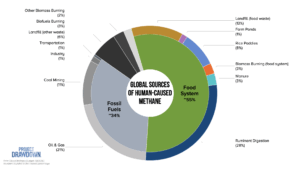
With support from the Global Methane Hub, Project Drawdown has used peer-reviewed research and the Drawdown Explorer to map hot spots of methane emissions across the global food system. Here are the four biggest sources of food-related methane, where they occur, and what solutions could help us curb emissions and limit planetary warming.
Burping Cows
There are a lot of cattle raised for beef and dairy on Earth – about 1.5 billion of them each year. And when they burp, they emit methane. Ruminant livestock (including cattle, sheep, and goats) with multi-chambered stomachs can digest grasses and other biomass that humans can’t. But this digestion process – and the belching that comes with it – emits about 28% of human-caused methane emissions.
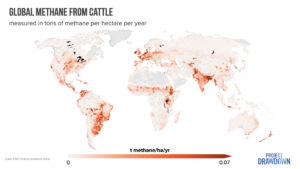
Methane emissions from cattle around the world, expressed in tons of methane per hectare. About 1.5 billion cattle are raised and slaughtered for meat and dairy every year, according to the Food and Agriculture Organization of the UN. On average, cattle annually emit about 91 kilograms of methane.
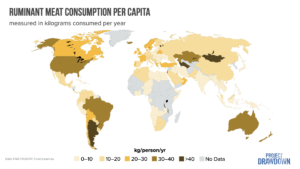
Eating less beef is the best way to reduce emissions from cattle. For the Improve Diets solution on the Drawdown Explorer, we evaluated the emissions savings from reducing beef (and other ruminant meat, such as lamb) consumption in high- and middle-income countries to a 100-gram (3.5-ounce) serving per week, which is estimated to be a healthy and sustainable level by an international team of scientists. We found that reducing beef consumption to this level could reduce global greenhouse gas emissions by 2.8 billion tons of carbon dioxide equivalents per year, which is more than half of the annual emissions of the U.S.
In addition to eating less beef, there are promising developments in feed additives that can reduce methane emissions from ruminants. Many feed additive compounds are still being researched to determine their efficacy and safety; however, at least one product, 3-NOP (3-nitrooxypropanol), has been shown to be effective and is approved for use in many countries. Still, due to the cost and the need to be administered daily, the use of feed additives is currently limited to more industrial production systems in high- and middle-income countries.
Rotting Food
Rotting food doesn’t just smell bad; when put in an oxygen-poor environment like a landfill, it readily generates methane. Using previously published data, we mapped methane emissions from food loss and waste and identified hot spots of emissions from landfills.
Globally, municipal solid waste is responsible for about 70 million tons of methane, and food waste contributes about 60% of these emissions. Depending on how landfills are managed, emissions can differ immensely. We found that the top 10 highest-emitting landfills account for 4% of all landfill emissions; the top 100 of the 9,625 landfills analyzed account for 15%.
Methane is finally having its moment; we need the solutions that best address it to have their moment, too.
Detecting leaks, implementing biocovers, and capturing methane are all solutions for reducing landfill emissions, which are calculated and illustrated on the Drawdown Explorer.
Burning Biomass
Burning biomass releases harmful pollutants and greenhouse gases into the air, including about 17 million tons of methane each year. One kind of biomass that is regularly burned is crop residues, the plant materials such as stalks, leaves, and seed husks that are left over after a crop is harvested. Many farmers burn crop residues in the field to remove weeds or to clear fields before the next planting.
On many farms, straw baling equipment can be used to harvest residues for off-farm use. When residues are baled or otherwise collected from the field, and where markets are developed, they can be used or sold for compost production, livestock feed and bedding, bioenergy applications, and feedstock for manufacturing paper and other products.
Flooded Rice Fields
Rice is a nutritious staple crop, but growing it produces 30 million tons of methane annually. Most rice is grown in flooded fields called paddies, where oxygen-poor conditions trigger methane production. Emissions from rice are disproportionately high in regions with multiple harvests per year and in regions that practice continuous flooding without draining their fields.
An international science team, including researchers at Project Drawdown, developed a new geospatial dataset of methane emissions from croplands. Their findings reinforce that rice fields generate the most greenhouse gases of any crop. Much of the emissions are concentrated in India and Southeast Asia, and to a lesser extent, along the Mississippi River Delta.
By mapping the potential effectiveness, adoption, costs, and impact of different climate solutions on the Drawdown Explorer, we have identified “hot spots” for climate action – regions where putting solutions into practice can maximize climate benefits.
This research enables us to guide philanthropies, businesses, and nonprofits toward the most effective climate solutions, so they can target action where and when it will lead to the greatest reduction in emissions.
The world has already lost far too much time in the race against climate change. Emergency brake climate solutions that reduce methane emissions, such as those enumerated here, can have a disproportionately fast impact after implementation, helping us get back on track. Methane is finally having its moment; we need the solutions that best address it to have their moment, too.
Emily Cassidy is an environmental scientist and writer, with expertise in agriculture, ecology, and land use. As a research associate at Project Drawdown, Emily evaluates the emissions mitigation potential of climate solutions in the food system.
Paul West, Ph.D., is an ecologist developing science-based solutions for sustaining a healthy planet for people and nature. At Project Drawdown, Paul assesses how climate solutions can create win-wins and trade-offs for conserving biodiversity, creating a sustainable food system, and otherwise improving planetary health and human well-being.
Relevant library resources

Opportunities for methane mitigation in agriculture: Technological, economic, and regulatory considerations
This report assesses cost-effective methods to reduce methane emissions from enteric fermentation, manure management, and rice cultivation. It outlines region-specific strategies and underscores the need for research, regulatory frameworks, and cross-sector collaboration to support implementation and scale-up of mitigation solutions.
Unlocking Opportunity: Addressing Livestock Methane to Build Resilient Food Systems
This Ceres report outlines the financial and climate case for reducing livestock methane. It maps methane exposure across food supply chains and sets out strategies for companies and investors to manage risk, strengthen resilience, and capture value through near-term methane mitigation.

Curbing methane emissions: how five industries can counter a major climate threat
This McKinsey Sustainability report discusses the climate impact of methane emissions in five key sectors: agriculture, oil and gas, coal mining, waste management, and wastewater. Existing barriers for abatement of methane emission and potential solutions and trade-offs for stakeholders to consider are presented.
Creating a sustainable food future
The report assesses how to feed nearly 10 billion people by 2050 while limiting land expansion and emissions. It identifies food, land and greenhouse gas gaps, and proposes 22 solutions spanning demand reduction, productivity gains, ecosystem protection, fisheries growth and agricultural emissions mitigation.

Farming our way out of the climate crisis
The report focuses on how modifications in farming techniques, land use practices, and food systems can commune climate change reduction, carbon sequestration and carbon sink development and initiates numerous opportunities to become a part of the solution. By changing farming techniques and food systems, we can create numerous opportunities for climate solutions.
Rethinking food and agriculture 2020-2030: The second domestication of plants and animals, the disruption of the cow, and the collapse of industrial livestock farming
Rethinking food and agriculture focuses on new technologies driving the transformation of the food and agriculture sectors and the implications for the cattle industry in the United States. It argues that 2020-2030 will see the current industrialised, animal-agriculture system be replaced with a Food-as-Software model.


