Best practice transition plans for listed equity asset managers
Most listed equity managers now have a target. Fewer have a plan that shows how it will be met. By January 2024, 264 Net Zero Asset Managers signatories had had their targets reviewed. Method is no longer the hard part.


How this article was made: It was drafted by Alma, Altiorem’s custom AI research assistant, from records held in the Altiorem library, and cites only those records. It was reviewed and approved for publication by Pablo Berrutti. Every figure and quotation is referenced to its source below.
Altiorem evidence review
Most listed equity managers now have a target. Fewer have a plan that shows how it will be met. By January 2024, 264 Net Zero Asset Managers signatories had had their targets reviewed [1, p.13]. Method is no longer the hard part. Coverage, attribution and scenario design are.
The short answer. A target is not a transition plan. The target names the destination; the plan sets out what the firm will do differently, and how anyone will know. Pick a recognised methodology and explain any departure: the Net Zero Asset Managers commitment is methodology-neutral, but requires disclosure of coverage, fair-share interim targets and method within 12 months of signing [1, p.6]. Then separate what the number measures from what it achieves. Portfolio emissions can fall through real-economy reduction, reallocation, changes in data coverage or moves in enterprise value [3, p.6], and carbon intensity can improve while global emissions rise [6, p.27]. Be explicit about exclusions: many managers leave out cash, sovereign bonds and asset classes without accepted methodologies [1, p.11]. Design scenario analysis to test sensitivity, not to forecast [9, p.31]. And expect the plan itself, not just the target, to be assessed against published criteria [14, p.6].
The target is one component of the plan, not a substitute for it
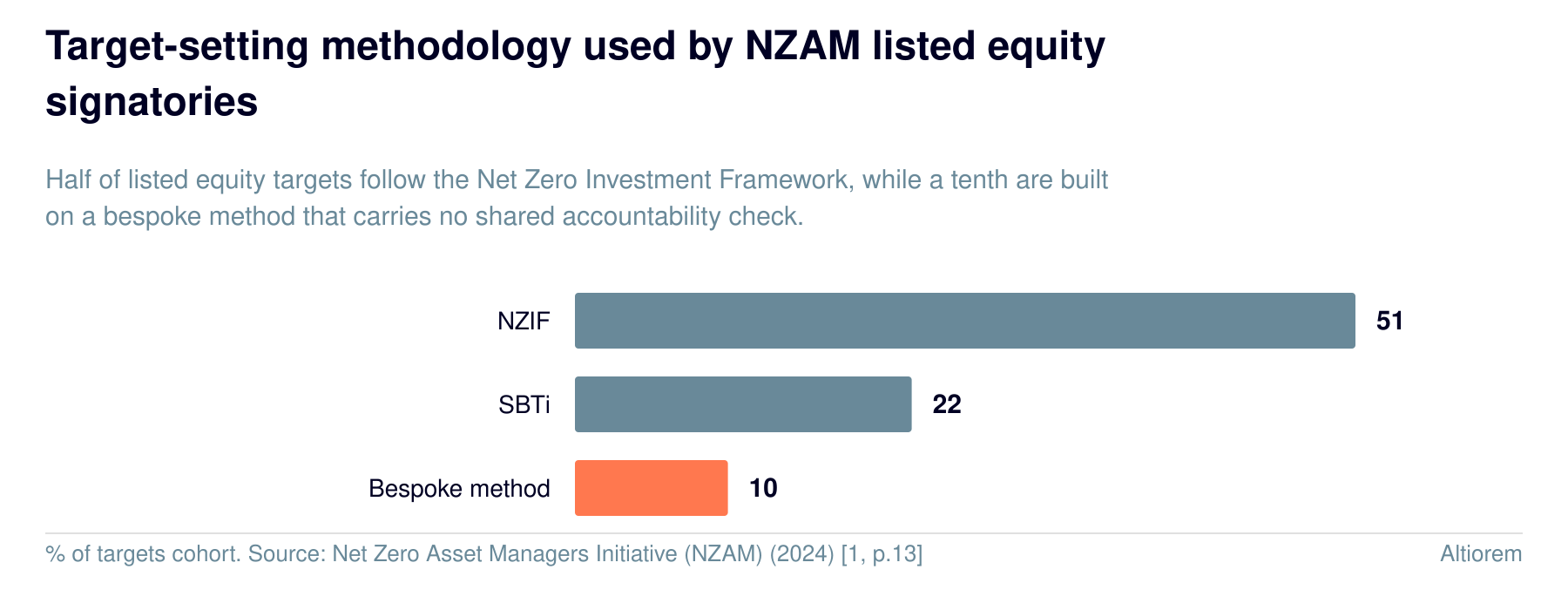
Half of listed equity targets follow the Net Zero Investment Framework, while a tenth are built on a bespoke method that carries no shared accountability check.
A target and a transition plan answer different questions. The target names the destination and the interim waypoints. The plan names the actions, governance and resourcing meant to get there. A firm can hold a defensible target and have no plan worth the name.
Methodology is the easiest part of either. The Net Zero Investment Framework was used for 51 per cent of the targets reviewed and SBTi for Financial Institutions for 22 per cent, with 10 per cent using a bespoke method [1, p.13]. Listed equity carries more targets than any other asset class, with 184 signatories having set them as at January 2024 [1, p.13]. Alternatives are allowed, but they have to be argued. The Net Zero Asset Managers initiative sets the test:
“If asset managers wish to use an alternative methodology, they should explain the rationale in their disclosure and reporting, including how their alternative methodology is in line with best available science on achieving the 1.5°C goal of the Paris Agreement.” [1, p.6]
Choosing a method discharges a disclosure obligation. It says nothing about what the resulting number means.
A falling carbon intensity is not evidence of decarbonisation
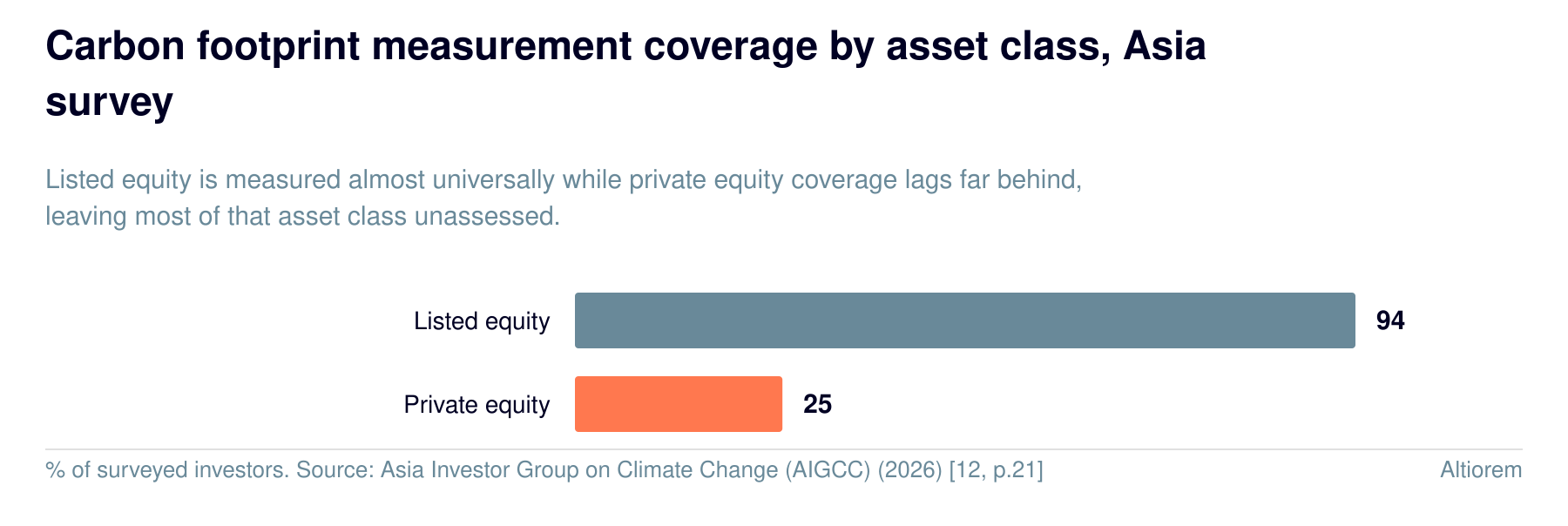
Listed equity is measured almost universally while private equity coverage lags far behind, leaving most of that asset class unassessed.
Four forces move a portfolio’s financed emissions: investee decarbonisation, reallocation, changes in data coverage, and external factors such as shifts in enterprise value or revenue [3, p.6]. Only the first is real-economy progress. Mercer puts the consequence bluntly:
“Today, measures of carbon intensity across portfolios can result in better reported metrics, at the cost of real-world progress.” [6, p.27]
ShareAction warns in the other direction. A wholesale shift out of high-carbon sectors could undermine a transitioning economy, so managers should underweight or divest laggards and reallocate against clear engagement expectations [4, p.20]. Both risks are managed in the plan, not in the target.
Coverage is where the two come apart most visibly. An exclusion limits what the target measures. It does not limit what the plan must address. Rathbone Greenbank excludes about 5 per cent of AUM in inherited “tail stocks” plus cash and sovereign bonds, leaving around 80 per cent coverage of total AUM [1, p.63]. Wellington sets targets only in asset classes with established decarbonisation methodologies, nearly 30 per cent of AUM it considers eligible [1, p.80]. The usual constraint is the absence of methodologies for derivatives, cash and private equity [1, p.11]. Disclose the excluded share, and say what the firm will do about it.
Scenario analysis earns its cost only when it changes a decision
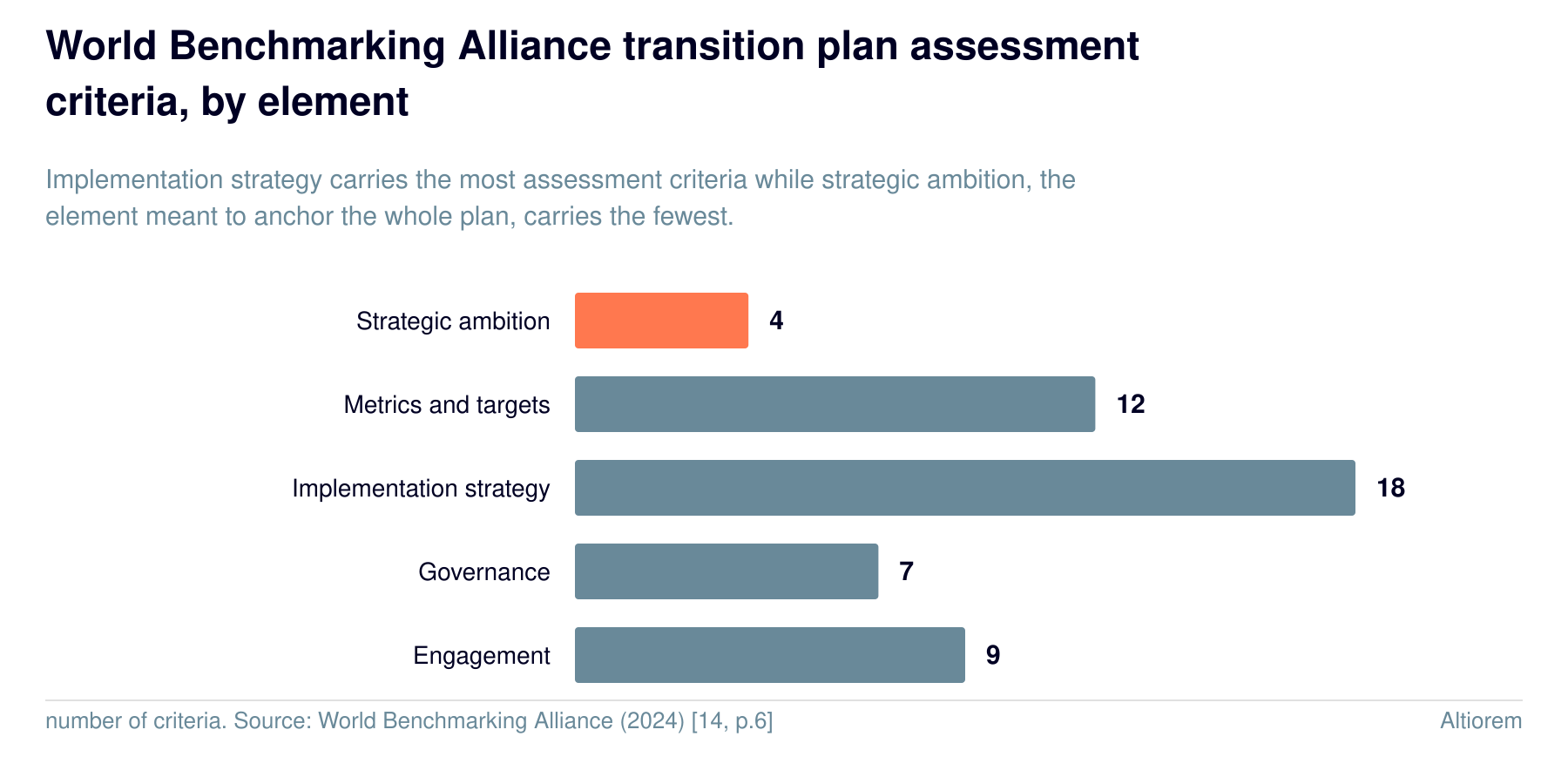
Implementation strategy carries the most assessment criteria while strategic ambition, the element meant to anchor the whole plan, carries the fewest.
In the AIGCC survey, 33 per cent of investors had run scenario analysis across the whole portfolio, and 22 per cent of listed equity investors published the resulting actions [12, p.27]. Running the analysis is a target-era discipline. Publishing what changed because of it is a plan-era one.
Quality varies with design. Aberdeen probability-weighted 16 outcomes, including 7 bespoke scenarios, to escape the uniform policy assumptions of off-the-shelf runs, and found within-sector dispersion decisive: up to 120 per cent equity valuation uplift for some materials firms while the sector is impaired [9, p.11]. Barclays found cement equity impacts spanning minus 100 per cent to plus 25 per cent [9, p.7].
“The goal is not to forecast the future but to test the sensitivity of the portfolio under different pathways and inform decision making.” [9, p.31]
EDHEC adds a methodological caution: analytics tools typically return a single central estimate, which does not do justice to the uncertainty around climate impacts [11, p.3].
Credibility is judged against published criteria, not intent
The plan, not the target, is what assessors now score. The World Benchmarking Alliance framework organises 50 assessment criteria and 43 red flags across five elements: strategic ambition (4), metrics and targets (12), implementation strategy (18), governance (7) and engagement (9) [14, p.6]. Note where the weight sits. The framework also names its own problem, that the growing number of assessment methods risks confusion for users, including the companies assessed [14, p.5]. On the investor side, the NZIF principles make real emissions reductions the primary objective and require that clients and beneficiaries can judge alignment [13, p.8].
The criteria are widening. A nature target-setting framework published in 2024 starts with listed equity and corporate bonds, recommending an initial focus on ten sectors and their key impact drivers [10, p.15]. Just transition indicators are being drawn from existing benchmarks, including Climate Action 100+ metrics on decarbonising in line with just transition principles and on retaining, retraining, redeploying or compensating affected workers [5, p.9]. Reporting is tightening too: emissions reporting should distinguish reductions driven by transition initiatives from those caused by economic downturns or market shifts, and disclose forecast assumptions [8, p.51].
Recommendations
- Choose a recognised target methodology, or document why your alternative meets the science, and disclose coverage, fair-share interim targets and method [1, p.6].
- Attribute reported emissions change across real-world reduction, reallocation, coverage change and external forces [3, p.6].
- Reallocate with engagement expectations attached, rather than exiting high-carbon sectors wholesale [4, p.20].
- Build scenarios that test sensitivity and within-sector dispersion instead of assuming uniform policy [9, p.11].
- Publish the climate engagement strategy, including time-bound issuer expectations and the action taken when they are not met [2, p.8].
- Report annually against short, medium and long-term targets, with independent verification of decarbonisation targets [7, p.19].
What the reader can use today
| Tool | What it does | Who runs it | Supports |
|---|---|---|---|
| Net Zero Asset Managers’ target disclosures series | Peer benchmarking of target methodologies, coverage and baselines | NZAM | Rec 1 |
| Transition Pathway Initiative | Public assessments of company alignment with the low-carbon transition | TPI and LSE | Rec 3 |
| NGFS Scenarios Portal | Harmonised climate and macroeconomic scenarios for risk assessment | NGFS | Rec 4 |
| Climate Action 100+ net zero company benchmark | Assessments of focus companies used to frame engagement asks | IGCC, AIGCC, Climate Action 100+ | Rec 5 |
| Corporate climate responsibility monitor series | Independent assessment of target integrity and disclosure quality | NewClimate Institute, Carbon Market Watch | Rec 6 |
Evidence panel
| Measure | Figure |
|---|---|
| Passages read | 54 |
| Distinct records retrieved | 23 |
| Records cited in this article | 14 |
| Distinct publishers or author groups | 18 |
| Publication years | 2018 to 2026 |
| Largest single source share | 29 per cent (Net Zero Asset Managers’ target disclosures series) |
| Tools and databases found | 14 |
Appendix: where this evidence comes from
| Region of lead publisher | Sources |
|---|---|
| Europe | 8 |
| Asia-Pacific | 2 |
| Publisher works across several regions | 2 |
| Location could not be established | 2 |
| Total | 14 |
References
- Net Zero Asset Managers Initiative (NZAM) (2024) Net Zero Asset Managers’ target disclosures series, pp.6, 11, 13, 63, 80.
- Principles for Responsible Investment (PRI), United Nations Environment Programme, United Nations Environment Programme Finance Initiative (UNEP FI) (2023) Elevating asset manager net-zero engagement strategies: A foundation for asset owner expectations of asset managers, p.8.
- United Nations Environment Programme Finance Initiative (UNEP FI), Principles for Responsible Investment (PRI) (2023) Understanding the drivers of investment portfolio decarbonisation, p.6.
- ShareAction (2023) How asset managers can set interim net zero targets that are fit for purpose: Responsible investment standards and expectations, p.20.
- Institutional Investor Group on Climate Change (IIGCC) (2026) Just transition in action: Complement to NZIF supplementary guidance for just transition, p.9.
- Mercer (2024) Transition today: A progress update – How investors can support climate transition across portfolios, p.27.
- Investor Group on Climate Change (2022) Corporate climate transition plans: A guide to investor expectations, p.19.
- Accounting for Sustainability (A4S) (2025) Aligning transition planning and financial planning: A guide for finance teams, p.51.
- Climate Financial Risk Forum (CFRF) (2025) Quantitative climate scenario analysis in financial decisions: Case studies, pp.7, 11, 31.
- Finance for Biodiversity Foundation (2024) Nature target setting framework for asset managers and asset owners, p.15.
- EDHEC Climate Institute (2024) How does climate risk affect global equity valuations? A novel approach, p.3.
- Asia Investor Group on Climate Change (AIGCC) (2026) AIGCC’s the state of investor climate transition in Asia benchmark series, p.27.
- Institutional Investor Group on Climate Change (IIGCC) (2023) Investor expectations of corporate transition plans: From a to zero, p.8.
- World Benchmarking Alliance (2024) Assessing the credibility of a company’s transition plan: framework and guidance, pp.5, 6.
Relevant library resources
Net Zero Asset Managers' target disclosures series

Transition Pathway Initiative

NGFS Scenarios Portal

Climate action 100+ net zero company benchmark