

The Three Horizons of Decarbonisation
This article presents the Three Horizons of Decarbonisation framework, helping companies distinguish between short-term efficiency measures, operational transformation, and fundamental business model shifts. It explains how clear horizon identification improves capital allocation, stakeholder engagement, and the likelihood that net zero plans translate into meaningful action.

AUTHORS

Disclaimer: This article is republished with permission from the author. The article was originally published on LinkedIn and can be found here. Any views expressed in this article are those of the original author and do not necessarily reflect the views of Altiorem.
Over the last decade, thousands of companies have developed decarbonisation plans. With increasing stakeholder pressure and the introduction of mandatory climate reporting worldwide, tens of thousands more are likely to follow suit in the coming decade.
Despite best intentions, many decarbonisation plans fail to achieve their intended impact or plot the most efficient path to net zero. One reason for this is that there are fundamentally different types of decarbonisation plans, and companies are often unclear on which they are developing. This lack of clarity can lead to a narrow view of decarbonisation and failure to engage critical stakeholders.
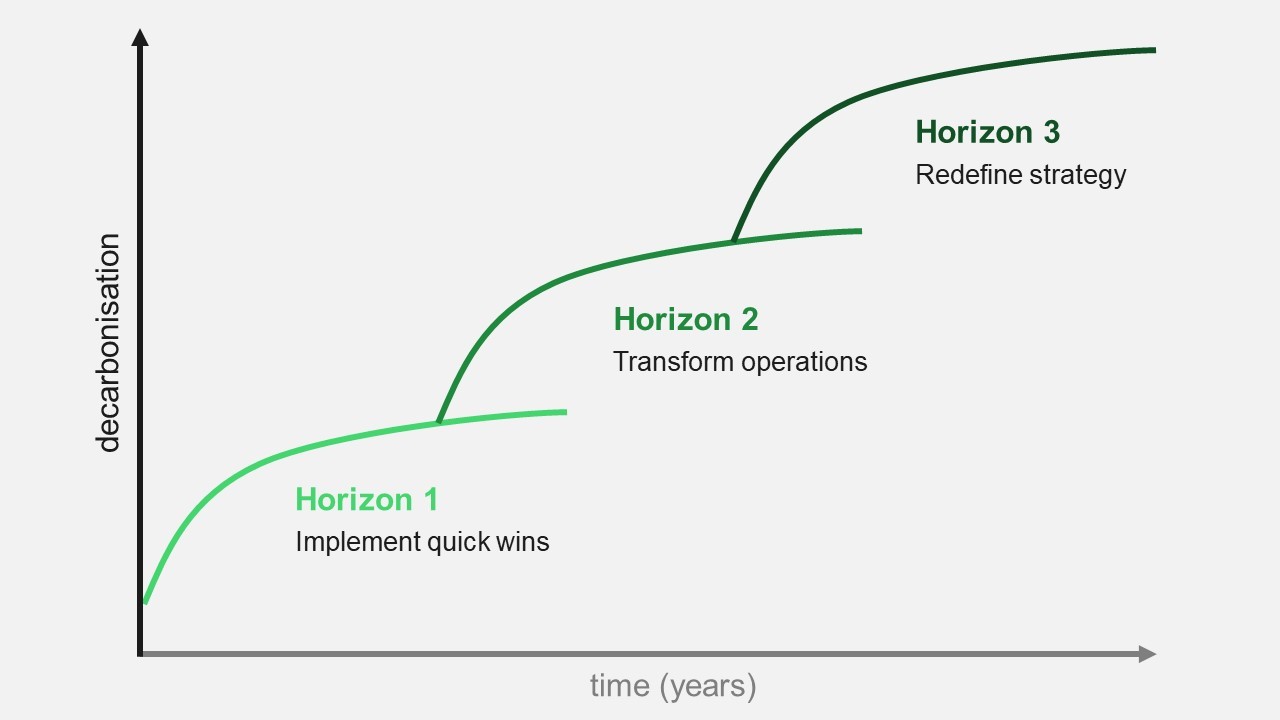
In this article, I introduce the Three Horizons of Decarbonisation framework to help companies understand and strategically plan their path to net zero. Similar to McKinsey’s Three Horizons of Growth, this framework considers actions based on their timeframes and impact, rather than sequential steps:
- Horizon One: Short-term, profitable or low-cost initiatives with minimal operational impact.
- Horizon Two: Medium-term, higher-cost abatement levers requiring operational changes and robust change management.
- Horizon Three: Long-term, fundamental business transformations, such as pivoting to new markets and winding down carbon-intensive business units.
Each of the three horizons requires progressively more extensive consultation within the business. Horizon One initiatives might be planned by the sustainability department with minimal consultation, while Horizon Two initiatives require widespread stakeholder engagement, and Horizon Three should be deeply entwined with corporate strategy.
Horizon One
Most large companies have already started implementing Horizon One initiatives, and many smaller companies are starting to do so as well. These initiatives are typically the first part of a marginal abatement cost (MAC) curve, being either profitable or low-cost with minimal operational implications.
Switching to renewable energy is a prime example; it changes procurement processes and costs slightly but not the nature of electricity itself, thus having minimal business impact (as long as electricity is not a significant proportion of overall costs and the renewable energy premium isn’t too high).
The abatement levers within Horizon One will change over time as technology, market, and policy developments present new opportunities. For instance, while electric vehicles (EVs) are currently in Horizon Two for many companies, advancements in vehicle variety, cost reductions, and infrastructure improvements will eventually make them a more straightforward choice. As such, Horizon One decarbonisation plans need to be revisited periodically.
Horizon Two
Horizon Two involves decarbonisation initiatives that have significant operational implications. Converting to biofuel may require changing refueling locations, upgrading a component in a facility might require a shutdown period, or there might be safety implications in adopting a new approach that need to be carefully considered.
Due to these considerations, decarbonisation planning becomes a change management exercise. Relevant stakeholders need to be identified and engaged, and their concerns surfaced, analysed and addressed.
Horizon Two abatement initiatives typically come at significant cost, beyond what most companies could justify without additional motivators such as short-term targets tied to sustainability-linked loans. The business case for investment needs to be carefully constructed and presented to decision-makers.
Horizon Three
The final horizon of decarbonisation planning involves making fundamental changes to strategy and business models to shift to a low-carbon economy. Not all companies need to undertake Horizon Three transformations — and not many will — but those that succeed can expand into growth markets while fundamentally addressing their emissions footprint.
For example, in 2021, Volvo announced it would phase out sales of internal combustion engine (ICE) cars by 2030, shifting its focus entirely to EVs. This strategy aims to significantly reduce Volvo’s scope 3 emissions from the use of its products while transitioning the company’s focus from a declining market to a growing one.
Decisions to make such fundamental changes to a business do not happen overnight. As such, the actions from early Horizon Three decarbonisation planning exercises typically involve gathering more information for decision-making. For example, a company might conduct trials, partner with startups, or engage in an academic study to gain a better understanding of the technology and markets in question.
The Three Horizons of Decarbonisation framework can help companies take a more strategic approach to decarbonisation. By considering all horizons, companies can allocate capital efficiently, such as avoiding costly Horizon Two initiatives for business units that might pivot as part of a Horizon Three transformation. Clear identification of the horizon also ensures the right stakeholders are engaged, increasing the likelihood that planning turns into action.
Relevant library resources
Assessing the credibility of a company’s transition plan: framework and guidance

Corporate climate transition plans: A guide to investor expectations

The new disclosure landscape - Comparing sustainability standards and regulations: ESRS, IFRS S1/S2, SEC Climate Rule, and CA SB 253/261

The good transition plan: Climate action strategy development guidance for banks and lending institutions: COP26-version
Net zero carbon buildings in cities: Interdependencies between policy and finance


