

Altiorem Weekly - 1 November 2026
Youth-led social movements and their historical role in driving divestment campaigns provide a backdrop for current challenges in intergenerational wealth transfer.
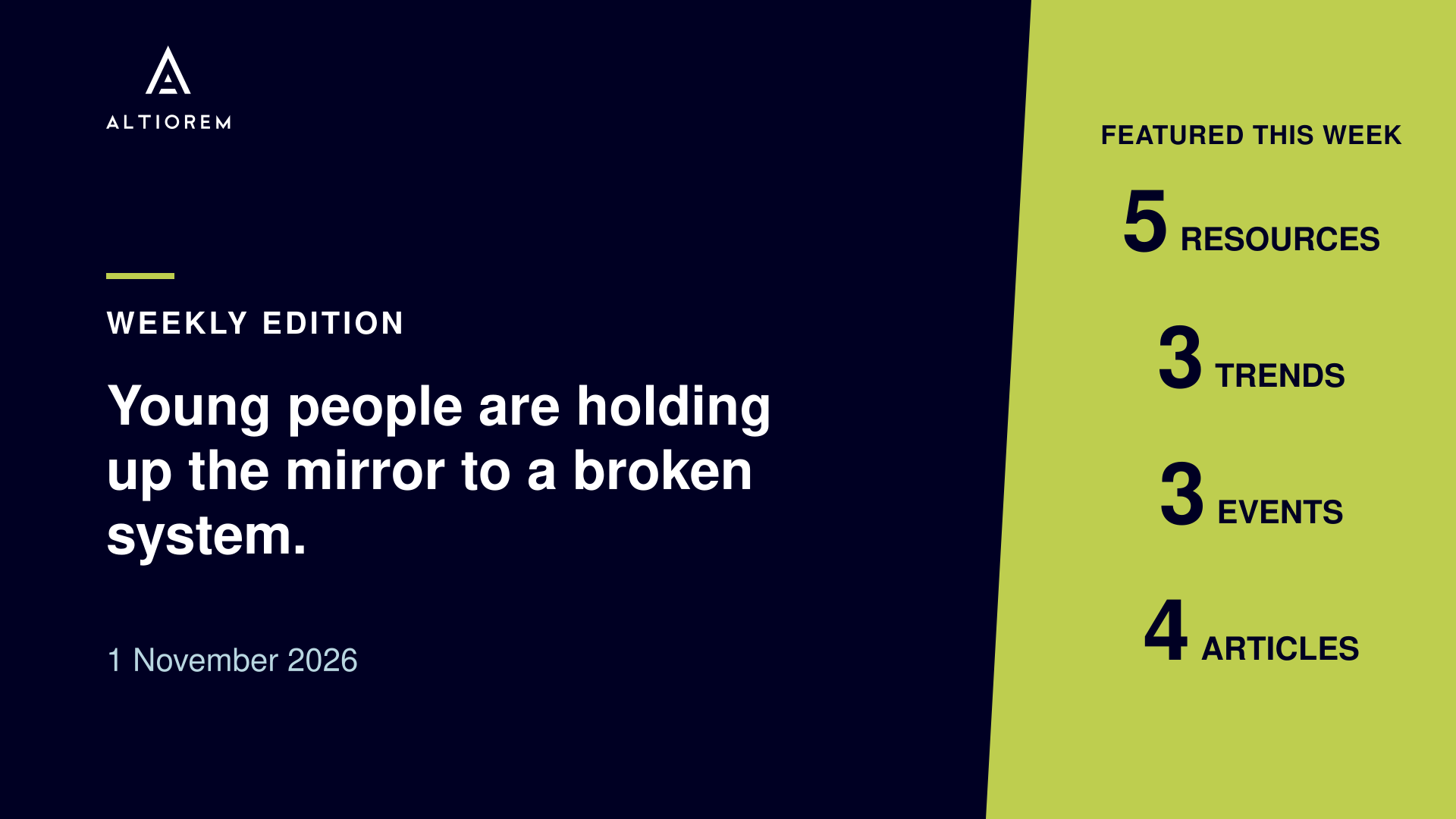
New research in the library this week includes a new framework by Marsh on the insurability crisis and a report which explores how AgFinTech is being utilised across Africa, Asia, and Latin America. Trends and recommended reading include the articulation of Indigenous Peoples of Brazil’s response to mining threats and the Oxford Sustainable Finance Group’s findings on the lack of AI governance among major asset owners.

Dear friends and supporters of Altiorem,
A few weeks ago, I wrote about two imminent threats to the Amazon, being the likely election of Flávio Bolsonaro as president of Brazil and the record El Nino strengthening in the Pacific. In a rare comeback from a first-round deficit, the first of those threats didn't come to pass thanks in part to the extraordinary mobilisation of young activists across the country.
Across Europe we have also seen massive student-led protests, some turning to destruction of property. The protests in France, another example of how climate intersects with other issues, were sparked by teacher shortages, class sizes and the state of the buildings. This followed 1,352 schools and colleges needing to be closed and more than 4,000 adjusting their hours during the June heatwave and cuts to the Fonds vert, the general ecological transition fund local authorities draw on to renovate public buildings.
 |
While not directly connected, these protests coincided with student protests in at least ten other countries with issues including the cost of living, cuts to university funding, university fees and military spending driving students to take a stand.
We shouldn't be surprised that students are rising up at this time. After all, young people have driven social change movements from the Soweto uprising in South Africa in 1976 to the Sunflower protests in Taiwan in 2014, to the Bangladesh protests in 2024 which ended in a change of government.
| A HISTORY OF YOUNG PEOPLE HOLDING UP THE MIRROR |
The challenges for young people today have few parallels. They have been the subject of an uncontrolled social experiment of mass social media adoption while also enduring a global pandemic, the weight of polycrisis, unaffordable housing and education, and now the prospect of AI hollowing out the entry-level jobs that allowed them to gain the experience they need to progress in their careers. And if you think it is bad in wealthy countries….
 |
So once again, it is the youth who are left to hold the mirror to society and force us to reckon with the world we are leaving future generations. While the implications for sustainable finance are varied, from what it means for the economy, intergenerational wealth transfer and demographics where fewer young people carry an ever-greater load, there are more direct examples.
Students led the campaign to divest university endowments from apartheid South Africa (1977 to 1986) and the fossil fuel divestment movement (2011) and have held governments and companies accountable in the courts. Youth-led court cases including the German Constitutional Court ruling that the Climate Protection Law places an unreasonable burden on future generations directly challenge the idea that economists and financiers can “discount” their future.
Recently, I was shown that young people are not only holding the mirror up, but they are also driving the responses needed. I was approached by a remarkable young woman in India, Anandini Agrawal, who with other students established the Ashoka Impact Finance Club, the first student-led initiative in impact finance in India, the International Network of Students in Impact Finance (INSIF) and RISE Capital, Asia's first undergraduate impact investment fund, through which students gain direct exposure to deal scouting and deal evaluation. You can read about her inspiring story on Altiorem.
Separately, I was also approached by Sam Garis who is the incoming co-head of SII Capital, which was set up by the Sydney University Impact Investing Society (SUIIS) in 2025. SUIIS was founded in 2021 and has more than 1,500 student members. These young leaders are developing the impact focused investment approaches which must form the cornerstone of a new economy.
Altiorem’s original curation and publication model connected students to professionals to build a platform for expanding sustainable finance knowledge for the industry, while supporting students' future careers in sustainable finance. Over the years we have had more than 150 volunteers contribute to Altiorem, most of them students and we have been delighted to see many start their careers in roles with a focus on sustainability. It is no understatement to say that Altiorem would not have been possible without them.
While our model had to change following the closure of Stewart Investors and loss of our funding, we have not lost sight of our role and responsibility to the next generation of finance leaders. Altiorem is giving 20 complimentary gold subscriptions to both organisations, and we will also find other ways to support their purposeful work. If you would like to get involved, please reach out as these organisations need various forms of support to spread their inspiring work.
The mirror that young people have time and again put up to our industry shows one glaring fault more than any other. At its heart, stewardship and fiduciary duties have been too narrowly applied, the duty should have always been about what will be left for the generations that follow.
Until next week.
Pablo
| READ ANANDINI’S STORY |
New in the library
Pablo’s handpicked highlights from Altiorem last week:
|
★ Featured
Confronting the insurability crisis: A new framework for natural hazard insurance Fixing financial and economic systemsIndustry standards and guidanceLaws and regulations
|
| Investing in Resilience: Building an insurance-centric framework for resilience investment
Marsh
Industry standards and guidanceIssue/sector focused researchProduct development and trends
|
| Navigating physical climate risk in fixed income
US Sustainable Investment Forum (US SIF)
ESG Integration and analysisIndustry standards and guidance
|
| Can the emergence of AgFinTech revolutionize agrifinance? Lessons from five case studies in Africa, Asia, and Latin America
Consultative Group to Assist the Poor (CGAP)
Issue/sector focused researchProduct development and trends
|
| From chemical risk to competitive advantage: What BPA, PFAS, phthalates, and microplastics teach sustainability leaders about anticipating the next chemical of concern
Issue/sector focused researchLaws and regulationsProduct development and trendsStrategy and Organisational change
|
| Pure dynamite: How Bolsonaro’s government (2019-2022) mineral policy set up a climate and anti-indigenous bomb
Issue/sector focused researchLaws and regulations
|
To see all of the resources added this week visit Altiorem’s website: Altiorem Articles: Insightful Reads & Expert Knowledge
This week in ESG trends
|
★ Featured
Indigenous Rights Mining Dispute 29 October 2026
On October 27, 2026, the Articulation of Indigenous Peoples of Brazil (APIB) released a formal letter following a seminar in Luziânia (GO) to defend indigenous territories from mining and demand the completion of land demarcations by 2030. The protest responds to a Supreme Court (STF) mandate that gave the Brazilian Congress 24 months to regulate mining on indigenous lands under Article 231 of the Constitution. Indigenous leaders argue that the current legislative process, including a Senate working group with a December 22 deadline, is advancing without the mandatory consultation of affected communities. [Published: 27 Oct 2026] 📖 Principles of Indigenous Just Transition📖 A just transition for the Amazon: A mission-oriented framework |
Asia
| HKEX Green Equity Designation Programme
26 October 2026
Hong Kong Exchanges and Clearing Limited (HKEX) launched its Green Equity Designation programme on October 20, 2026, to provide a formal mechanism for identifying listed companies with significant green business operations. The programme allows companies to apply for a "Green Equity" label if they meet specific criteria regarding their green revenue or activities, aimed at strengthening capital support for the green economy. [Published: 20 Oct 2026] 📖 The impact of sustainability reporting on directors’ ESG duties: The disclosure-duty feedback loop📖 Contextualising ESG funds’ engagement strategies in Asia |
Australia/NZ
| Four Directions Fund Indigenous Clean Energy Commitment
27 October 2026
The Four Directions Fund announced a commitment on October 20, 2026, to partner with the First Nations Clean Energy Network to advance up to five Indigenous-led renewable energy projects across Australia. The partnership aims to enable one gigawatt of renewable energy projects to reach ready-to-build status across Australia, Aotearoa New Zealand, and the United States by 2029. The fund aims to secure at least 10 per cent Indigenous ownership in these projects. [Published: 20 Oct 2026] 📖 Aboriginal and Torres Strait Islander best practice principles for clean energy projects📖 Unlocking investment capital for Indigenous Peoples |
UK/Europe
| EuGBS Issuance Milestone
28 October 2026
Data released by the European Commission on October 20, 2026, confirmed that issuance under the voluntary European Green Bond Standard (EuGBS) reached €39 billion between January 1 and October 7, 2026, nearly doubling the total issued in 2025. This volume was generated by 44 different issuers across 16 European countries, representing approximately 15% of the total European Economic Area green bond market for the year. [Published: 20 Oct 2026] 📖 Taskforce on official standards and the Green Bond Principles. Phase 1: Comparison of the Green Bond Principles and the European Green Bond Standard📖 A time for change in the sustainable fund market: Reflections and recommendations in a new regulatory environment |
To see all of the daily trends follow us on LinkedIn: Altiorem on LinkedIn
Webinars and events
|
★ Featured
Exploring Progress: The Second Nature Action 100 Company Benchmark Nature Action 100 · 4 November 2026 · Online · webinar
This webinar explores the second Nature Action 100 Company Benchmark, assessing how 100 major companies across eight priority sectors are taking steps to protect and restore ecosystems. Issue/sector focused research
|
| COP31: What Will It Take to Deliver for Africa?
World Resources Institute · 3 November 2026 · Online · webinar
A webinar focused on expectations and necessary outcomes for Africa at the upcoming COP31 climate summit. Stakeholder engagement and advocacy
|
| State of the sovereign transition 2026: from national targets to sector signals
TPI Global Climate Transition Centre · 3 November 2026 · London, United Kingdom · in_person
Drawing on the TPI Centre’s latest research, this event examines national climate transition planning, policy gaps, and financial instruments used to mobilise private capital for a low-carbon economy. Issue/sector focused research
|
| 7th EAGE GET Global Energy Transition Conference
EAGE · 3 November 2026 · The Hague, Netherlands · in_person
A global conference exploring the role of geoscience data in supporting the energy transition. Issue/sector focused research
|
For the full list of sustainable finance events visit our events page
From the community
|
★ Featured
The Danger of Imaginary Can Openers Project Drawdown
Executive Director Jonathan Foley discusses the risks of over-relying on unproven carbon removal technologies in climate scenarios. Effective communication and greenwash
|
| Five critical success factors for the ISSB nature-related disclosures consultation
Capitals Coalition
An article outlining key factors for stakeholders to consider when engaging with the ISSB’s consultation on nature-related disclosures. Industry standards and guidance
|
| Allocators are investing in AI without a moral compass: Report
Oxford Sustainable Finance Group
A report highlighting that only one of the world’s 200 largest asset owners addresses AI in investment beliefs, warning of fiduciary risks regarding AI’s societal impacts. Governance and directors’ duties
|
| Watch the closing session: Long-term value creation in a changing world
Wespath Benefits and Investments
Jake Barnett discusses how asset owners must move beyond incrementalism to confront systemic risks as core drivers of market performance. Fixing financial and economic systems
|
| What Would Losing Shareholder Proposals Mean for System-Level Investors?
The Shareholder Commons
The October 2026 edition of The Shareholder Commons newsletter, covering the SEC’s proposal to eliminate Rule 14a-8 and its impact on system-level investing and corporate accountability. Active ownership
|
|
Support Altiorem If this newsletter is useful to you, please consider becoming a paying subscriber. Your support keeps the library growing.
|


