

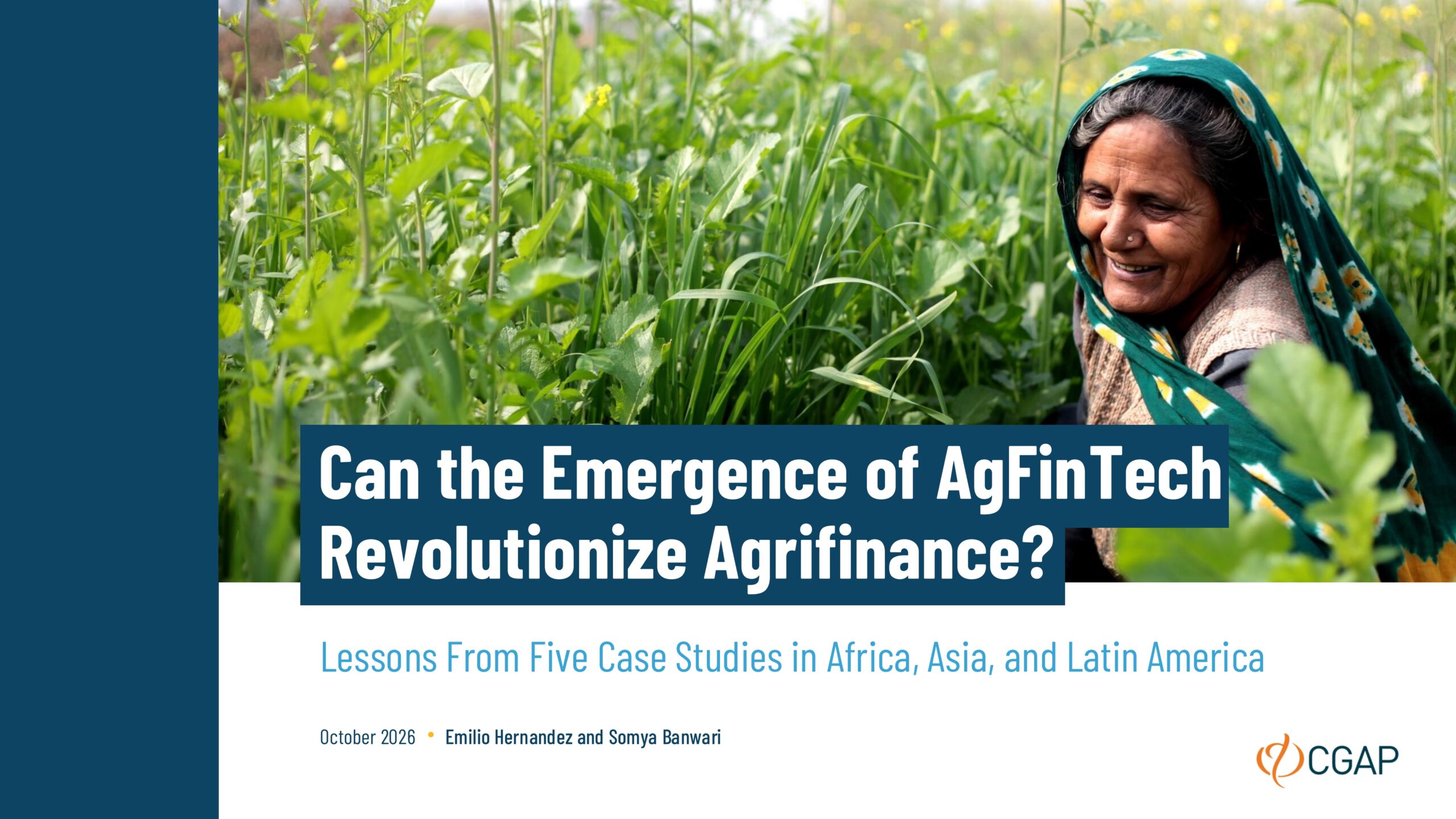
Can the emergence of AgFinTech revolutionize agrifinance? Lessons from five case studies in Africa, Asia, and Latin America
This report examines how digital innovations address barriers to inclusive agricultural credit in developing countries. Through five case studies, it highlights the role of agri-data stacks and AI-powered analytics in reducing information asymmetries, improving risk management, and lowering service delivery costs for smallholder farmers and agri-MSMEs.
Please login or join for free to read more.

OVERVIEW
The problem
Limited access to agricultural finance (agrifinance) remains a binding constraint to transforming food systems into more equitable, nutritious, and sustainable ones. Globally, only about 10 per cent of smallholder farmers have access to credit, leaving an estimated US$170 billion financing gap, while up to 97 per cent lack insurance. Large segments of the agricultural sector lack the financial services needed to invest in improved technologies that can raise productivity, reduce costs, and support a transition to more resilient and sustainable production systems.
The core challenge is structural: formal financial service providers (FSPs) often lack the reliable data and analytical capacities needed to assess creditworthiness and model agricultural risks accurately. This prevents them from pricing agricultural credit risk correctly and serving dispersed rural clients cost-effectively. Specifically, FSPs face three compounding barriers: creditworthiness analysis, where existing systems struggle to identify clients with thin data histories; risk management, where modelling complex and interconnected risks like climate shocks is difficult; and cost-to-serve, as customer acquisition and monitoring are expensive in rural contexts.
Game-changers to unlock agrifinance
Recent advances in digital technologies, particularly agri-data stacks and artificial intelligence (AI)-powered analytics, are beginning to address these longstanding barriers. Agri-data stacks are integrated platforms that aggregate various data layers, including public data led by governments (farmer IDs, land records, weather data) and private data added by AgFinTechs (yields, financial transactions, revenues). These data layers can now be analysed with AI-powered tools that help FSPs form actionable insights.
These trends mark a paradigm shift, helping FSPs move from collateral-based lending toward cashflow-based and farm performance-based lending. New agrifinance solutions allow FSPs to reduce persistent information asymmetries, more accurately assess customer exposure to production and climatic risks, and enable remote onboarding and supervision. The resulting “finance-grade” agri-data stacks enable more effective agrifinance applications by linking production, market, and climatic information to individual customers.
New digital agrifinance solutions
Five case studies illustrate this transformation. In India, Dvara E-Registry uses integrated data and machine learning to improve retail credit underwriting. By combining satellite data with transactional records from farmer organisations, it generates a “KhetScore” to support lending decisions. Since 2019, it has disbursed 40,000 loans, with non-performing loans (NPLs) for their core product below 4 per cent, and 36 per cent of primary borrowers being women.
Kaleidofin, operating in India, Kenya, and Uganda, addresses the wholesale finance bottleneck by pooling loans from smaller lenders into securitised structures. This has resulted in a 10–20 per cent increase in credit approvals and a 20–30 per cent reduction in costs incurred by investors to process transactions. SatSure Analytics leverages geospatial intelligence in India and Kenya to manage production and climatic risks. It has supported 370,000 farmers in FY2025-2026 and achieved an 80 per cent reduction in field visit costs for partner lenders.
In Zimbabwe, E-Mudhumeni has built a “phygital” data stack, deploying 1,200 POS devices in informal markets to capture documented trade history. This approach has served over 1 million agricultural borrowers across various FSPs. Finally, AgriTech Nexus in Mexico acts as a digital marketplace connecting FSPs with AgFinTech solutions. Initial results show a 10x reduction in loan monitoring costs for FSPs and over 700,000 hectares georeferenced.
Key enablers for scale
Scaling these innovations requires two critical enablers. First, the creation of open, finance-grade public agri-data stacks is essential to provide foundational layers, such as asset registries and georeferenced farm data, that are not commercially viable for private actors to build. Second, a temporary incentive mechanism is needed to accelerate the adoption of these solutions among FSPs. Because many FSPs have limited confidence in new solutions due to past failures, public and philanthropic support is required to document evidence of effectiveness and provide technical assistance to mainstream these innovations.
Implications for key stakeholders
Governments should prioritise open, interoperable, and privacy-protected agri-data infrastructure and standardise APIs for data sharing. Development Finance Institutions (DFIs) are uniquely positioned to finance the development of public goods and provide concessional financing to AgFinTechs and FSPs for testing innovative solutions. Donors should focus on strengthening the capabilities of last-mile service providers like farmer organisations and supporting digital capability building among smallholders.
Impact investors should provide the patient capital needed to scale proven AgFinTech business models. FSPs should learn how to mainstream these solutions into their core systems to tailor their financial offerings to underserved agricultural actors. Adoption requires investment in systems, staff capabilities, and change management to ensure effective technologies are embedded into lending processes.
Conclusion
AgFinTech solutions are already demonstrating their ability to reduce information asymmetries and lower operating costs. The evidence suggests that reducing the agrifinance gap is no longer a question of whether digital innovation can help, but whether stakeholders can create the conditions for these innovations to scale. Establishing these enabling conditions will help millions of smallholders and agri-enterprises invest in more productive, resilient, and sustainable futures.




