
Library | Finance relevance
Bankers and financiers
Refine
733 results
REFINE
SHOW: 16


Still Banking on Coal
Still Banking on Coal is a dataset by Urgewald that tracks global bank financing for the thermal coal industry. It provides transparency on loans and underwriting from over 740 banks, highlighting the gap between climate commitments and actual financial flows.
More critical than ever: Strengthening growth and resilience through the multilateral development banks
This report examines the critical role of Multilateral Development Banks in driving growth and resilience. It highlights challenges from declining official aid and geopolitical fragmentation, while proposing reforms to scale financing, accelerate project delivery, and target concessional resources toward the world’s poorest and most vulnerable nations.
State of blended finance series
State of Blended Finance is a research series examining how public, philanthropic and private capital combine to finance sustainable development in emerging markets. It analyses transaction structures, investor participation, capital mobilisation, development impact, market trends and barriers to scaling blended finance.
Artificial intelligence and climate change: balancing innovation and sustainability
This report examines the interaction between artificial intelligence and climate change, highlighting potential for mitigation and adaptation alongside significant environmental costs. It explores two technological trajectories—AI copilot and artificial general intelligence—while discussing implications for central banks regarding productivity, inflation, financial stability, and emerging global policy frameworks.
National development banks: Policy integration for climate
This research analyses the integration of national development banks (NDBs) into climate policies across 103 economies. It highlights that only 17.5% of countries explicitly reference NDBs in climate commitments. The report provides recommendations for governments and NDB leadership to strengthen institutional alignment and improve climate finance effectiveness.
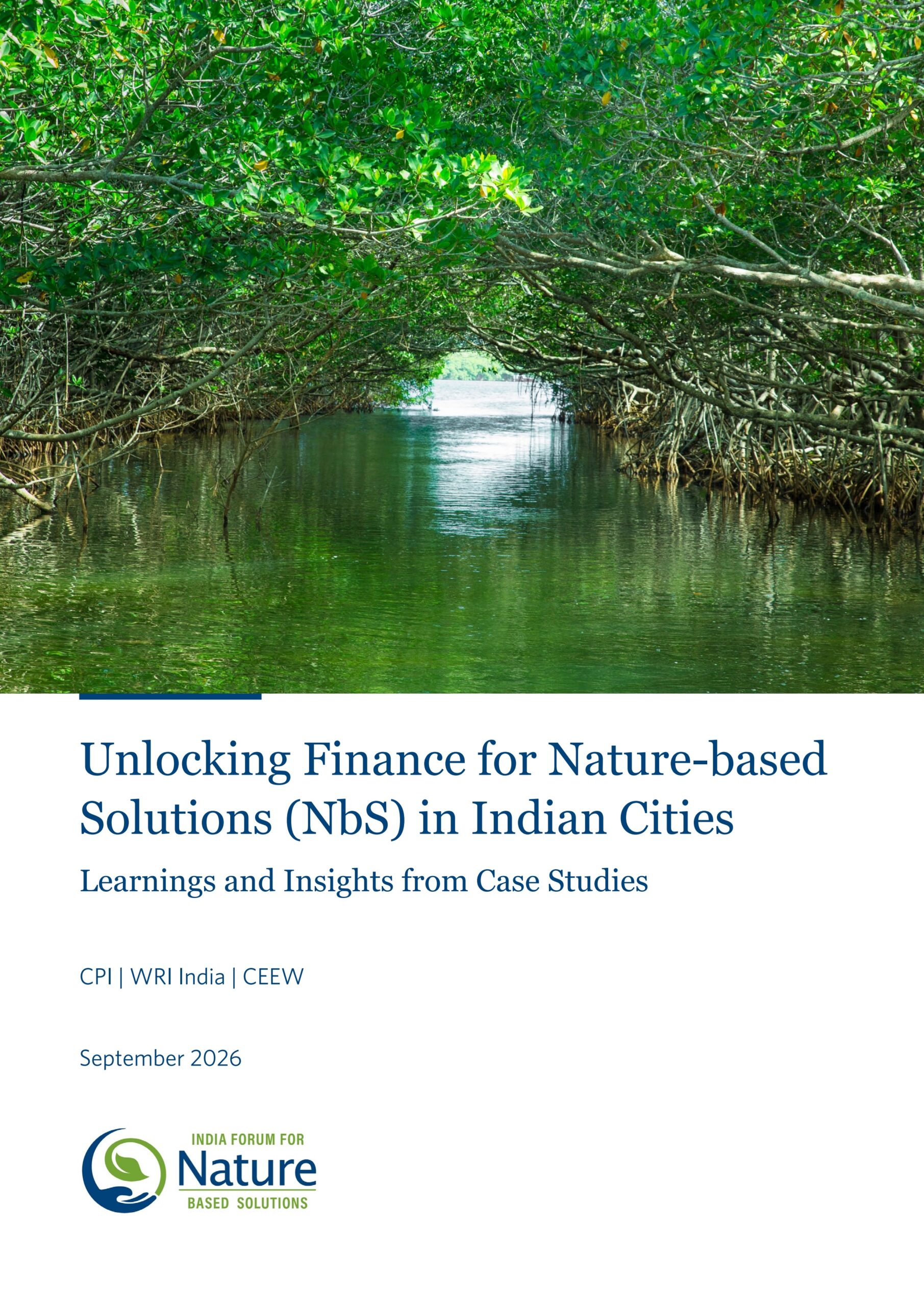
Unlocking finance for nature-based solutions (NbS) in Indian cities: Learnings and insights from case studies
This report examines nine Indian nature-based solutions (NbS) case studies to evaluate financing mechanisms and institutional frameworks. It highlights the importance of reducing technical risk through feasibility studies, aligning with national policies, and sequencing capital to support project scalability and long-term sustainability in urban environments.
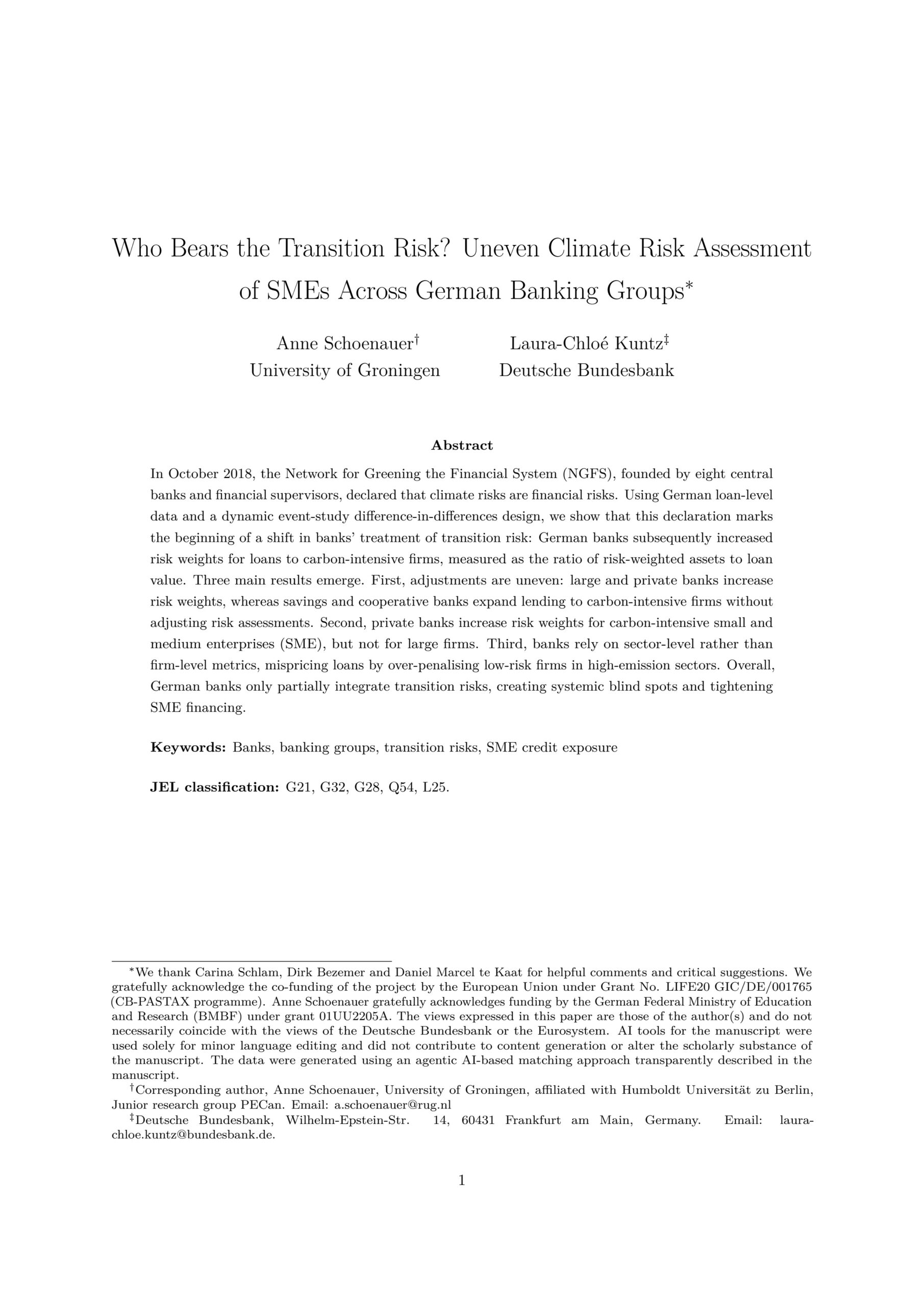
Who bears the transition risk? Uneven climate risk assessment of SMEs across German banking groups
This report examines how German banks assess climate transition risks, specifically for SMEs. It finds that private banks significantly increased risk weights for carbon-intensive firms after 2018, while cooperative and savings banks did not. The reliance on sector-level metrics suggests potential loan mispricing and systemic risks within regional banking groups.
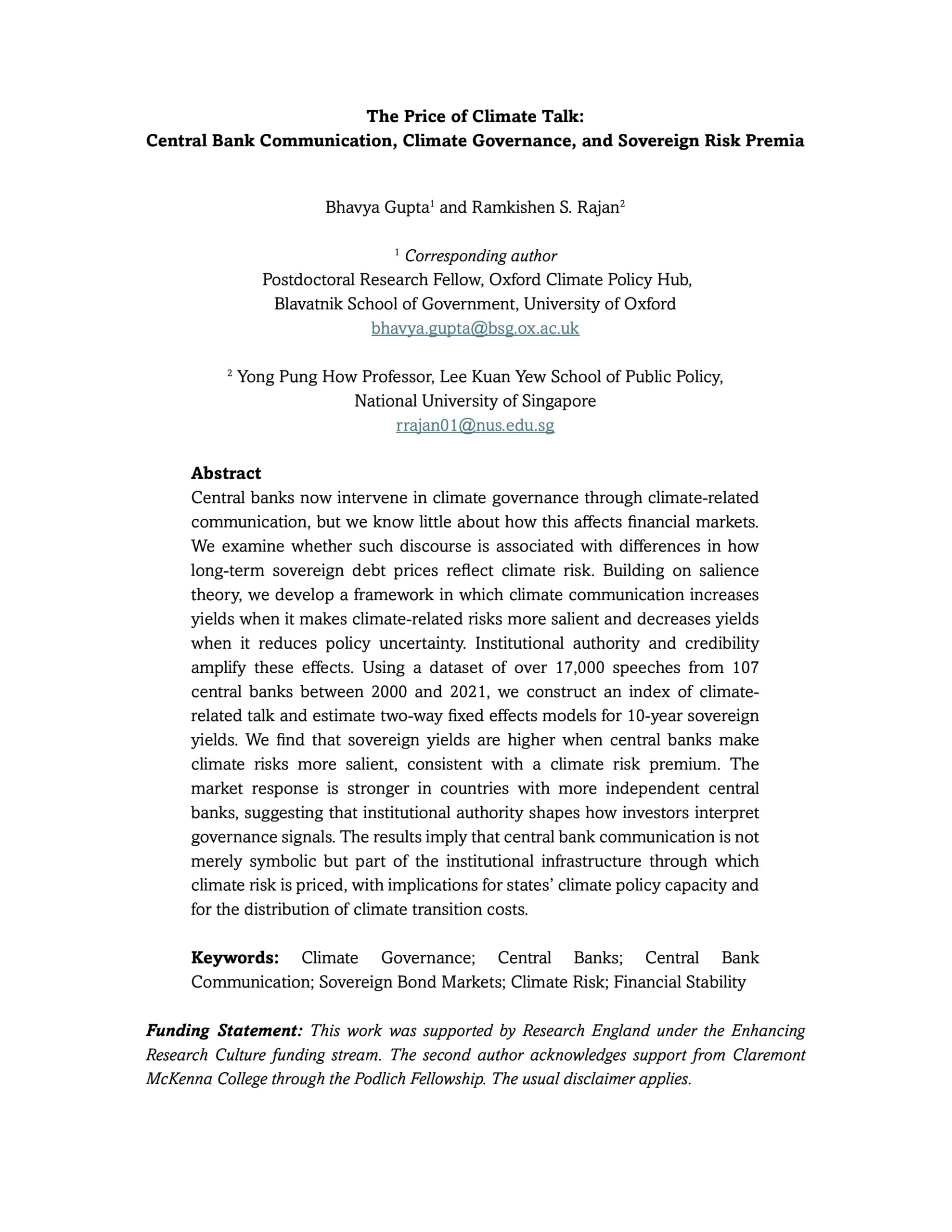
The price of climate talk: Central bank communication, climate governance, and sovereign risk premia
This research examines how central bank climate communication affects 10-year sovereign bond yields. Using a dataset of over 17,000 speeches, it finds that climate-related discourse increases yields by making risks more salient. This effect is stronger in countries with independent central banks, reflecting the role of institutional credibility.
Investing in water-related and dependent infrastructure: Risks, considerations, and opportunities
This report examines water risks as systemic financial threats to infrastructure. It proposes a seven-step decision framework to integrate ecosystem services into project appraisal and financing. Through case studies in Africa and Asia, it advocates for hybrid green-grey solutions and innovative financial mechanisms to address the global water infrastructure gap.
Pricing in resilience: The future of financial services for soil health
This research examines how agricultural finance, markets and policy are transitioning soil health from a conservation goal to a financial metric. It details five forces driving structural carbon demand and seven financial innovations, including carbon warrants and digital verification, designed to reprice risk and unlock institutional capital for regenerative agriculture.
Maritime chokepoints and the global economy: Evidence from the Strait of Hormuz
This research examines the global economic consequences of maritime disruptions in the Strait of Hormuz. Utilising Portwatch data, the analysis demonstrates that traffic shocks act as stagflationary forces, significantly increasing energy prices, reducing global industrial production, and tightening financial conditions through widened corporate and sovereign bond spreads.
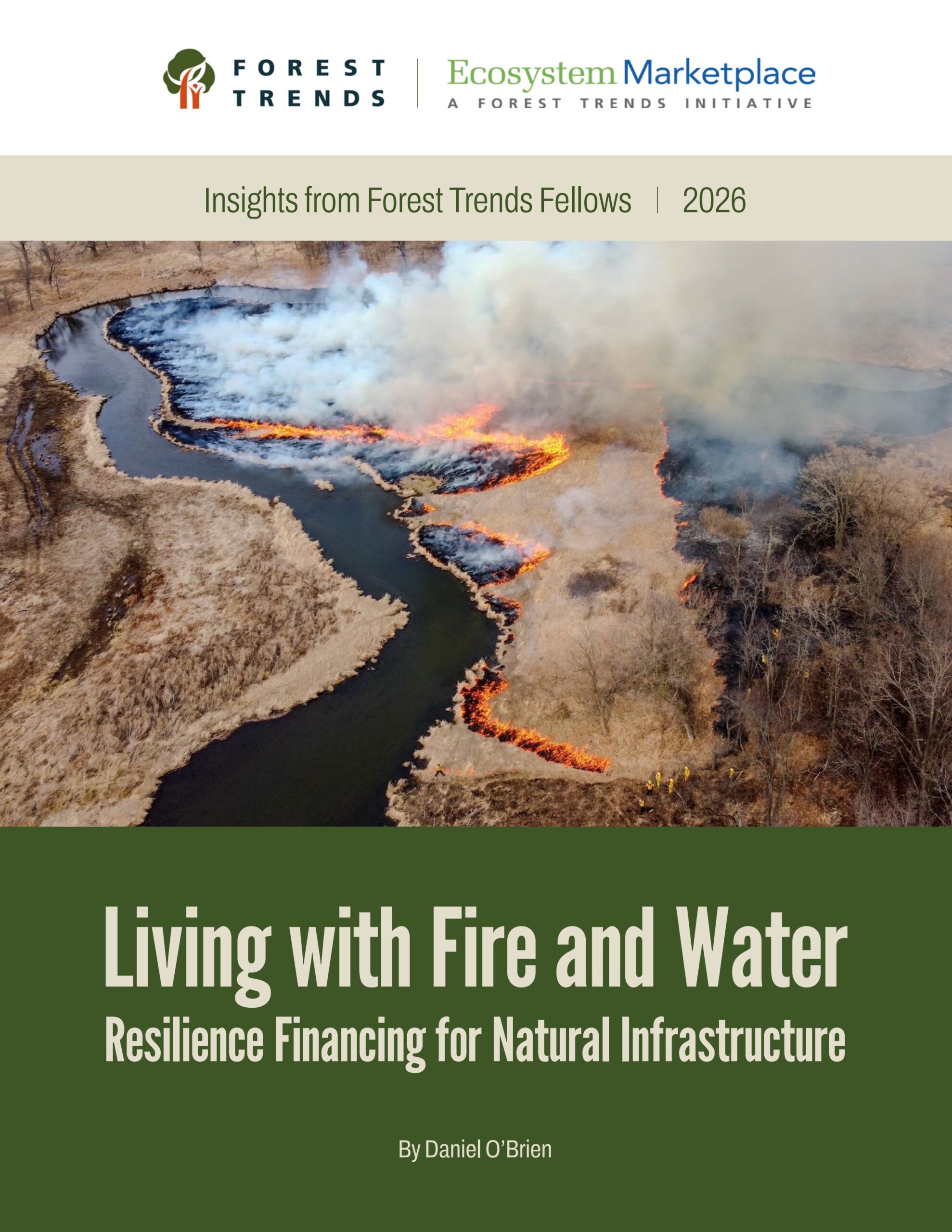
Living with fire and water: Resilience financing for natural infrastructure
This report proposes a resilience-financing architecture to fund natural infrastructure. By wrapping catastrophe bonds with government credit enhancement, it creates a spread to finance landscape-scale mitigation. This mechanism aims to preserve insurability, reduce systemic climate risk, and convert unpriced contingent liabilities into structured, capped financial positions.
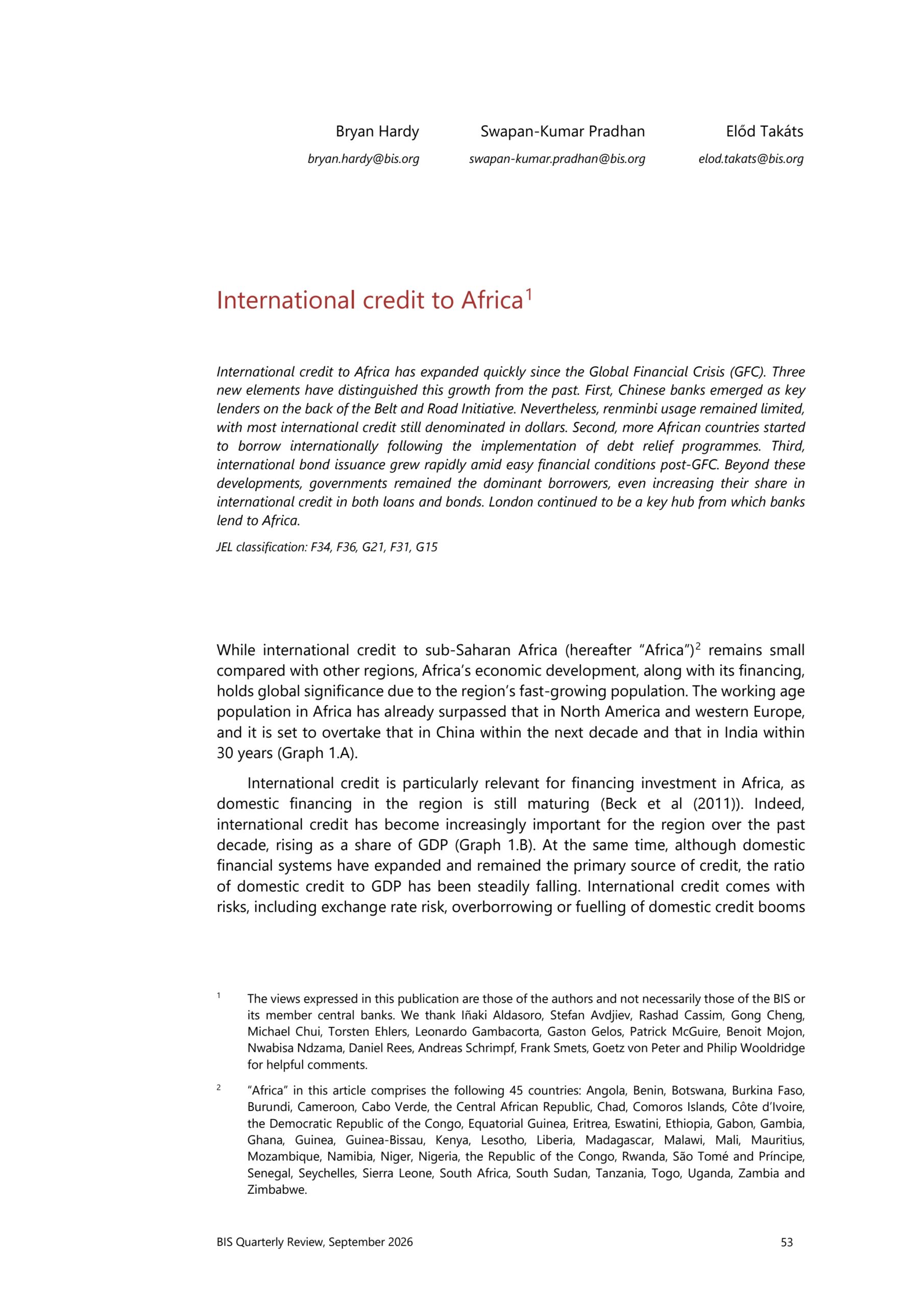
International credit to Africa
This research examines the rapid expansion of international credit to Africa since the Global Financial Crisis. It highlights the rise of Chinese lending under the Belt and Road Initiative, the dramatic growth of international bond issuance, and the continued dominance of governments as borrowers in US dollar-denominated markets.
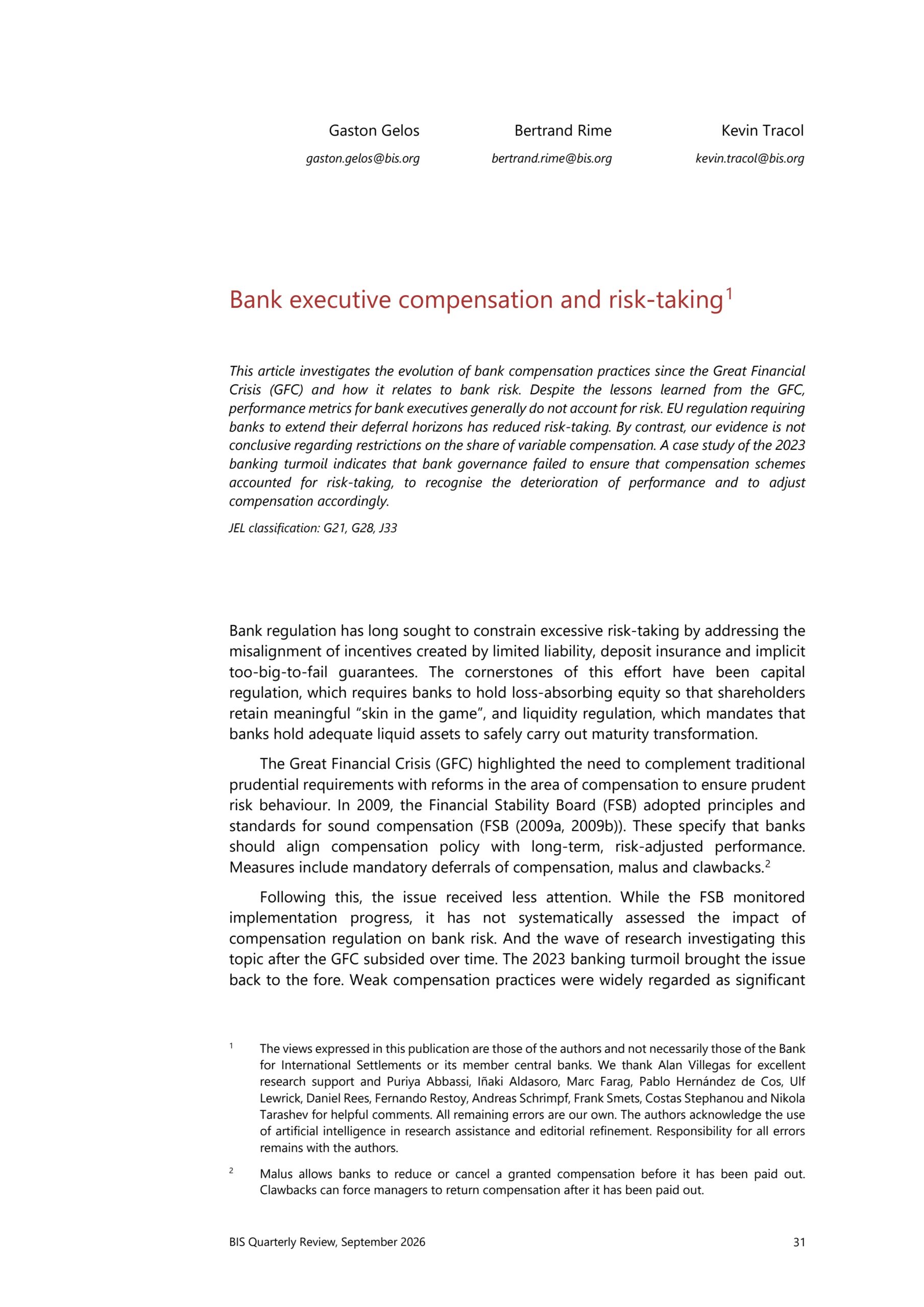
Bank executive compensation and risk-taking
This research investigates bank executive compensation since the Great Financial Crisis. It finds that longer deferral horizons successfully reduce risk-taking and encourage prudent capital management. However, evidence regarding variable pay caps is inconclusive. Case studies from 2023 failures highlight governance shortcomings in risk-adjusting performance metrics and compensation schemes.
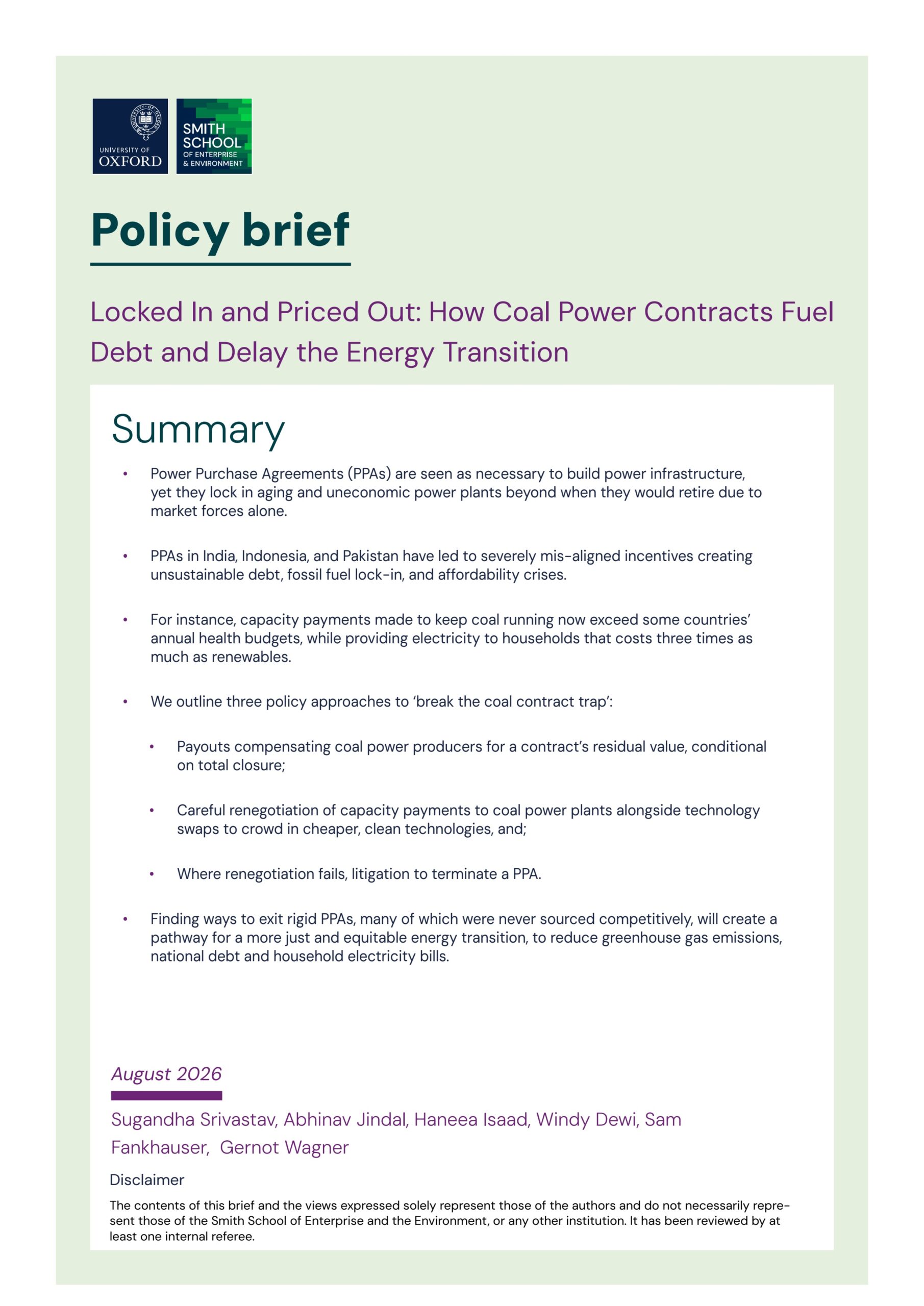
Locked in and priced out: How coal power contracts fuel debt and delay the energy transition
This report examines how rigid power purchase agreements for coal power in India, Indonesia, and Pakistan create unsustainable debt and delay the energy transition. It highlights how these contracts lock in expensive, polluting energy and proposes policy solutions including payouts, technology swaps, renegotiation, and litigation.
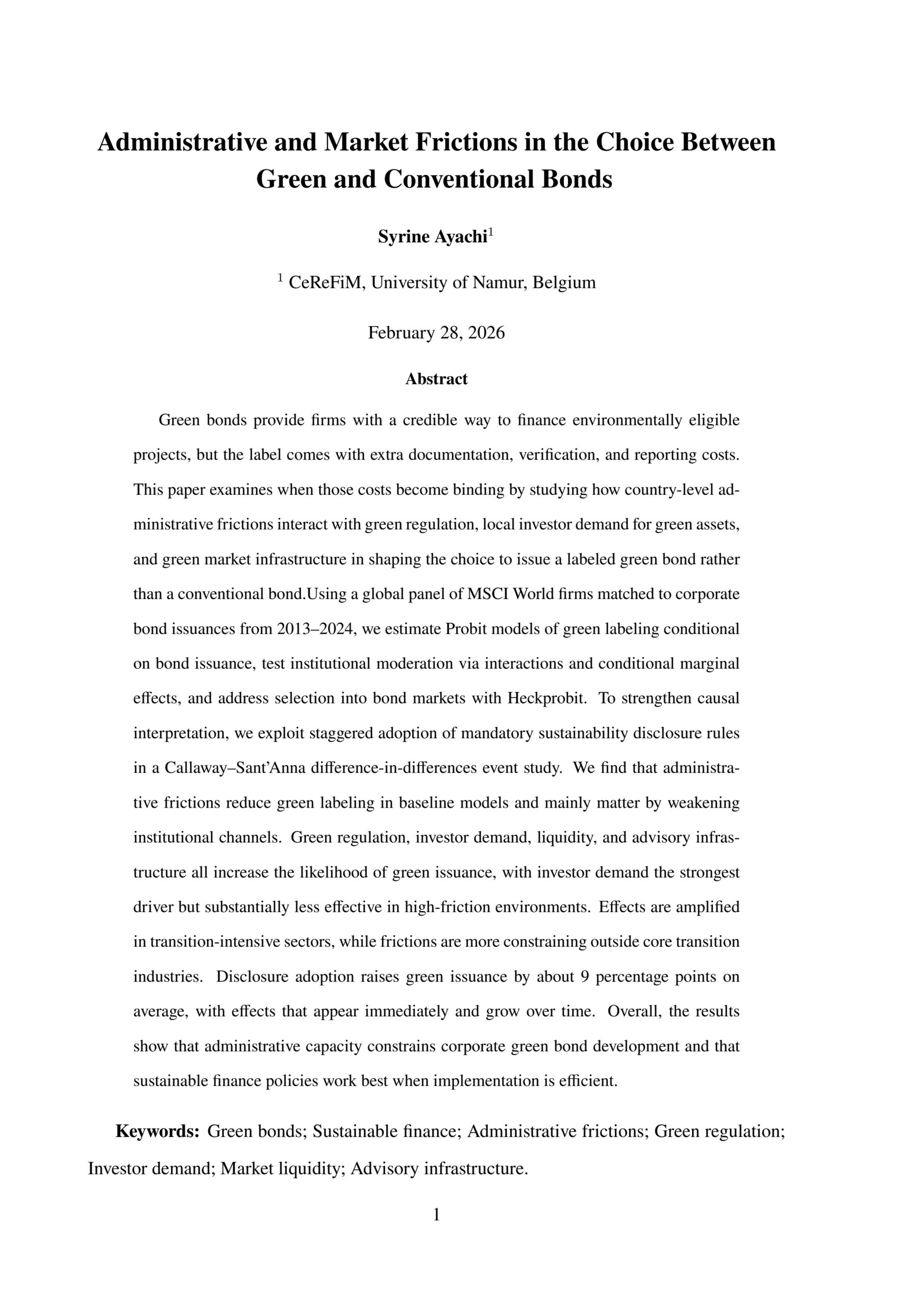
Administrative and market frictions in the choice between green and conventional bonds
This research investigates how administrative frictions and institutional environments influence corporate green bond issuance. Using global data from 2013–2024, it finds that bureaucratic complexity reduces green labelling probability, particularly outside transition-intensive sectors. Mandatory sustainability disclosure significantly increases issuance, highlighting the importance of efficient implementation for sustainable finance policies.


