
Refine
180 results
REFINE
SHOW: 16



Mental state of the world report series
This benchmark series examines global trends in mind health using data from the Global Mind Project. It assesses people’s capacity to navigate life’s challenges and function productively using the Mind Health Quotient (MHQ), analysing generational, geographic, and societal factors influencing mental wellbeing across the internet-enabled global population.
Sustainable Finance Roundup February 2026: Disclosure, Carbon Trade, and Transition Economics
This month’s sustainability roundup traces a rapidly evolving landscape in climate governance and industrial transition, highlighting the convergence of ISSB-aligned disclosure standards and emerging carbon trade measures alongside shifting cost curves in transport and critical minerals. It underscores how tighter emissions accounting and border policies are embedding carbon competitiveness into capital allocation, while advances in electrification, AI-driven power demand and expanding legal accountability are integrating climate and nature risk into mainstream financial decision-making.
Sustainable investment funds: Design, implementation, monitoring and communication of sustainability attributes
PAS 7342:2025 sets out specifications for designing, implementing, monitoring and communicating sustainability attributes of sustainable investment funds. It provides requirements to support clear objectives, governance, evidence, disclosures and labelling, aiming to reduce greenwashing and improve consistency in fund communication.
Voices of Aotearoa: Demand for ethical investment in New Zealand series
This annual research series examines public attitudes, expectations and behaviours relating to ethical, responsible and impact investing in New Zealand. It tracks how consumers engage with investment choices, transparency, fund practices and adviser interactions, providing a consistent evidence base to monitor evolving demand over time.
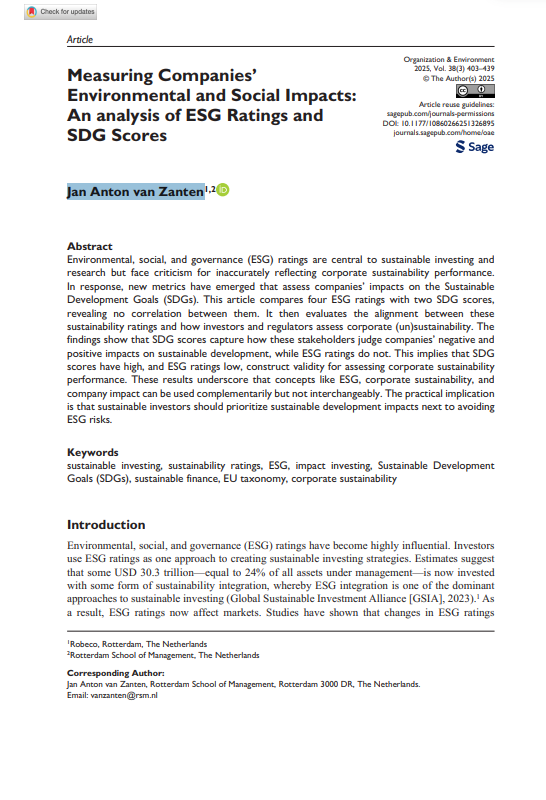
Measuring companies’ environmental and social impacts: An analysis of ESG ratings and SDG scores
This study compares ESG ratings with SDG scores across major providers. It finds little correlation. SDG scores align with investor exclusions and EU Taxonomy assessments, while ESG ratings largely measure financial risk exposure, not real-world environmental or social impacts.
The twin transition century
This paper argues that Europe’s green transition depends on aligning digital transformation with sustainability goals. It outlines how digital research can both reduce its own environmental footprint and enable climate action, calling for long-term, interdisciplinary research investment and coordinated EU policy.
Engaging the ICT sector on human rights series
This is a series of sector-wide risk assessment briefings for the Information and Communications Technology (ICT) sector. It examines salient human rights issues linked to ICT business models and technologies, providing a consistent analytical framework to support investor assessment, engagement, and governance analysis across multiple thematic areas.
Salient Issue Briefing: Artificial intelligence based technologies
This briefing examines human rights risks from AI-based technologies in the ICT sector, outlines business, legal, and financial implications, and provides investor-oriented guidance grounded in international standards to support rights-respecting AI development, deployment, and oversight.
Responsible investing in defence, security and resilience
The NATO Innovation Fund advocates removing financial exclusions on defence to bolster European security. The report recommends reforming procurement for rapid dual-use technology adoption and implementing a ‘Responsible Use Framework’ to ensure ethical development of emerging capabilities like AI and autonomous systems.
The (mis)use of scenarios in fossil fuel and industry climate disclosures
The report analyses climate disclosures by investor-owned carbon majors, finding widespread misuse of climate scenarios to claim Paris alignment. Common issues include outdated scenarios, opaque assumptions and misleading aggregation, which obscure transition risks and may misinform investor decision-making.

Fashion’s plastic paralysis: How brands resist change and fuel microplastic pollution
The report examines fashion brands’ continued reliance on synthetic fibres, highlighting how voluntary commitments, lobbying, and weak accountability delay fibre reduction and regulation. It links current business models to rising microplastic pollution and concludes that systemic policy and production changes are required.
Information integrity about climate science: A systematic review
Systematic review of 300 studies (2015-2025) finds coordinated misinformation and greenwashing by corporate, political, and media actors undermine climate science, eroding trust and delaying policy. Research is Global North–centric. Evidence supports regulation, litigation, coalitions, and education to strengthen information integrity.

Changing markets foundation
Changing Markets Foundation accelerates sustainability market shifts by exposing irresponsible corporate practices and promoting environmentally and socially beneficial solutions. Working with NGOs and research partners, it drives campaigns on climate, plastics, food systems and fashion to influence markets and public policy. It is an independent environmental advocacy nonprofit.
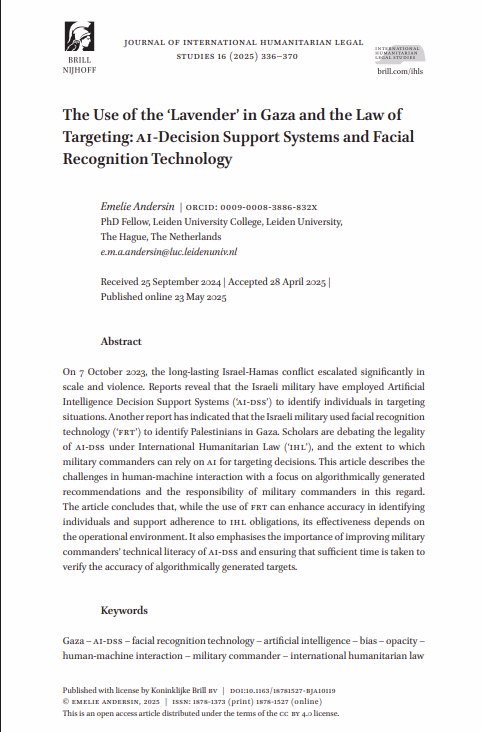
The use of the Lavender in Gaza and the law of targeting: AI-decision support systems and facial recognition technology
The report analyses Israel’s alleged use of the ‘Lavender’ AI decision-support system and facial recognition in Gaza, assessing compliance with international humanitarian law. It highlights risks from inaccuracy, bias, automation and opacity, concluding that commanders must retain judgement and verification to meet targeting obligations.
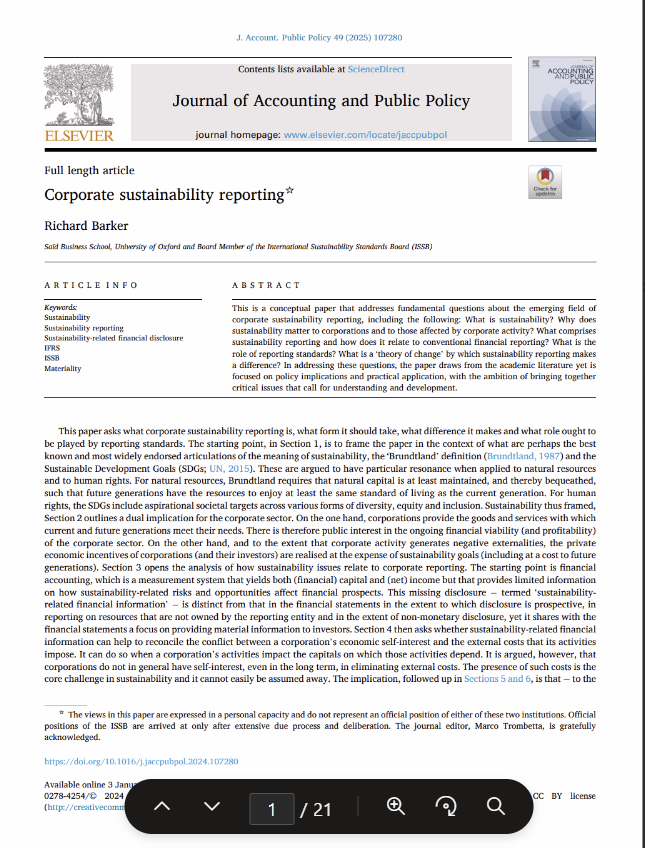
Corporate sustainability reporting
This conceptual paper examines corporate sustainability reporting, distinguishing investor-focused sustainability-related financial disclosure from broader impact reporting. It argues investor interests are imperfectly aligned with societal goals and concludes that complementary financial and impact reporting standards are needed to support accountability, capital allocation and sustainability transition.

Preparing for next-generation information warfare with generative AI
The report analyses how generative AI reshapes information warfare by enabling scalable manipulation, behavioural influence and dual-use knowledge diffusion. It highlights heightened risks to civilians, military operations and international law, stressing gaps in protection and the need for anticipatory, whole-of-society resilience strategies.


