
Library | Location
Ukraine
Refine
26 results
REFINE
SHOW: 16


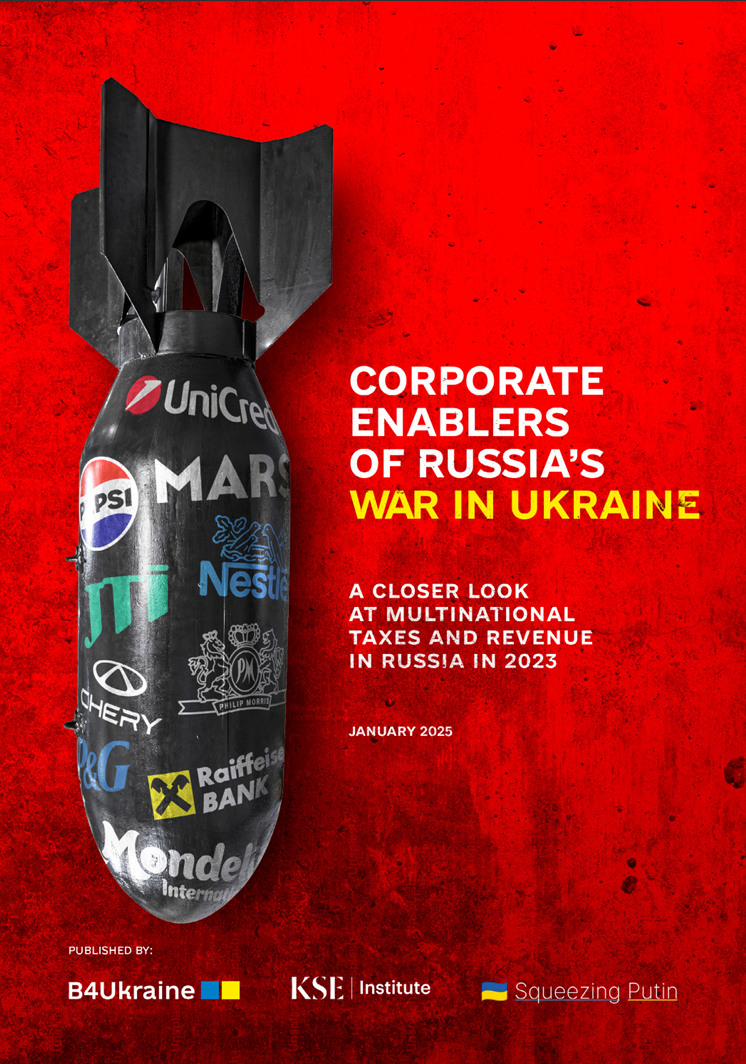
Corporate enablers of Russia’s war in Ukraine: A closer look at multinational taxes and revenue in Russia in 2023
Examines multinational companies’ revenues and taxes in Russia (2021–2023), showing continued corporate activity generated significant tax contributions supporting the Russian state. Highlights sectoral drivers, limited exits, and rising fiscal pressures, concluding that ongoing operations pose financial, legal, and human rights risks.

Kyiv School of Economics (KSE)
Kyiv School of Economics (KSE) is a Ukraine-based academic institution and think tank specialising in economics education, policy research and public administration. It delivers internationally aligned degree programmes and produces economic analysis, policy advice and recovery research to support Ukraine’s economic development, governance and post-war reconstruction efforts.
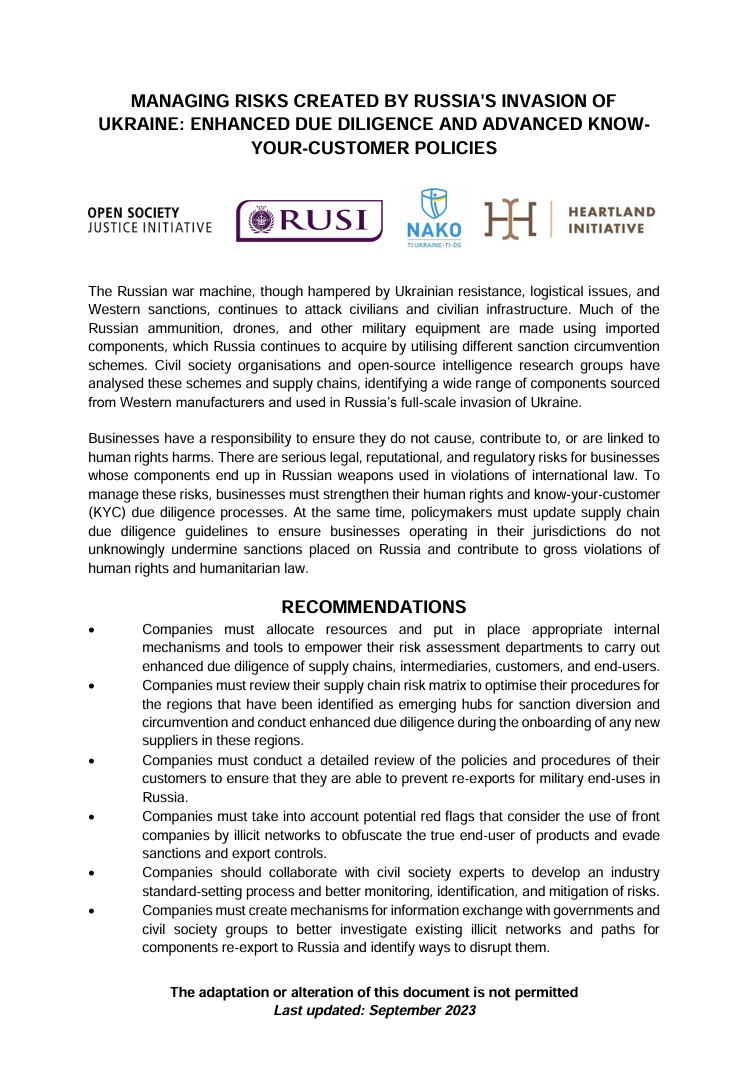
Managing risks created by Russia's invasion of Ukraine: Enhanced due diligence and advanced know your-customer policies
The report advises firms to strengthen due diligence and advanced know-your-customer checks to prevent sanctions evasion and re-exports supporting Russia’s war in Ukraine. It highlights front-company red flags, recommends stronger internal controls and information-sharing, and uses case studies to show how diversion risks can be detected.

Independent Anti-Corruption Commission (NAKO)
Independent Anti-Corruption Commission (NAKO) is a Ukrainian civil society organisation focused on defence sector transparency, anti-corruption and governance reform. It conducts research, advocacy and policy analysis on defence procurement, sanctions and security risks, supporting accountability and strengthening Ukraine’s national security and public sector integrity.
Europe sustainable development report 2025: SDG priorities for the new EU leadership
The Europe Sustainable Development Report 2025 assesses EU, EFTA, UK and candidate countries’ progress on the SDGs using updated indices. It highlights stalled convergence, rising within-country inequalities and significant international spillovers, and calls for scaled-up green, social and multilateral investment under the EU’s 2024–2029 leadership.
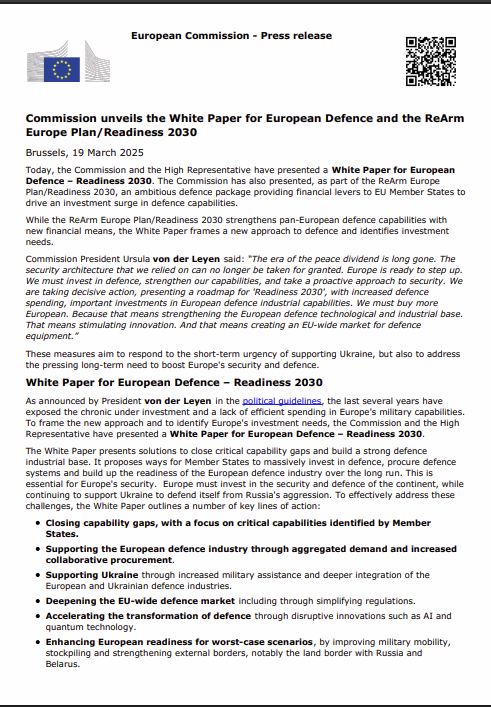
Commission unveils the white paper for european defence and the rearm europe plan readiness 2030
The report outlines the EU’s White Paper on European Defence and the ReArm Europe Plan, targeting defence readiness by 2030 through closing capability gaps, strengthening the defence industrial base, and mobilising over €800 billion via public, EU, and private funding mechanisms.
BPI France: European Defence Bond Framework
Bpifrance’s European Defence Bond Framework defines principles for issuing use-of-proceeds bonds financing eligible defence-sector projects, mainly SMEs, to support European sovereignty. It details eligibility criteria, exclusions, ESG safeguards, governance, reporting, and proceeds management, while stating the bonds are not ICMA-aligned sustainable instruments.
Responsible investing in defence, security and resilience
The NATO Innovation Fund advocates removing financial exclusions on defence to bolster European security. The report recommends reforming procurement for rapid dual-use technology adoption and implementing a ‘Responsible Use Framework’ to ensure ethical development of emerging capabilities like AI and autonomous systems.
The end of ESG: Financial management, forthcoming
This report argues that ESG is both essential and ordinary: vital as a driver of long-term value but not unique compared to other intangibles such as culture or innovation. It cautions against over-emphasising ESG metrics, politicisation, and superficial classification, advocating instead a broader focus on overall sustainable value creation.
Kantar
Kantar is a global leader in marketing data, insights and analytics, supporting over 96 of the world’s top 100 advertisers across 90+ markets. It combines behavioural and attitudinal data to inform brand strategy, creative testing, media effectiveness, customer experience and sustainable growth.

War and sanctions database
The War and Sanctions portal, managed by Ukraine’s Defence Intelligence, is an open-access database detailing individuals, entities, and assets linked to Russia’s military activities. It supports due diligence and compliance efforts by providing verified information on sanctions, war-related logistics, and foreign components in weaponry.
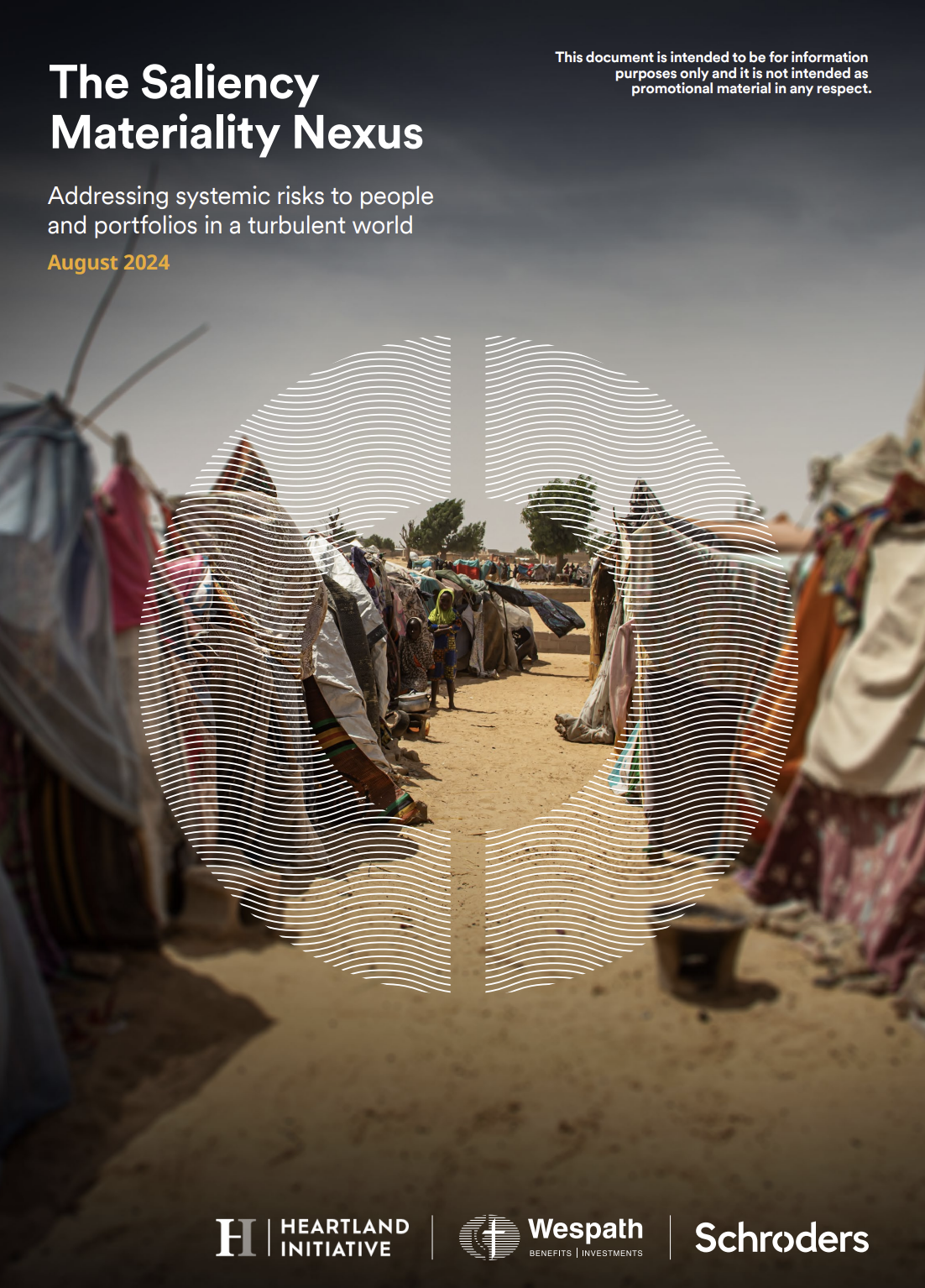
The saliency-materiality nexus: Addressing systemic risks to people and portfolios in a turbulent world
This report introduces the saliency-materiality nexus, a framework linking severe human rights harms to financially material risks in conflict-affected areas. It highlights case studies totalling over $85 billion in losses and offers guidance for investors on due diligence, portfolio risk management, and alignment with legal and ethical responsibilities.
Closing the gap: Investing in natural capital to meet the SDGs
The report analyses the investment required to address the natural capital gap for achieving Sustainable Development Goals in 40 countries, finding that investing US$7.4 trillion could generate returns exceeding US$152 trillion, greatly benefiting air quality, human health, ecosystems, and reducing premature deaths and resource depletion globally.

Environmental Finance's biodiversity insight series
This series explores the evolving role of biodiversity in sustainable finance, investment strategies, and regulatory developments. It examines biodiversity risk, natural capital investment, reporting frameworks, and financial instruments supporting conservation efforts. The series provides insights into emerging market mechanisms, data challenges, and the integration of biodiversity considerations into financial decision-making.
Storm clouds and silver linings: Long-term investing in an age of geopolitical uncertainty
The report explores the impact of geopolitical uncertainty on long-term investing, highlighting risks and opportunities for institutional investors. It emphasises the need for integrating geopolitical considerations into investment strategies, governance, and decision-making frameworks. The report provides practical tools for investors to assess geopolitical resilience, manage risks, and engage with stakeholders while balancing short-term pressures with long-term value creation.

Infrastructure tokenization: Does blockchain have a role in the financing of infrastructure?
The report explores the potential of blockchain technology in financing infrastructure projects. It evaluates blockchain's capabilities in enhancing efficiency, transparency, and accessibility in infrastructure tokenisation, while addressing challenges like regulatory constraints, market adoption, and technical barriers. The findings highlight both opportunities and limitations for integrating blockchain into infrastructure financing.


