
Why create this series?
Why create this series?
Something has been troubling me for a long time. Over the next five weeks I want to work through it in the open, and I need your help.

Dear friends and supporters of Altiorem,
Something has been troubling me for a long time. In 2007, when I completed my first Carbon Disclosure Project response for my employer, I had managed to merge my concern for the environment and our collective future with my job as a risk manager. I was excited and determined not to waste the opportunity to make a difference.
However, when this eventually turned into my first dedicated responsible investment role in 2009, it didn’t take long for me to be convinced that rather than concern for our collective future, the only way to get the investment professionals around me to pay attention was to make the case for sustainability through the prism of risk and return. We were doing it for the money, with win-win was a nice to have.
I felt uncomfortable with this but time and again the paradigm of institutional investment where fiduciary duty was reduced to the narrowest possible financial interest of beneficiaries, performance (and pay!) was assessed against benchmarks that treated company size as a substitute for quality, and time horizons that seemed to get shorter by the month, demanded that any other reason for caring be put aside. That they were not just irrelevant, but contrary to our solemn duty.
When the SDGs were agreed in 2015 and a few months later the Paris Agreement was also, there seemed an inevitability that the interests of people and planet could be made to align with the financial interests of beneficiaries. That governments would enact laws and regulations that would introduce costs that made destructive and extractive practices unprofitable and incentives that would supercharge a green and just transition. The endless studies and debates on the financial materiality of ESG issues and the positive performance of more sustainable companies could end, as the weight of the challenges and growing societal response made it so.
Ten years on, it is easy to see how naïve this was. After all the Global Financial Crisis, which started the year after the Principles for Responsible Investment were founded, took the economic system to the precipice and yet governments responded with more debt, money printing and bailing out the organisations which caused the crisis in the first place!
Our unsustainable economic and financial system has proved resilient (with massive government support) through repeated crises, growing climate and environmental disasters, wars and even a global pandemic. The wheels spin faster and the signs of strain continue to grow but on and on it goes with AI its latest manifestation. Nothing must stop the runaway train that we are all on, institutional investors and their beneficiaries included.
But even runaway trains run out of track. In her book Hospicing Modernity, Vanessa Machado de Oliveira reflects on a Brazilian saying that you can’t learn to swim until the water is up to your hips. Maybe that has been the issue with the last 20 years of sustainable finance, and now with the confirmation that the 1.5°C goal will be breached and that we have exceeded seven of nine planetary boundaries, we will finally learn to swim.
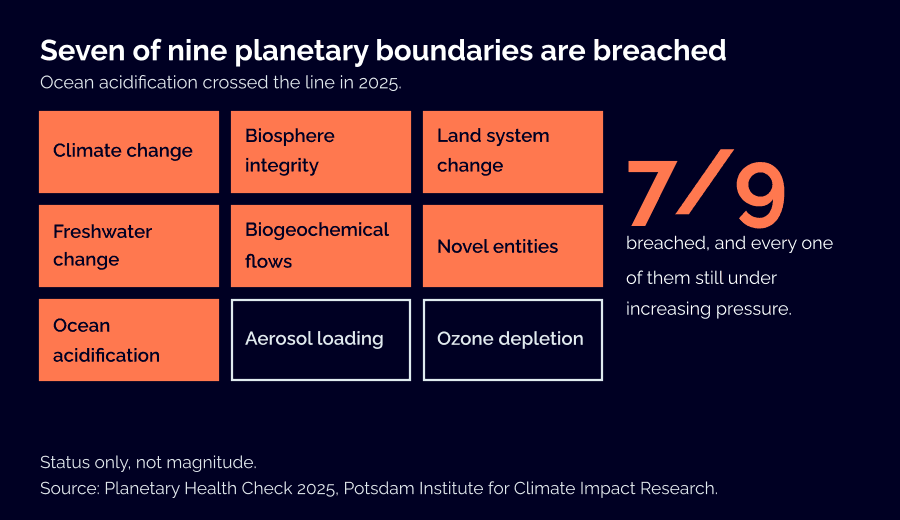
Source: Planetary Health Check 2025.
The pushback/rollback/backlash on ESG issues and sustainability over the last few years is an opportunity to reckon with these questions and be deliberate about what we fight to protect, what we reform, what we discard, and the new things we need to build in their place. Over the next five weeks, we will be exploring these issues in more depth and we need your help. To start, I would be very grateful if you would complete this survey, which will take only two minutes and forms an important plank of the series. Secondly, if you would like to write (300-500 words) or contribute case studies we would love to incorporate them. Please get in touch.
But even runaway trains run out of track.
Until next week,
Pablo
Test what you know
Ten questions drawn from the evidence behind this week’s letter and the further reading below. Open book, and it counts towards your CPD record.
Further reading
Everything this series rests on is in Altiorem’s library. These are the places to start.
Limiting overshoot: Navigating exceedance of 1.5°C and pathways towards return
United Nations Environment Programme, 2026
This report examines the inevitability of exceeding the 1.5°C global warming limit and outlines strategies for navigating this overshoot, from escalating non-linear risks to the transformational adaptation needed to limit peak temperatures.
Planetary Boundaries Science, Potsdam Institute for Climate Impact Research
An annual, science-based assessment of the Earth system that applies the Planetary Boundaries framework. The 2025 edition is where the seventh breached boundary, ocean acidification, comes from.
The race of our lives revisited
Jeremy Grantham, GMO, 2018
A wide-ranging analysis of interconnected environmental crises, the solutions available and what they mean for investors, covering climate change, soil erosion and the role of capitalism.
Fiduciary duty in the 21st century: Final report
UNEP FI and the Principles for Responsible Investment, 2019
The final report of a four-year, multi-jurisdiction exercise. It argues that environmental, social and governance integration is a component of investors fiduciary duty.
ESG and financial performance: aggregating evidence from 1,000 plus studies
NYU Stern Center for Sustainable Business and Rockefeller Capital Management, 2021
Summarises over 1,000 studies and finds that most show a positive relationship between ESG and financial performance, while disclosure alone has limited financial impact.
Measuring the economic impact of short-termism
McKinsey Global Institute, 2017
Measures corporate long- and short-termism systematically and quantifies the effect of each on financial performance and growth. Long-term approaches outperform.
Sustainable finance and corporate law: Lessons from the US
European Corporate Governance Institute, 2026
Analyses the trajectory of sustainable finance and corporate law in the US, the political and institutional challenges it faces, and what a federalist approach means for compliance.
The global rise of index-based ownership of firms
European Corporate Governance Institute, 2026
Examines the global expansion of index-based ownership from 2004 to 2023, finding it reached 16.9 per cent of global market capitalisation by 2023, with significant regional variation.
Add your voice
Seven statements, about two minutes. We will publish the results in week four.


