
PART THREE
Add your voice
Seven statements, about two minutes. If you have not taken the poll yet there is still time. We will publish the results in week four.
Introduction
In part one of this series, I outlined why I was writing it, which was more succinctly put by GMO founder and famed investor Jeremy Grantham in his 2018 paper, The race of our lives revisited. In it he opened bluntly:
“It was always going to be difficult for us – Homo sapiens – to deal with the long-term, slow-burning problems that threaten us today”.
The paper sets out the state of some of our environmental and social problems and takes aim at capitalism’s inability to deal with them, including issues covered in part two of this series: short-termism, and the discount rates that monetise and devalue the non-fungible essentials of human and non-human life, like a stable climate and clean water.
Part two of the series finished with Donella Meadows’ leverage points for transforming systems, which we will return to in part four. Our work in sustainable finance may reduce some harms and promote some goods, but systems science tells us that so long as the goals of our economic and financial system remain the same, it will keep operating in the same extractive and exploitative way. Getting real about sustainable finance requires composting the shit, as Vanessa Machado de Oliveira puts it in her book Hospicing Modernity. An essential part of that is accepting that more of the same will not produce different outcomes.
This part, the most difficult one, explores the contours of the state we are in, which I call the age of consequences. In his podcast The Great Simplification, Nate Hagens talks about humanity now being beyond the frame of problems and solutions. Rather, we face predicaments, which cannot be solved and instead require responses. Composting the shit means sitting with the difficult truths of our predicament so we can respond as well as possible. We will come to responses in part four next week.
This part includes many interactive elements with a rich array of data from across the Altiorem library and beyond. The interactive elements are best viewed in full screen by clicking the full screen button in each panel. As we did in the first two parts, we end with a quiz which will grant paying subscribers a certificate for CPD purposes and a list of further reading from Altiorem.
Overshoot
Earth Overshoot Day marks the day each year when humanity has used more than the Earth can regenerate in that year. In the interactive below, you can guess this year’s date and the date in the year you were born. Another way to think about overshoot is how many planets of resources we would need if everyone consumed like us. The interactive lets you choose a country to see how that changes with where you live.
For people working in finance, overshoot is compound interest in reverse. Think of a person trying to live off the interest on their savings who overspends and starts eating into the principal. With less principal, the future interest received is also less. If the spending stays the same, a growing share of the principal goes on expenses. This cycle accelerates exponentially until either the spending falls below the interest earned or the principal is gone. The longer it takes to bring spending into line, the bigger the cuts need to be.
This is a highly simplified example. Our fictional person could earn more income to fill the gap or seek higher returns (with more risk), and the same is possible for the planet.
We can protect and restore nature, or take riskier bets on technologies that may or may not create the additional ‘income’ needed to provide essential ecosystem services.
Safe operating limits
Exponential growth, or decline, is hard to fathom, but there is another twist: tipping points. The Earth is a collection of interacting, dynamic and complex systems. Like the organs of the human body, each regulates different functions, and pushing one beyond its limit can cause the larger system to fail.
The point at which a system tips is difficult to predict, but once it does, returning it to its original state is often impossible.
Tipping points are largely absent from economic models of the physical impacts of climate change, one of the many deficiencies that have given everyone from policy makers to company directors false comfort.
While tipping points are hard to predict, you can identify the pressures that drive the system towards them and what a safe threshold is, like a railing set back from a cliff edge. Scientists have identified nine planetary boundaries that should not be breached if we are to keep the safe space humanity has enjoyed for the last 12,000 years of the Holocene. We have breached seven.
The interactive below allows you to explore each of these boundaries and its current status.
What 16th-century Italian art and windscreens have in common
One of these boundaries is biosphere integrity. Climate change has been the dominant environmental issue of the last 50 years and the extinction of charismatic species gets headlines, but both these great animals and climate are underpinned by the health of the very small and microscopic life in the oceans and under our feet, which creates the soil we need to grow food.
As a child born in the 70s, I remember country drives where our windscreen was covered in bugs. My kids, who are now 19 and 21, saw a few, and now we barely see any. Scientists who weighed the insects caught in German nature reserves found three quarters had gone in 27 years.
Under the water, the story stretches back centuries. Researchers studied 384 Italian still-life paintings made between 1515 and 1800 to identify the fish and other water life on display, and found freshwater fish and sturgeon appear far less often after 1650.
Research like this shows nature loss is part of a longer story, and that the acceleration of the last 50 years, with WWF estimating a 59 per cent decline in ocean populations, is not a freak occurrence but the way exponential growth works – slowly at first and then really fast.
The interactive below lets you explore these declines.
At the same time as the planetary “cup” gets shallower, the shocks that can tip natural systems are also increasing in severity and frequency. Climate change multiplies risk, with acute effects like more intense storms and wildfires, and chronic ones like persistent heat. The warming we have seen is only a portion of what would have occurred had the oceans not absorbed both heat and CO2 emissions, but this buffer is producing its own impacts.
El Niño is part of a natural cycle, but climate change is driving it to new extremes. The El Niño now strengthening in the Pacific is unprecedented. A lot of things are called unprecedented these days, but this event could completely break the mould. If your feeds look like mine, you will have seen it described as Godzilla, super or, as one of the world’s most respected climate scientists, James Hansen, called it, super-duper.
We know what El Niño means for South America (droughts in the north and floods in the south), the Pacific (extreme rain in some places and heat, drought and fire in others) and a weaker Indian monsoon, to name a few. The event will disrupt weather well beyond the most directly affected areas, and the second and third order effects, in particular for food and energy security, should not be forgotten.
Hundreds of millions of people are in harm’s way.
In his paper Hansen points to India, Pakistan, Bangladesh, Myanmar and Niger as among the worst-affected countries, with large populations already facing poverty and little access to cooling. While he states that these countries are far more vulnerable than regions like Europe where adaptation options exist, he also noted Europe’s excess heat deaths this summer had passed 25,000 by August. A later study put the summer’s toll at more than 50,000, with the elderly especially vulnerable.
Climate change, directly and through its influence on natural processes like El Niño, is increasing the pressures that risk tipping planetary-scale systems. Research has identified more than 25 tipping points, from a collapse of the Atlantic Meridional Overturning Circulation (AMOC) to the Amazon rainforest tipping into savannah.
However you cut it, we are in a dangerous place. The age of consequences is here, but what lies in wait if we do not start living within the “interest” generated by the Earth’s natural systems will be far worse.
One thing is certain: by design or disaster, it will happen, but whether we bend or break is still a choice we can make.
Energy transition or energy additions?
To understand what bending rather than breaking requires, we need look no further than the energy system. Fossil fuels are the largest contributor to greenhouse gas pollution, and to many other problems, and the energy transition is the story we have told ourselves about how we will reduce them.
However, rather than a transition to renewable energy and storage, what we have had is energy additions. At a global level, whether measured over 1, 10 or 50 years, no energy source has declined. Even traditional biomass is about twice what it was 200 years ago.
This should come as no surprise, as increased efficiency and the falling cost of renewables mean we keep adding demand faster than even the stunning growth in clean energy can keep up with. The energy demand of artificial intelligence may be the last and greatest example of this phenomenon known as Jevons paradox.
Technological optimists may say this will change globally, as it has in wealthier countries that have slowly bent the curve on their electricity emissions. But unless we stop adding demand, the job we are asking of renewables only gets harder. At a time when the resilience of our environmental and social systems to the impacts described above continues to wane, the risks of this approach multiply and border on recklessness.
If all this demand were improving the lives of the poorest people, it would have some justification, and to some extent it is. Access to energy from cheap renewables is one of the stories we will explore in part four, but the social story, for poorer and richer alike, is more complex, mixed and surprising than we might expect.
Social fissures and the production line for exploitation
Conflict and displacement push more vulnerable people to leave their countries, spurring anti-immigrant sentiment on one hand and feeding modern slavery on the other. These are the signs of our social systems fracturing but are not their source.
Imagine you see a child drowning in a river. You swim out and save the child, but then you see another child struggling downstream. More and more float down, so you call others to help. You build barges and long poles, but try as you might, you can’t reach them all. Now suppose you went upstream and saw someone throwing the children into the river. What would you do then?
Directly or indirectly, the ecological crisis is feeding and driving social and political ones. Conflict, displacement and modern slavery are all higher than a decade ago, and the rise of authoritarian regimes risks a further deterioration.
The risk that the loss of ecological and societal resilience become coupled, each feeding the other, is poorly understood. But we should recognise it, and the need to go upstream to reduce harms while not forgetting those still in the water. We should also recognise that the reverse is also true: positive relationships that restore nature and improve wellbeing are possible.
Development for what end?
Kate Raworth’s Doughnut Economics takes the planetary boundaries we discussed earlier as an outer ring, and inserts a social foundation within. The doughnut represents an economy which operates within planetary boundaries while lifting people above a social floor, a space that is both ecologically safe and socially just. At its heart, it represents a fundamentally different goal for the economic system.
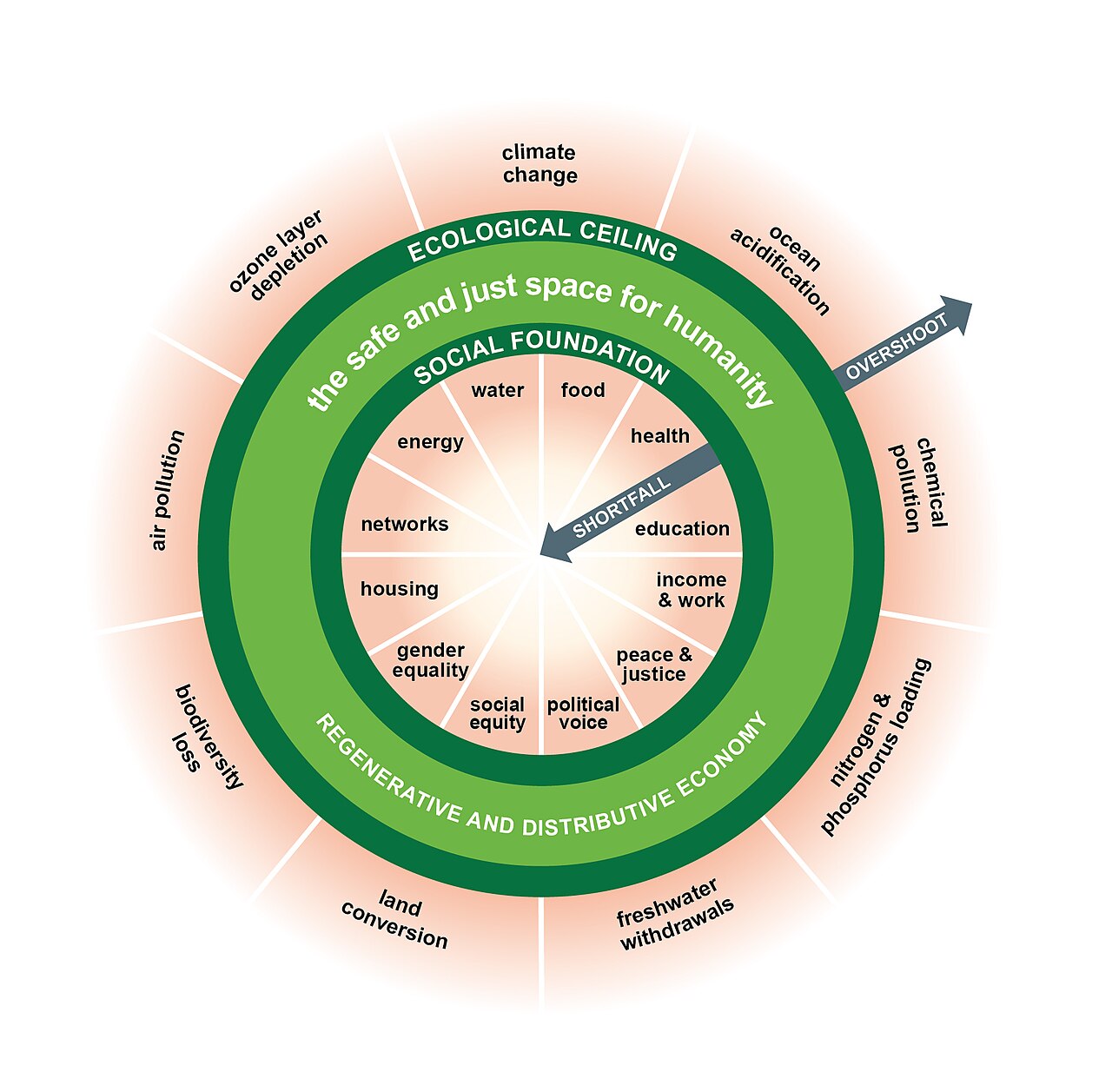
Data to 2022 shows improvement across most of the doughnut’s social dimensions, although the shortfall remains significant, and more recent data on the Sustainable Development Goals and the Human Development Index shows much of that progress has stalled. Inequality within and between countries has also grown, and a significant part of the gains in human development is lost to it.
However, another, more surprising story also emerges from the data. Life satisfaction and life expectancy rise with a country’s ecological footprint, but only up to a point.
Costa Ricans are more satisfied with their lives than Australians on about a third of the footprint, and all ten countries with the largest footprints sit in the bottom half of the Happy Planet Index, which measures how well countries turn their footprint into long, happy lives.
If not for happiness, what are these enormous ecological footprints, and the risks we run by growing them, for?
One planet living
Hospicing Modernity uses a graphic that tells the story of modernity, our current system, as a house that has grown too big for the planet it sits on. In four panels the image describes most of what you have just read. What this article has missed, and the image’s first panel shows, are the underlying causes of our predicament.
The house is built on foundations that separate us from nature, and increasingly from each other. One wall is the promise of universal reason and humanist values, which discards or diminishes the Indigenous wisdom that allowed peoples to live with nature for millennia. The other is the nation state, which promises security and homogeneity, enforced by violence. The roof is global capitalism, held up by beams of endless economic growth and consumption as the measures of progress.
The house is materially comfortable, for some, but the bigger it grows the less happy it makes us (if you are reading this, you most likely live in it).
It grows through extraction, exploitation and violence, but hides these harms from its occupants. It has grown so large and so damaged its true foundations in the natural world that it is starting to crack apart.

The final interactive lets you pick from a selection of the ecological and social measures we have used in the other interactives to see where they relate and where they don’t. It starts with countries’ ecological footprint on one axis and human development on the other. Like the doughnut, it shows where we need to go.
It is within us to set a new goal, and to build a new house. But neither is possible without some composting first, and that will be the subject of part four.
If you have made it this far, thank you. I know it’s a lot. It’s hard and it’s heavy. I feel the grief of what has been lost and all that we will still lose. Over the last few years, I have been taking steps towards better self-care, relationships and lifestyle so I can build and maintain the resilience I need to respond to these predicaments with energy, heart and openness. I fail often but pick myself up each time and try again. It is what being human is.
That I can do that is a privileged position to be in. If this piece has upset you or caused you distress, please talk to someone or seek services that can support you. There are many resources available for building your own resilience for the times ahead and to aid you in your own composting.
Test what you know
Ten questions drawn from the evidence behind this part and the further reading below. Open book, and it counts towards your CPD record.
Further reading
Everything this part rests on is in Altiorem’s library. These are the places to start.
The race of our lives revisited
GMO, 2018
Jeremy Grantham’s wide-ranging analysis of interconnected environmental crises, from climate change to soil erosion and toxicity, and the structural barriers to change, including capitalism’s short-termism.
Estimating the date of Earth Overshoot Day 2026
Global Footprint Network, 2026
Puts Earth Overshoot Day 2026 on 30 July. The date is later than in 2025, but underlying ecological overshoot is at record levels.
Potsdam Institute for Climate Impact Research
The annual science-based assessment of the planetary boundaries. The 2025 edition finds seven of the nine crossed.
The global tipping points series
Global Systems Institute, University of Exeter
The evidence on Earth system tipping points, from ice sheets to the Atlantic Meridional Overturning Circulation, and on the positive tipping points that could speed up change.
Planetary solvency: Tipping into the wild unknown
Institute and Faculty of Actuaries, 2026
Actuaries on how the degradation of ecosystems threatens economic resilience, why tipping points are missing from financial models, and what systemic risk management would look like instead.
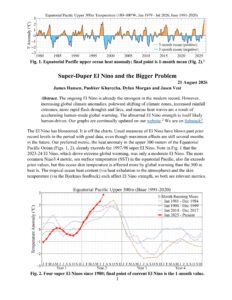
Super-duper El Niño and the bigger problem
James Hansen and colleagues, 2026
Why the 2026 El Niño is the strongest in the modern record, the doubling of Earth’s energy imbalance, and who is most exposed to the heat.
Doughnut of social and planetary boundaries monitors a world out of balance series
Doughnut Economics Action Lab
Measures whether humanity is meeting everyone’s essential needs while staying within planetary boundaries, globally and country by country.
The Sustainable Development Goals Report 2026
United Nations, 2026
The UN’s own assessment of progress four years from the 2030 deadline, and how financing gaps and climate impacts are holding it back.


