
Library | ESG issues
Board Structure
An effective board structure combines diverse expertise, skills, backgrounds, gender, and cultural perspectives. Boards consider factors like independence, rotation, term limits, and skill gaps when appointing directors. A well-structured board enhances resilience, strategic leadership, risk management, and investor confidence, fostering long-term value.



Refine
79 results
REFINE
SHOW: 16


Outsourcing active ownership in Japan
This report summarises private shareholder engagements in Japan by Governance for Owners Japan between 2009 and 2019. Findings show high success rates and positive abnormal returns, with quiet activism proving more effective than public campaigns. Evidence indicates such private engagements support Japan’s governance reforms and long-term shareholder value.

Research Institute of Economy, Trade and Industry (RIETI)
Research Institute of Economy, Trade and Industry (RIETI) is a Japanese policy think tank founded in 2001. RIETI conducts theoretical and empirical economic research, bridges academe and government, and offers evidence-based trade, industry and economic policy recommendations.

London School of Economics and Political Science (LSE)
London School of Economics and Political Science (LSE) is a global research university specialising in economics, politics, law, social policy and data science. Based in London, LSE offers undergraduate, graduate and executive degrees, and leads in social science research, public policy impact and global academic partnerships.
NYU Stern Center for Sustainable Business
NYU Stern’s Center for Sustainable Business (CSB) conducts applied research, education and engagement to embed environmental, social and governance (ESG) practices into core business strategy. It helps leaders quantify sustainability’s financial value, offers executive certificates, and develops tools to assess materiality and carbon impact.

Morgan Stanley Wealth Management
Morgan Stanley Wealth Management provides financial advice, investment strategies, and portfolio management for individuals, families, and institutions. Its services include retirement planning, sustainable investing, and access to global market insights. Morgan Stanley combines advanced digital tools with expert guidance to help clients achieve long-term financial goals and preserve wealth across generations.
Evaluation project on the effects of engagement
The report by Japan’s Government Pension Investment Fund (GPIF) evaluates how engagement by external asset managers has affected investee companies from 2017–2022. Using causal inference analysis across over 26,000 engagements, it finds positive links between engagement and improvements in corporate value, governance, decarbonisation, and diversity.

Government Pension Investment Fund (GPIF)
Government Pension Investment Fund (GPIF) is an independent administrative institution in Japan. It manages and invests pension reserve funds under Japan’s Employees’ Pension Insurance and National Pension Acts. GPIF seeks long-term, diversified returns while emphasising ESG investment and stewardship in public pension finance.
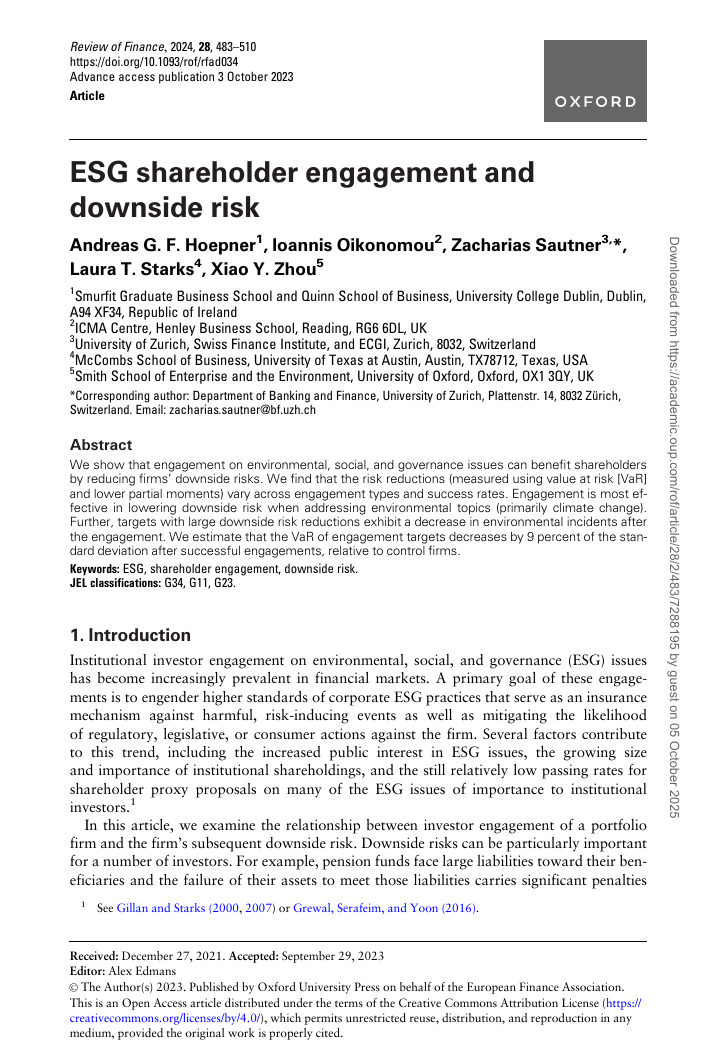
ESG shareholder engagement and downside risk
This study analyses whether investor engagement on environmental, social, and governance (ESG) issues reduces firms’ downside risk. Using data from 1,443 engagements with 485 global firms (2005–2018), it finds that successful engagements, particularly on environmental and climate issues, significantly lower downside risk and related environmental incidents.

United Nations Conference on Trade and Development (UNCTAD)
UN Trade and Development (UNCTAD) is a UN intergovernmental body that supports developing countries in trade, investment, finance and technology. It delivers data-driven policy analysis, technical cooperation and global consensus building to help countries integrate into the world economy and advance sustainable development.

Financial Markets Authority (FMA)
Financial Markets Authority (FMA) is New Zealand’s independent regulator overseeing financial markets. It promotes fair, efficient and transparent markets, ensures quality financial advice and protects investors. FMA develops regulation, supervises licenced entities, enforces compliance, supports innovation and aims to enhance trust in NZ’s financial sector.

EDHEC Climate Institute
EDHEC Climate Institute (ECI) equips finance professionals and decision-makers with climate risk research, tools and scenario analysis. It focuses on physical risks, transition risks, green assets, resilience technologies and climate policy. ECI bridges academia, industry and public stakeholders to support low-emission investment strategies.

EDHEC Business School
EDHEC Business School is an international, triple-accredited (AACSB, AMBA, EQUIS) business school with campuses in Lille, Nice, Paris, London and Singapore. It offers a broad portfolio of programmes like BBA, master's in management, MSc, MBA, PhD and executive education, emphasising research, global partnerships and real-world impact.

One Planet Network
One Planet Network is a global multi-stakeholder partnership advancing sustainable consumption and production (SCP). It implements the 10-Year Framework of Programmes (10YFP) through six thematic programmes. The network acts as a knowledge hub and convenes governments, businesses, civil society and experts on SCP and SDG 12.

Life Cycle Initiative
Life Cycle Initiative stewards global standards, tools and training for life-cycle assessment (LCA) and life-cycle thinking. It supports practitioners, policymakers and industry in applying LCA across plastics, textiles, tourism and construction. The initiative develops data networks, e-learning modules and hotspot analysis frameworks to advance sustainable decision making.
Corporate governance and equity prices
This report examines the link between shareholder rights and corporate performance in the 1990s. Using a Governance Index across 1,500 firms, it finds that stronger shareholder rights were associated with higher valuations, profits, and growth, while weaker rights correlated with lower performance and abnormal underperformance.
ESG and responsible institutional investing around the world: A critical review
This report reviews global ESG and responsible investing practices, focusing on definitions, regulation, climate finance, and institutional investor roles. It evaluates evidence from academic research and PRI data, highlighting investor influence, governance, and engagement strategies, while noting challenges around ratings, greenwashing, and measuring real outcomes.


