
Library | ESG issues
Social
The social pillar in ESG (environmental, social, and governance) assesses a organisation’s impact on people and society. It covers labour practices, diversity and inclusion, human rights and community engagement. Prioritising social responsibility not only benefits society but also mitigates risks, strengthens reputation, and creates long-term value for businesses and investors.
Refine
1118 results
REFINE
SHOW: 16


Parallelle Finance
Explore Parallelle Finance's expertise in ESG investing, with a focus on gender lens investing. Gain insights from their detailed quarterly reports on women in the global economy. Benefit from their analysis tool for scoring investments with a gender equality lens, complemented by consulting and training sessions for impactful diversity-centered investing.

The Pew Charitable Trusts
The Pew Trusts is a global non-profit organisation dedicated to addressing pressing challenges such as environmental conservation, public health, and civic engagement. With a focus on evidence-based solutions, Pew Trusts collaborates across sectors to drive positive change and contribute to a sustainable future.

Financial Stability Board (FSB)
The Financial Stability Board (FSB) is an international body that monitors and makes recommendations about the global financial system. Explore FSB's reports, guidelines, and initiatives, contributing to the resilience and sustainability of the international financial system.

Omidyar Network
Omidyar Network is a philanthropic investment firm that seeks to bring about social impact by supporting and investing in innovative initiatives. With a focus on areas like financial inclusion, education, and civic engagement, Omidyar Network works to create positive change globally through a combination of strategic grants and impact investments.

ImpactAssets
ImpactAssets is a non-profit financial services firm that aims to catalyse capital for a sustainable future. Through innovative investment strategies, they connect investors with opportunities to create positive social and environmental impact.

Pacific Community Ventures
Discover Pacific Community Ventures, a non-profit organisation empowering small businesses and communities. Through impactful investments and advising, they foster economic growth and create positive social change.

Center for the Advancement of Social Entrepreneurship (CASE) at Duke
Explore Duke University's Fuqua School of Business Center for the Advancement of Social Entrepreneurship (CASE) for impactful insights into social entrepreneurship and sustainable business practices.

Modern Slavery and Human Rights Policy and Evidence Centre
Modern Slavery PEC is a leading organisation combating modern slavery, providing insights, research, and tools to address this global issue. Visit modernslaverypec.org for resources on prevention, research findings, and collaborative efforts to eradicate modern slavery through informed policies and actions.

Center for Sustainable Finance and Private Wealth (CSP)
The Center for Sustainable Finance and Private Wealth (CSP) at the University of Zurich is a leading institution in sustainable finance research and education. Explore their site at csp.uzh.ch for insights into sustainable investment strategies, ESG integration, and the intersection of finance and environmental, social, and governance considerations.

United Nations Office for Disaster Risk Reduction (UNDDR)
The United Nations Office for Disaster Risk Reduction (UNDRR) is a global organisation dedicated to reducing the impact of disasters. Visit their official site at undrr.org for valuable resources, reports, and insights on disaster risk reduction. Access information on global initiatives, partnerships, and strategies aimed at building resilient communities and safeguarding lives.

Concrete problems in AI safety
This paper explores practical research issues associated with accidents in machine learning and artificial intelligence (AI) systems, due to incorrect objectives, scalability, or choice of behaviour. The authors present five research problems in the field, suggesting ways to mitigate risks in modern machine learning systems.

Toward a G20 framework for artificial intelligence in the workplace
This report advocates for creating a high-level, G20 framework using a set of principles for the introduction and management of big data and AI in the workplace. The paper identifies main issues and suggests two paths towards adoption.

Top 10 principles for ethical artificial intelligence
This report provides 10 principles for ethical artificial intelligence. From transparency in decision-making to ensuring a just transition and support for fundamental freedoms and rights, the report aims to empower workers and maintain a healthy balance of power in the workplace.

The state of AI in 2022 - and a half decade in review
The adoption of AI has more than doubled, with a peak of 58% in past years. The report highlights the importance of best practices and investing in AI as it is shown to bring financial returns. However, the majority of organisations are not mitigating risks associated with AI despite increasing use.

The state of AI governance in Australia
This report reveals that Australian organisations lack structured governance around AI systems. Corporate leaders should invest in expertise, create a comprehensive AI strategy, implement addressing risks and support a human-centered culture. The appropriate governance of AI systems is critical for corporate leaders to mitigate risks.
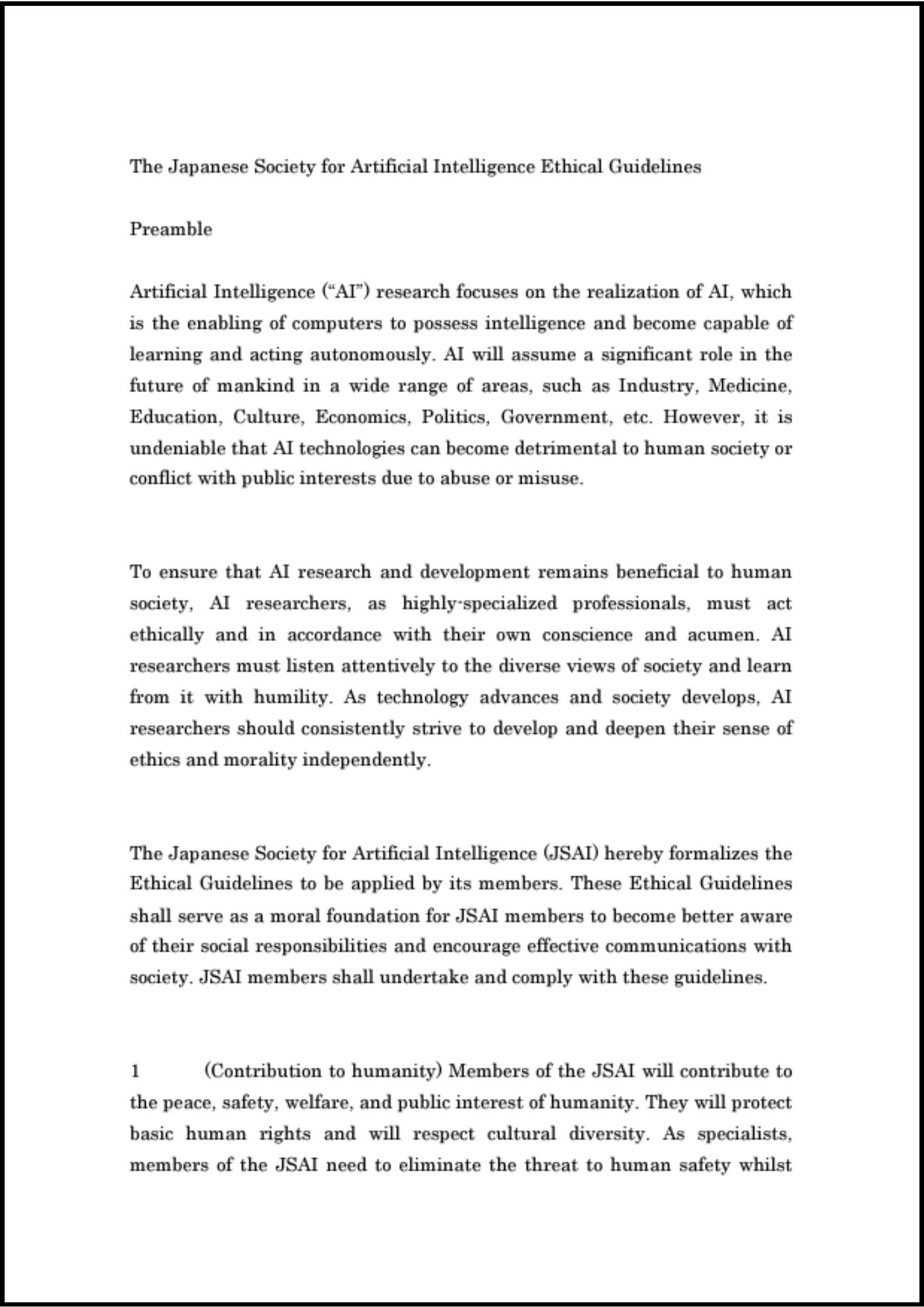
The Japanese society for artificial intelligence ethical guidelines
The Japanese Society for Artificial Intelligence has released ethical guidelines that aims to protect basic human rights and promote the peace, welfare, and public interest of humanity. The eight guidelines include: contributing to humanity, abiding by laws and regulations, respecting others' privacy, being fair, maintaining security, acting with integrity, being accountable and socially responsible, and communicating with society and self-development.


