
Library | ESG issues
Systemic Risk Management
Systemic risk refers to the possibility that an event at the company level could trigger severe instability or collapse in an entire industry or economy. It extends beyond individual failures, encompassing large-scale threats such as climate change, natural disasters, inflation, geopolitical crises, and pandemics. Effective systemic risk management requires proactive monitoring, regulatory safeguards, and resilience strategies to mitigate risks and ensure financial stability in an increasingly complex and uncertain global landscape.

Refine
390 results
REFINE
SHOW: 16



You Built This
This article argues that modern investment strategies fuel economic extraction while often underperforming simpler alternatives. It calls on investors to realign portfolios with productive, community-oriented investments that generate real economic and social value.
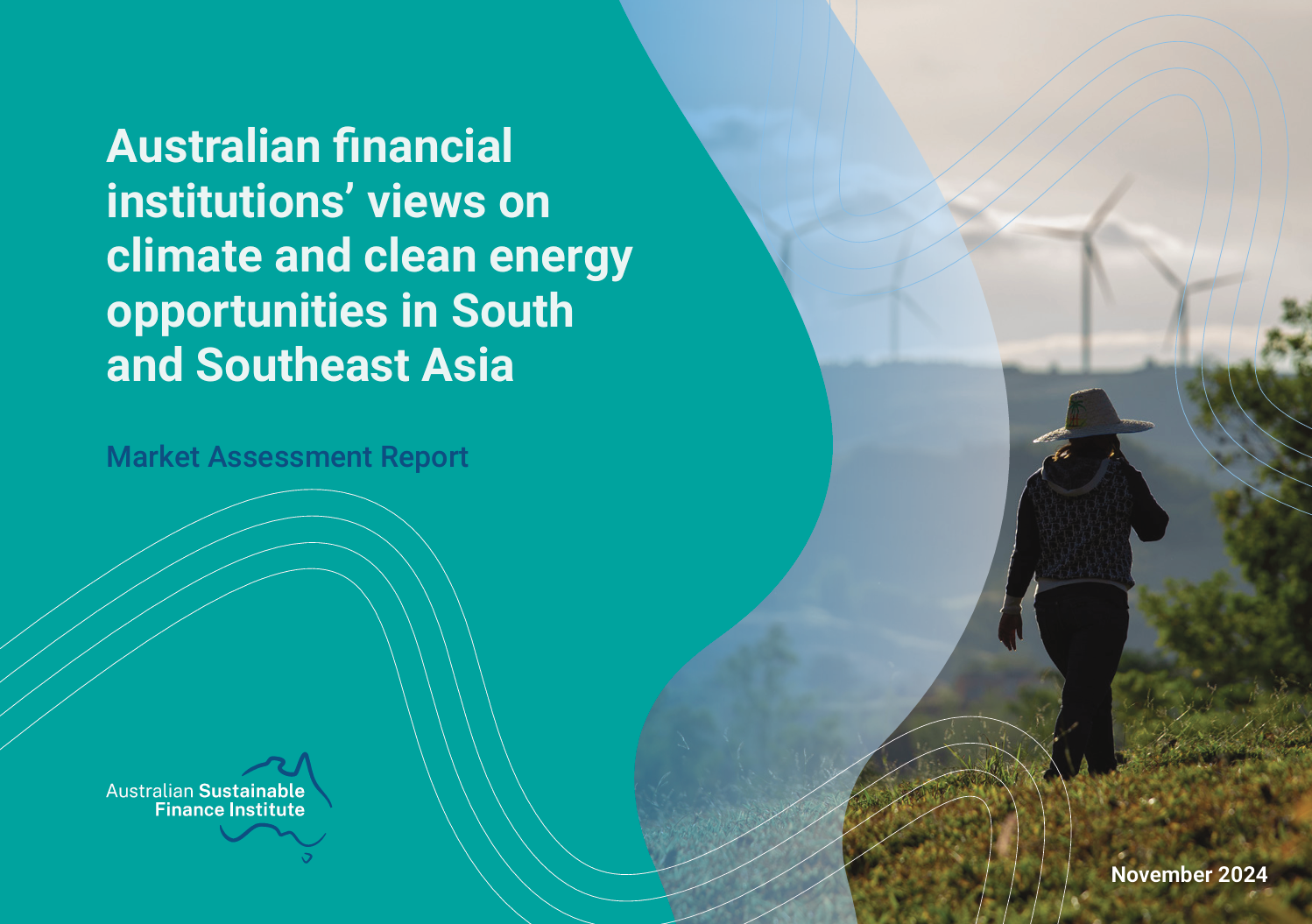
Australian financial institutions’ views on climate and clean energy opportunities in South and Southeast Asia
Assesses Australian financial institutions’ views on climate and clean energy investment in South and Southeast Asia, highlighting growth potential, limited current exposure, key risks, and barriers. It emphasises blended finance, policy support, and government intervention to mobilise private capital and scale regional investment.
The 12th national risk assessment: Property prices in Peril
First Street argues climate risk is reshaping US housing via higher insurance costs and climate-driven migration, with projected net residential property value losses of about US$1.2 trillion by 2055 and 84% of census tracts facing some negative valuation effects.
Sustainable and responsible investment for central banks
NGFS reports outline how central banks can integrate sustainable and responsible investment into corporate, sovereign and broader portfolio management, using climate metrics, risk and impact frameworks, governance arrangements and practical implementation guidance, while recognising data gaps, methodological limits and trade-offs with mandates and core investment objectives.
Breaking down silos: Navigating the intersection of environmental and social risks for investors
Examines how environmental and social risks interact to create compounding financial impacts for investors. Presents a systems-based framework and agrifood case study illustrating portfolio volatility, credit risk and supply disruptions. Recommends integrated risk assessment, value-chain finance, stewardship and blended finance to strengthen portfolio resilience.
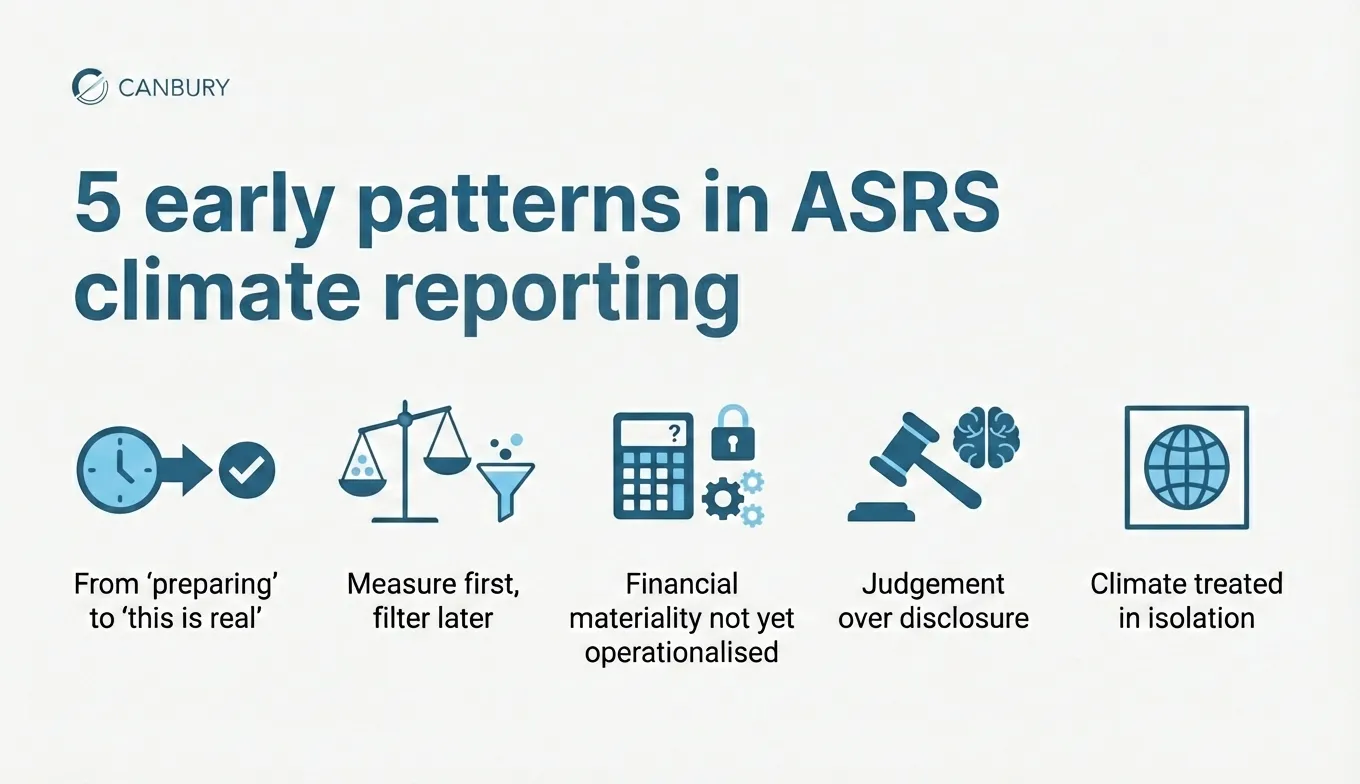
ASRS first year has landed: Here's what we’re seeing in the market
This article examines how Australian organisations are approaching the first year of mandatory ASRS climate disclosures. It highlights common implementation patterns, areas of misallocated effort, and emerging practices that prioritise financially material, decision-useful climate reporting.

The slow forces behind this year’s fast crises
The article argues that today’s rapid global crises (political, ecological, and social) are the visible outcomes of long-building systemic pressures. Using complexity science and systemic risk analysis, it highlights how understanding these deep drivers can help societies both anticipate crises and accelerate positive, transformative change.
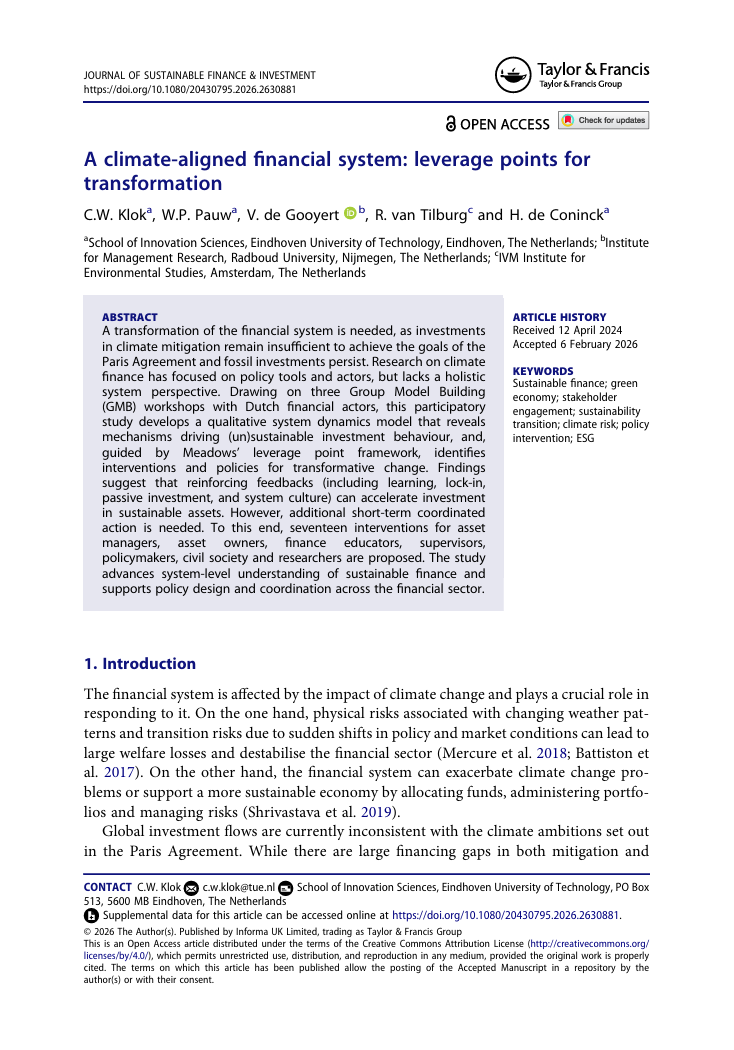
A climate-aligned financial system: Leverage points for transformation
This study models the financial system’s role in climate transition using participatory system dynamics with Dutch financial actors. It identifies reinforcing feedbacks like learning, technological lock-in, finance culture and passive investment and proposes seventeen policy and institutional interventions to redirect capital towards sustainable assets and align finance with Paris Agreement goals.
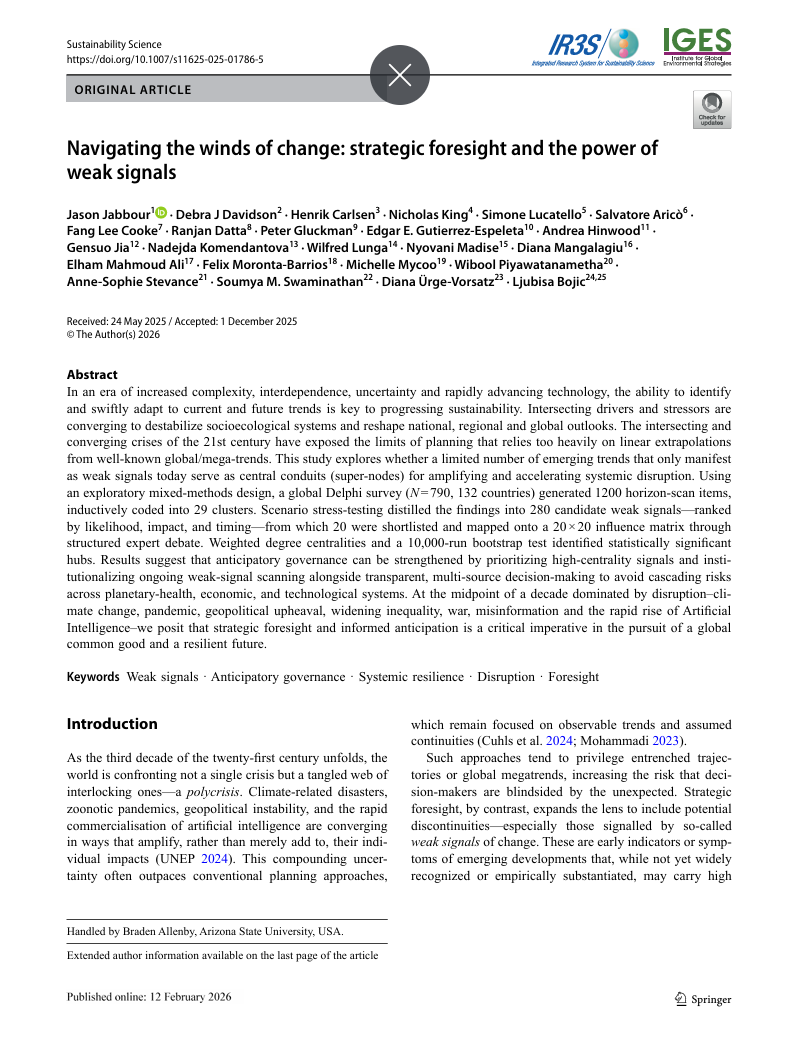
Navigating the winds of change Strategic foresight and the power of weak signals
The study highlights the importance of strategic foresight in addressing complex global challenges by identifying weak signals—early indicators of potential disruptions. It suggests that integrating these signals into governance frameworks can enhance resilience against systemic risks, urging continuous monitoring and cross-agency collabouration.
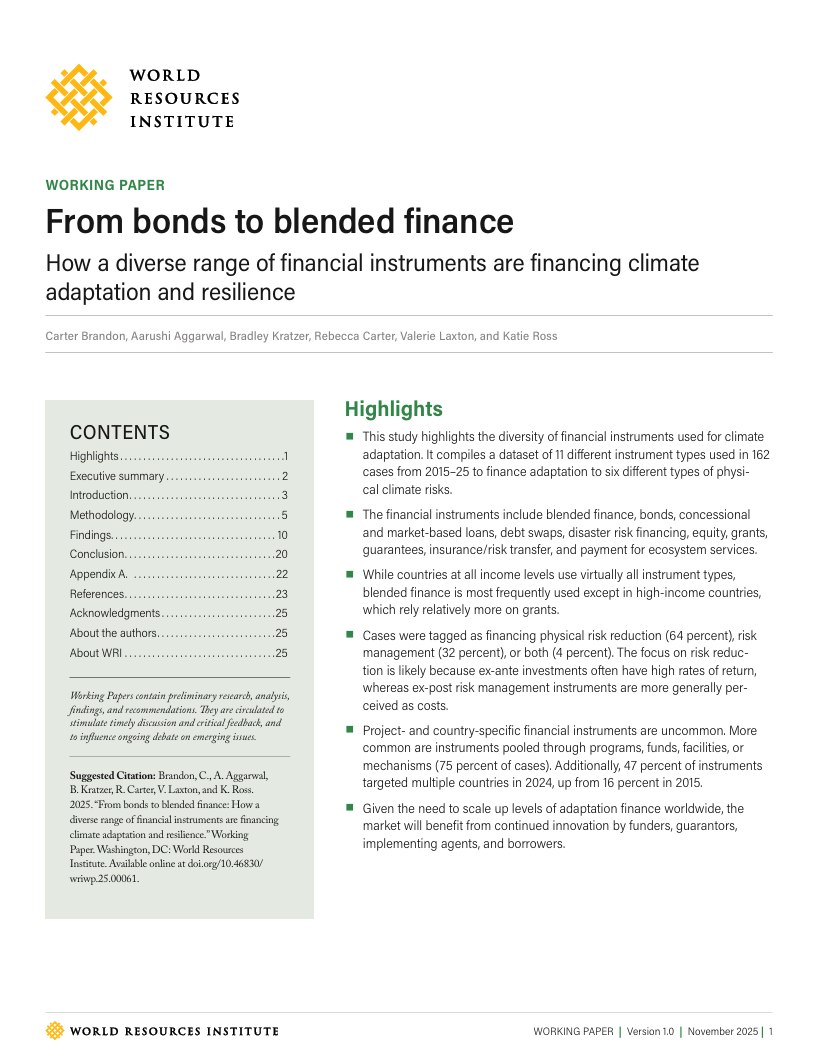
From bonds to blended Finance: How a diverse range of financial instruments are financing climate adaptation and resilience
Analyses 162 cases (2015–2025) of 11 financial instruments financing climate adaptation. Finds blended finance most prevalent, with instruments mainly supporting ex-ante risk reduction. Adaptation finance is largely pooled and increasingly multicountry. Use varies by income level, highlighting growing innovation to mobilise capital for resilience.
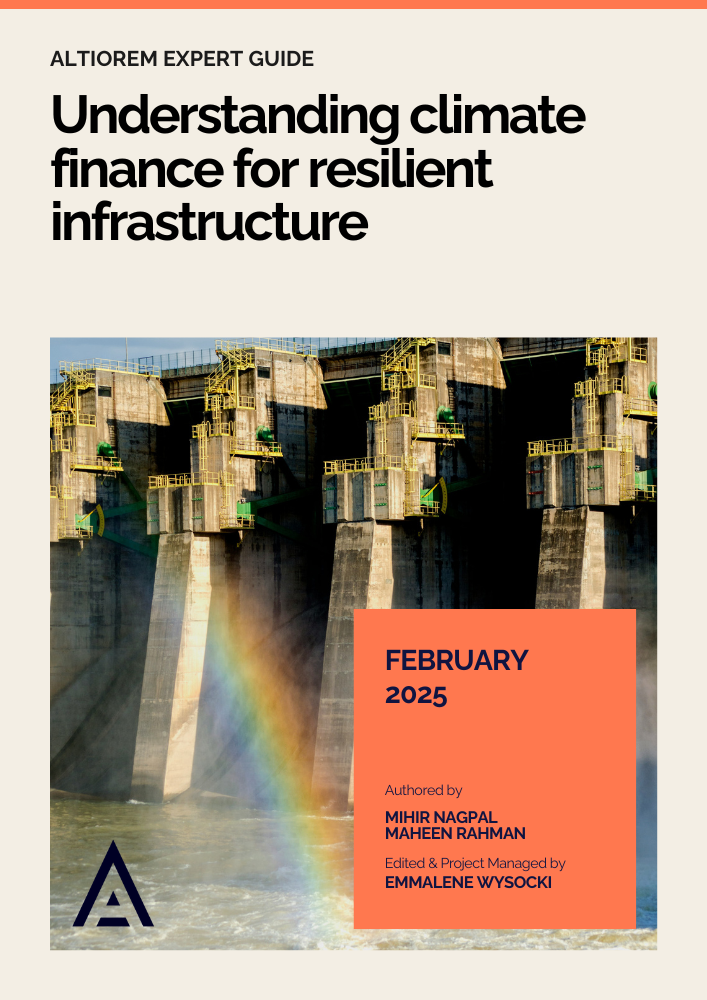
Understanding climate finance for resilient infrastructure
This expert guide outlines the rationale, tools and barriers for mobilising climate finance to deliver resilient infrastructure. It examines adaptation and mitigation finance, funding gaps, economic benefits, and stakeholder roles, supported by case studies demonstrating blended finance, insurance and public–private approaches in developing and developed contexts.
Recalibrating climate risk: Aligning damage functions with scientific understanding
This report argues climate damage functions systematically underestimate risks by relying on smooth, GDP-centred models. Drawing on expert elicitation, it highlights nonlinear, cascading and tail risks, tipping points, and limits to growth. It recommends recalibrating modelling and financial supervision towards precaution, systemic resilience and transparent uncertainty.
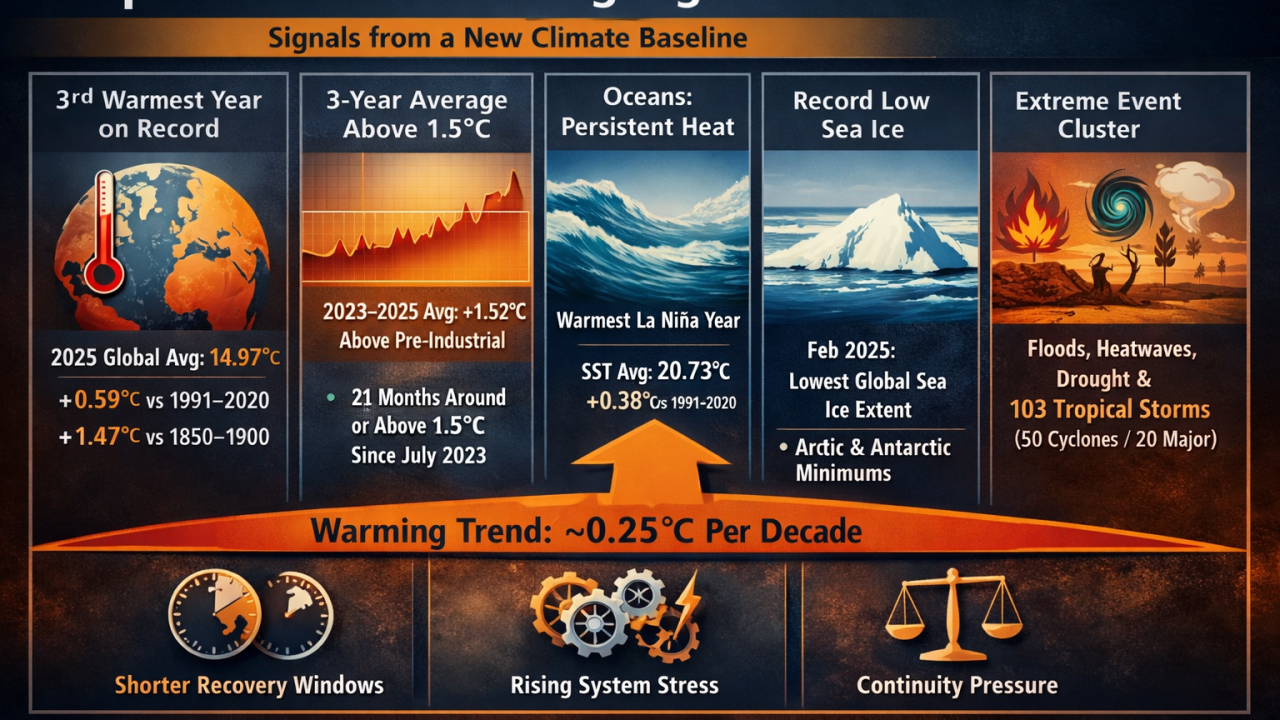
PerilScope: Strategic Deep Dive Copernicus Global Climate Highlights 2025 — From Records to Operating Conditions in the 3°C World SRP® Frame
The article interprets Copernicus’s Global Climate Highlights 2025 as a shift from episodic extremes to a structurally warmer, more volatile baseline. It argues that persistent temperature exceedances, ocean heat, cryosphere decline, and overlapping hazards demand a move from climate risk awareness to disciplined adaptation and continuity planning.
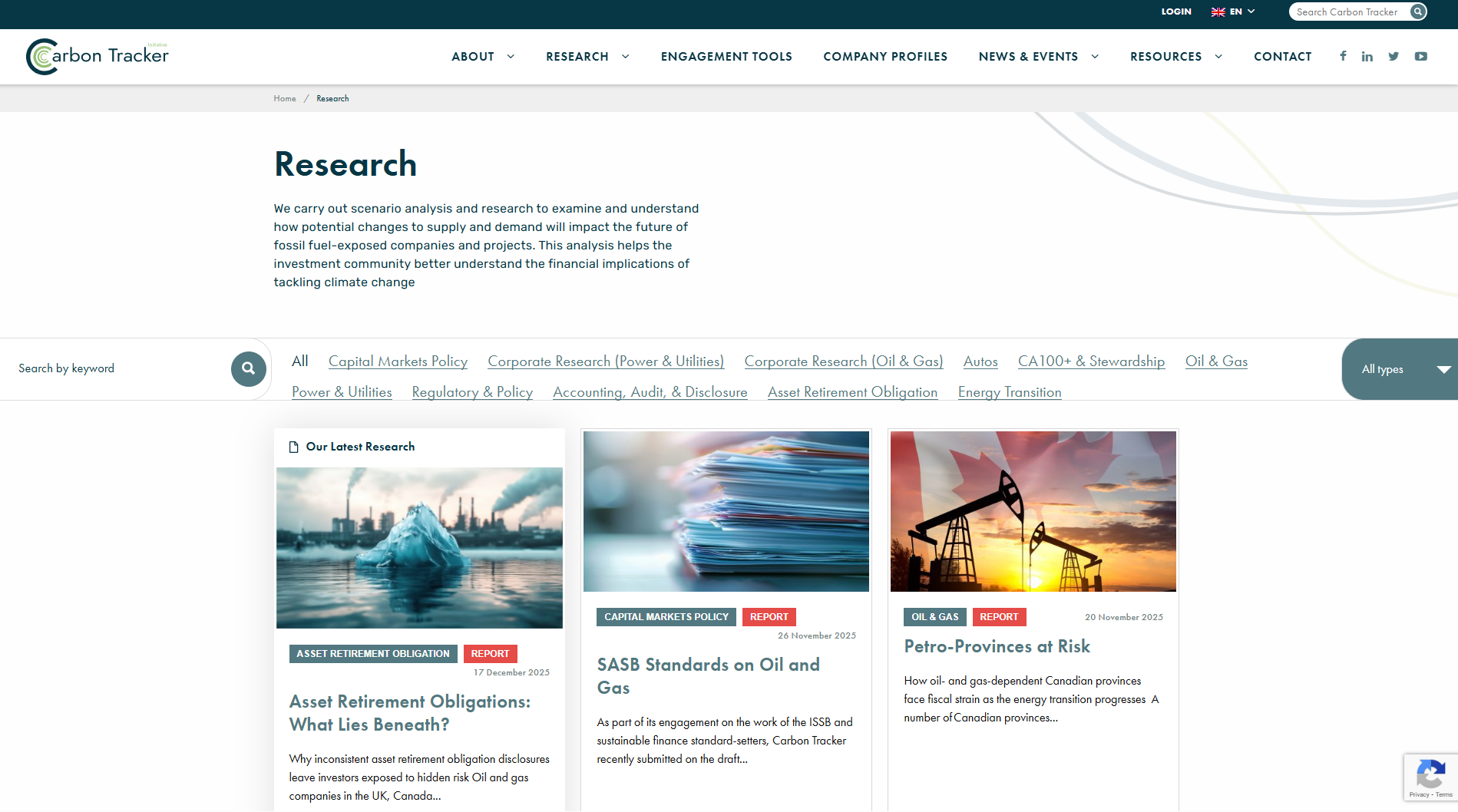
Carbon Tracker Initiative
Carbon Tracker’s Reports page hosts research analysing how supply, demand and climate policy affect fossil-fuel exposed companies and markets. It provides scenario analysis, methodological frameworks and sector-specific insights for investors and policymakers on climate-related financial risk and the energy transition.

Global cybersecurity outlook 2026: Insight report
Global Cybersecurity Outlook 2026 examines AI-driven threats, geopolitical volatility and supply chain vulnerabilities shaping cyber risk. Drawing on a global survey, it highlights rising AI-related risks, escalating cyber-enabled fraud, regulatory fragmentation and persistent skills shortages, emphasising resilience, ecosystem collaboration and economic impacts as strategic priorities.

Systems-informed stewardship part III: Reimagining stewardship for a sustainable future
This article presents systems-informed stewardship as a new approach to advancing sustainability across the finance sector. It outlines two interdependent lenses and three practical shifts, embedding responsibility, designing for complexity, and managing adaptively to improve stewardship effectiveness.


