
Library | SASB Sustainability Sector
All industries
Refine
624 results
REFINE
SHOW: 16


Deconstructing ESG ratings performance: Risk and return for E, S and G by time horizon, sector, and weighting
This article evaluates the relevance of key environmental, social, and governance (ESG) issues and the importance of their pillars regarding risk and return using a comprehensive analysis of market performance. It additionally compares the weighting and performance of each pillar and key ESG issues.

Climate contract playbook: Edition 2
This report presents a playbook of precedent clauses designed to address climate change risks and opportunities across different sectors and financing scenarios. The clauses, drafted by Hogan Lovells lawyers from over 60 jurisdictions, can be used in corporate and finance agreements to help achieve the Net Zero targets of the UK Government and others.

Overcoming the myths of mainstream economics to enable a new wellbeing economy
This report discusses the flawed theoretical pillars of mainstream economics that support unsustainable environmental, social, and economic outcomes. The paper identifies paradoxes and delusions in theories related to efficiency, wealth, well-being, and economic growth. It argues that adopting a new approach that prioritises well-being can help overcome these challenges.

Building capacity for the Paris Agreement's Enhanced Transparency Framework: What can we learn from countries' experiences and UNFCCC processes?
This report outlines the necessity of capacity building to enhance transparency in the Paris Agreement. The report uses 13 case studies to highlight challenges in implementing transparency requirements and six lessons for effective capacity building. International initiatives and support programs are discussed to inform the construction of transparent and sustainable climate governance.

Workplace health is workplace wealth: A case for investor action on worker health and a practical guide for getting started
This report highlights the financial benefits to companies and the economy as a whole of investing in worker health. The report urges investors to consider population health when making investment decisions, and outlines a practical guide for companies to improve worker health. Key areas include job security, mental health, and good work-life balance.

Concrete problems in AI safety
This paper explores practical research issues associated with accidents in machine learning and artificial intelligence (AI) systems, due to incorrect objectives, scalability, or choice of behaviour. The authors present five research problems in the field, suggesting ways to mitigate risks in modern machine learning systems.

Top 10 principles for ethical artificial intelligence
This report provides 10 principles for ethical artificial intelligence. From transparency in decision-making to ensuring a just transition and support for fundamental freedoms and rights, the report aims to empower workers and maintain a healthy balance of power in the workplace.

The state of AI in 2022 - and a half decade in review
The adoption of AI has more than doubled, with a peak of 58% in past years. The report highlights the importance of best practices and investing in AI as it is shown to bring financial returns. However, the majority of organisations are not mitigating risks associated with AI despite increasing use.

The state of AI governance in Australia
This report reveals that Australian organisations lack structured governance around AI systems. Corporate leaders should invest in expertise, create a comprehensive AI strategy, implement addressing risks and support a human-centered culture. The appropriate governance of AI systems is critical for corporate leaders to mitigate risks.
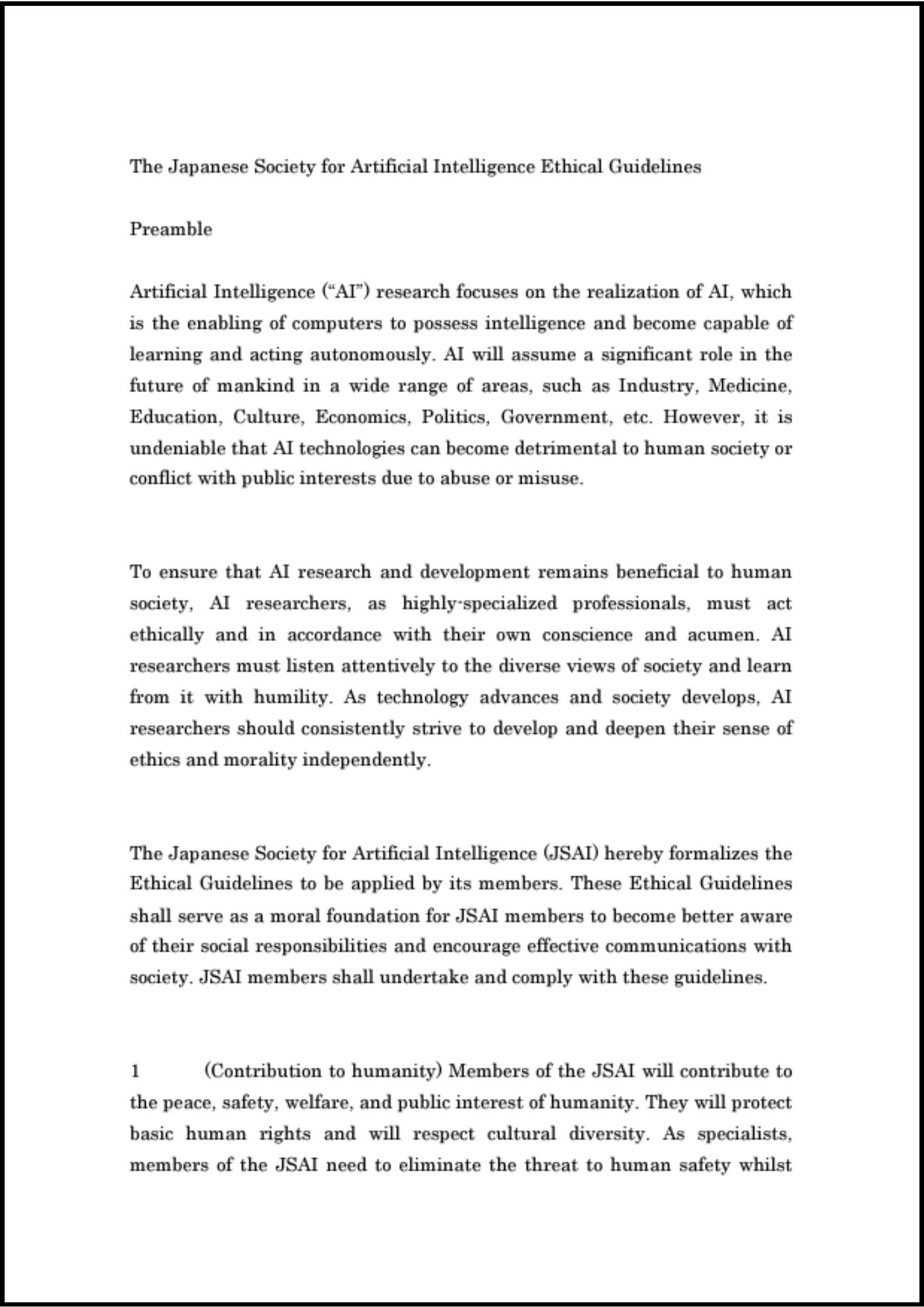
The Japanese society for artificial intelligence ethical guidelines
The Japanese Society for Artificial Intelligence has released ethical guidelines that aims to protect basic human rights and promote the peace, welfare, and public interest of humanity. The eight guidelines include: contributing to humanity, abiding by laws and regulations, respecting others' privacy, being fair, maintaining security, acting with integrity, being accountable and socially responsible, and communicating with society and self-development.

The implications of AI across sectors and against 6 key ESG considerations
AI offers great positive impacts and risks. This report helps to understand the risks associated with developing and using AI tech. Scoping exercise identifies opportunities and threats across sectors. Six core ESG considerations including trust and security, data privacy, and sentience are evaluated for potential impact.

The impact of digital technology on human rights in Europe and Central Asia
This report examines the impact of digital technology and artificial intelligence on human rights in Europe and Central Asia, with a particular focus on the use of data protection and legislative frameworks. It provides an overview of the relevant international and regional initiatives, and analyses the applicable legal, regulatory, and institutional frameworks.

The global governance of artificial intelligence: Next steps for empirical and normative research
This analytical essay outlines an agenda for research into the global governance of artificial intelligence (AI). It distinguishes between empirical research, aimed at mapping and explaining global AI governance, and normative research, aimed at developing and applying standards for appropriate global AI governance.

The geography of Australia’s digital industries: Digital technology industry clusters in Australia’s capital cities and regions
This report documents the location of 96 digital technology industry clusters in Australia’s capital cities, regions, and suburbs. The report draws attention to the variables that affect industry growth and development, from company profit growth to housing affordability and quality of life.

Technology tools in human rights
This report explores technology tools available to human right defenders for collecting, managing, analysing, communicating and archiving data. HRDs should prioritise simplicity, familiarity, and ease of use when choosing a tool, and be mindful of potential security risks. Strategic partnerships and obtaining second opinions can also aid decision making.

Statement on artificial intelligence, robotics and 'autonomous' systems
This statement from the European Group on Ethics in Science and New Technologies emphasises the need for a shared international ethical and legal framework for the design and governance of artificial intelligence, robotics, and 'autonomous' systems. It also proposes ethical principles based on EU values to guide the framework's development.


