
Library | Finance relevance
Investment managers / asset managers
Refine
1140 results
REFINE
SHOW: 16


GHG protocol scope 2 guidance: An amendment to the GHG protocol corporate standard
This report updates the GHG Protocol Corporate Standard by introducing dual reporting for Scope 2 emissions—requiring both location-based and market-based methods. It defines Scope 2 accounting principles, emission factor hierarchies, and quality criteria for contractual instruments, aiming to improve transparency, accuracy, and comparability across energy markets.

Corporate value chain (scope 3) accounting and reporting standard: Supplement to the GHG protocol corporate accounting and reporting standard
The Corporate Value Chain (Scope 3) Accounting and Reporting Standard provides a consistent framework for measuring and reporting indirect greenhouse gas (GHG) emissions across a company’s value chain. It outlines 15 categories of Scope 3 emissions, offers guidance on boundary setting, data collection, and reporting, and aims to improve transparency, enable emissions reduction, and support strategic decision-making.

Green and intelligent: the role of AI in the climate transition
Artificial intelligence (AI) can support the climate transition by reducing global emissions by up to 5.4 GtCO₂e annually by 2035 in the power, food, and transport sectors, surpassing its own energy footprint. Strategic government action is essential to ensure AI accelerates low-carbon solutions equitably and effectively.

Counterproductive sustainable investing: The impact elasticity of brown and green firms
Sustainable investing strategies that reallocate capital from brown to green firms may unintentionally worsen environmental outcomes. This study finds that green firms show minimal environmental improvement from lower capital costs, while brown firms become more polluting when financially constrained. Current investment approaches offer weak incentives for impactful emissions reductions.

Corporate climate litigation in Australasia: (Re)shaping the private law-climate interface
The report examines how corporate climate litigation in Australia and New Zealand is shaping private law. It highlights legal actions involving directors’ duties, disclosure obligations, consumer protections, and tort law. The analysis shows incremental adaptations in private law to address climate change impacts, especially through anti-greenwashing and climate accountability claims.

The path to a new era for nuclear energy
Nuclear energy is gaining momentum as a reliable, low-emissions electricity source. The report outlines growth drivers, investment needs, emerging technologies such as small modular reactors, and policy frameworks required for scale-up. Financing challenges, supply chain risks, and workforce planning are key to realising nuclear’s role in future energy systems.
Targeting net zero: The need to redesign bank decarbonization targets
This report examines the limitations of current bank decarbonisation targets and proposes design reforms to align with net zero. It analyses scope coverage, target types, and sector alignment, offering practical recommendations for enhancing climate credibility and effectiveness in financial institutions’ transition planning.

Nature positive: Leaders’ insights for the transition in cities
The report outlines strategies and case studies from global cities integrating nature into urban development to address climate and biodiversity challenges. It highlights the importance of public-private collaboration, compact planning, and nature-based infrastructure in fostering resilient, sustainable, and equitable cities. Solutions are scalable and grounded in real-world examples.

Kantar
Kantar is a global leader in marketing data, insights and analytics, supporting over 96 of the world’s top 100 advertisers across 90+ markets. It combines behavioural and attitudinal data to inform brand strategy, creative testing, media effectiveness, customer experience and sustainable growth.
Starting up: Responsible investment in venture capital
This report examines how environmental, social, and governance (ESG) factors are being adopted in venture capital. It outlines current practices, challenges, and industry-specific considerations, and highlights the need for tailored guidance, collaboration, and early-stage engagement to advance responsible investment across the venture capital ecosystem.

Reducing animal testing in the health sector through strategic investment: Guide for investors
The report outlines how strategic investment can reduce animal testing in the health sector. It provides investors with guidance on promoting transparency, encouraging non-animal methods, and influencing regulation, while highlighting the risks of limited disclosure and misalignment with consumer concerns.

Market Forces
Market Forces works to hold financial institutions accountable for funding environmentally harmful projects. Based in Australia, it campaigns for banks, superannuation funds and governments to align investments with climate goals. Market Forces provides research, advocacy tools and transparency on fossil fuel financing to support climate-conscious financial decision-making.
Australian sustainable finance taxonomy (Version 1 - 2025)
The Australian Sustainable Finance Taxonomy (2025) provides a framework classifying economic activities aligned with environmental sustainability goals, particularly climate mitigation. It includes performance-based criteria for key sectors such as agriculture, mining, energy, construction, and transport, facilitating sustainable capital allocation, consistent reporting, and transition planning, thus supporting Australia’s transition to a net-zero emissions economy.
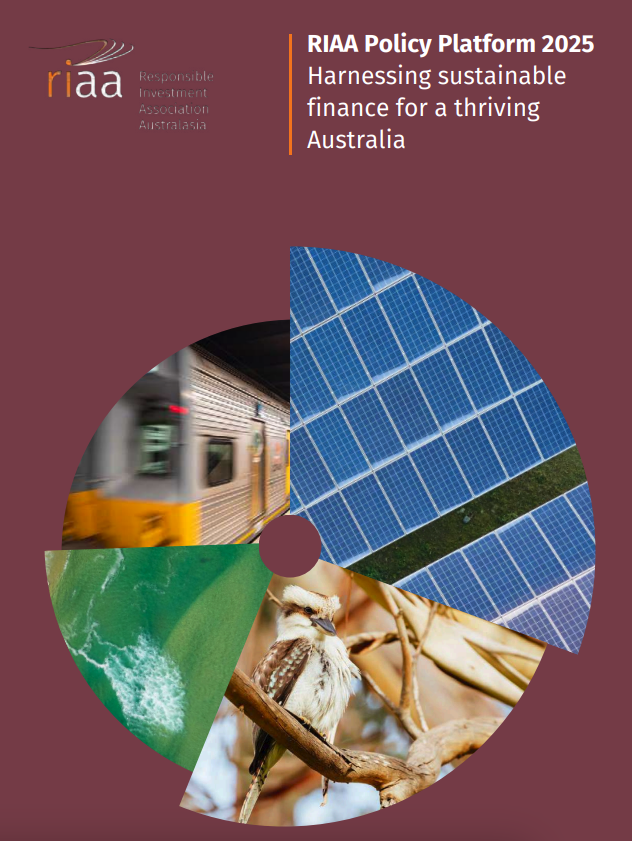
RIAA Policy Platform 2025: Harnessing sustainable finance for a thriving Australia
The RIAA Policy Platform 2025 outlines nine policy priorities and two principles to align Australia’s finance system with sustainability goals. It recommends regulatory reforms, improved data, Indigenous inclusion, and stronger accountability to mobilise capital for a net zero, nature-positive economy that supports long-term economic resilience and societal wellbeing.
Find it, fix it, prevent it: Modern slavery report 2024
CCLA’s 2024 report outlines investor-led efforts to address modern slavery through corporate engagement, policy advocacy, and improved data. Key sectors include construction and agriculture. Progress was made via benchmarking and collaborative initiatives, though disclosure and remedy remain limited. EU legislation and stakeholder coordination are driving further momentum.

Impact economies tractions and trends: Insights from 34 GSG National Partners
This report presents insights from 34 national ecosystems advancing impact investing. It highlights trends in policy, capital mobilisation, and transparency, showing governments and institutions integrating social and environmental outcomes into investment strategies. It tracks growth in green finance, outcome-based funding, and investment readiness across emerging and developed economies.


