
Library | Finance relevance
Investment managers / asset managers
Refine
1144 results
REFINE
SHOW: 16


Concrete problems in AI safety
This paper explores practical research issues associated with accidents in machine learning and artificial intelligence (AI) systems, due to incorrect objectives, scalability, or choice of behaviour. The authors present five research problems in the field, suggesting ways to mitigate risks in modern machine learning systems.

Toward a G20 framework for artificial intelligence in the workplace
This report advocates for creating a high-level, G20 framework using a set of principles for the introduction and management of big data and AI in the workplace. The paper identifies main issues and suggests two paths towards adoption.

The state of AI in 2022 - and a half decade in review
The adoption of AI has more than doubled, with a peak of 58% in past years. The report highlights the importance of best practices and investing in AI as it is shown to bring financial returns. However, the majority of organisations are not mitigating risks associated with AI despite increasing use.

The state of AI governance in Australia
This report reveals that Australian organisations lack structured governance around AI systems. Corporate leaders should invest in expertise, create a comprehensive AI strategy, implement addressing risks and support a human-centered culture. The appropriate governance of AI systems is critical for corporate leaders to mitigate risks.

The implications of AI across sectors and against 6 key ESG considerations
AI offers great positive impacts and risks. This report helps to understand the risks associated with developing and using AI tech. Scoping exercise identifies opportunities and threats across sectors. Six core ESG considerations including trust and security, data privacy, and sentience are evaluated for potential impact.

The impact of digital technology on human rights in Europe and Central Asia
This report examines the impact of digital technology and artificial intelligence on human rights in Europe and Central Asia, with a particular focus on the use of data protection and legislative frameworks. It provides an overview of the relevant international and regional initiatives, and analyses the applicable legal, regulatory, and institutional frameworks.

The global governance of artificial intelligence: Next steps for empirical and normative research
This analytical essay outlines an agenda for research into the global governance of artificial intelligence (AI). It distinguishes between empirical research, aimed at mapping and explaining global AI governance, and normative research, aimed at developing and applying standards for appropriate global AI governance.

The geography of Australia’s digital industries: Digital technology industry clusters in Australia’s capital cities and regions
This report documents the location of 96 digital technology industry clusters in Australia’s capital cities, regions, and suburbs. The report draws attention to the variables that affect industry growth and development, from company profit growth to housing affordability and quality of life.

Statement on artificial intelligence, robotics and 'autonomous' systems
This statement from the European Group on Ethics in Science and New Technologies emphasises the need for a shared international ethical and legal framework for the design and governance of artificial intelligence, robotics, and 'autonomous' systems. It also proposes ethical principles based on EU values to guide the framework's development.
Safety by design: Model clauses for due diligence arrangements and funding agreements
This document provides model clauses for due diligence arrangements and funding agreements related to eSafety for startups. It includes pre-conditions for funding agreements, covering policies, staffing, training, and external communication. Additionally, the document urges startups to complete the eSafety assessment tool and implement safety by design measures.

Safety by design: Investment checklist
This investment checklist is a concise guidance document, aimed at investors and venture capitalists considering whether to invest in tech companies. The checklist presents a 12-point criteria touching on design and provision of services, community guidance, safety reviews, user tools, and proactive steps to inform users about safety policies.
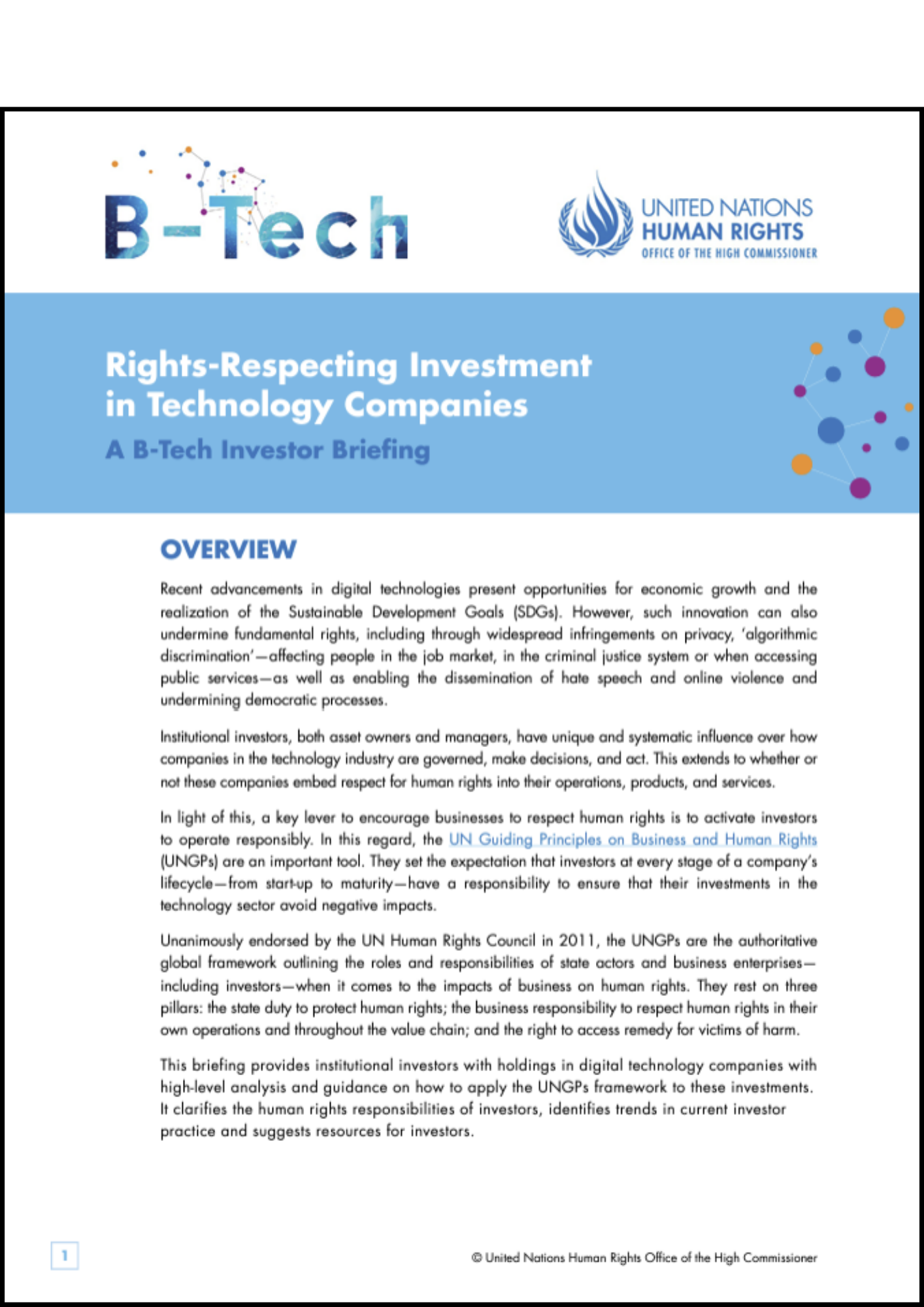
Rights-respecting investment in technology companies
This briefing highlights the potential human rights impact of technological advancements and the responsibility of institutional investors to mitigate these risks. Based on the UN Guiding Principles, investors should implement human rights policies, assess risks and divest from companies with inadequate human rights practices.

Report of COMEST on robotics ethics
COMEST has released a report on robotics ethics which covers the history, development, and social impact of robots. It also offers recommendations for the ethical use of robotics.

Montreal declaration for a responsible development of artificial intelligence
This report outlines a framework for responsible development of artificial intelligence. It provides principles that should guide ethical use of AI for the well-being of sentient beings, respect for autonomy, protection of privacy and intimacy, solidarity, democratic participation, equity, diversity inclusion, caution, responsibility, and sustainable development.

Investors' expectations on responsible artificial intelligence and data governance
This report outlines responsible AI and data governance principles and engagement framework for investors across multiple sectors. The six core principles aim to enhance machine learning, auditability, explainability, and transparency, while taking into account legal, regulatory, ethical, and reputational risks.

Human rights risks in tech: Engaging and assessing human rights risks arising from technology company business models
This tool outlines strategies for investors to assess technology companies’ responsibility to respect human rights. It includes questions addressing engagement on specific business model features that may create human rights risks and an evaluation framework to assess company responses.


