
Library | Asset Class
Fixed Income & Cash
Fixed income includes government bonds, corporate bonds and asset-backed securities. Cash typically refers to money market instruments and short-term, highly liquid investments that provide capital preservation and stability.
Refine
311 results
REFINE
SHOW: 16


Petrochemicals: Major credits, carbon risks, green bonds
This report reviews the petrochemical industry from a joint macro, credit specialist and climate mitigation perspective. It highlights that the industry has the highest energy demand and is the third-largest direct CO2 emitter. The first green bonds came out in 2020, although the sector’s environmental alignment remains questionable to investors.

Investing in Black technical talent: The power of partnering with HBCUs
Historically Black Colleges and Universities (HBCUs) are significantly underfunded compared to other higher learning institutions, yet excel in producing diverse professionals. Organisations can bridge the skills gap by developing, hiring, and retaining top technical talent.

Australian Social Impact Investing Taskforce: A Commonwealth strategy to build a mature and self-sustaining social impact investing market that improves the lives of vulnerable Australians
The report details a strategy to support early-stage social enterprises and foster growth in social impact investment (SII) opportunities. The report explores four action areas for government and stakeholders to accelerate SII growth and improve social impact measurement.

Five-step approach to stakeholder engagement
This is a comprehensive toolkit developed to help companies understand and respond to existing and emerging societal concerns through stakeholder engagement. It is based on the long experience of the authors and interviews with member companies and BSR employees.

Water risks and financial market: Overview and analysis
This report explores water risks and opportunities in the financial sector. It provides an overview of tools and approaches to assess water risks, identifies potential actions to align with international water goals, and calls for greater integration of water considerations into financial decision-making.

SDG action manager technical guide
This guide provides businesses with a web-based impact management solution to take action on the Sustainable Development Goals (SDGs) through 2030. The guide describes the overall structure, module design, baseline module, SDG-specific modules, scoring methodology, and development process of the SDG Action Manager in a concise manner.

Physical risk framework: Understanding the impacts of climate change on real estate lending and investment portfolios
This report provides lenders and investors with a four-step process to assess the physical impact of climate change on their real estate and infrastructure portfolios. The report emphasises the importance of using insurers’ extreme weather models within this framework to estimate natural catastrophe risks.
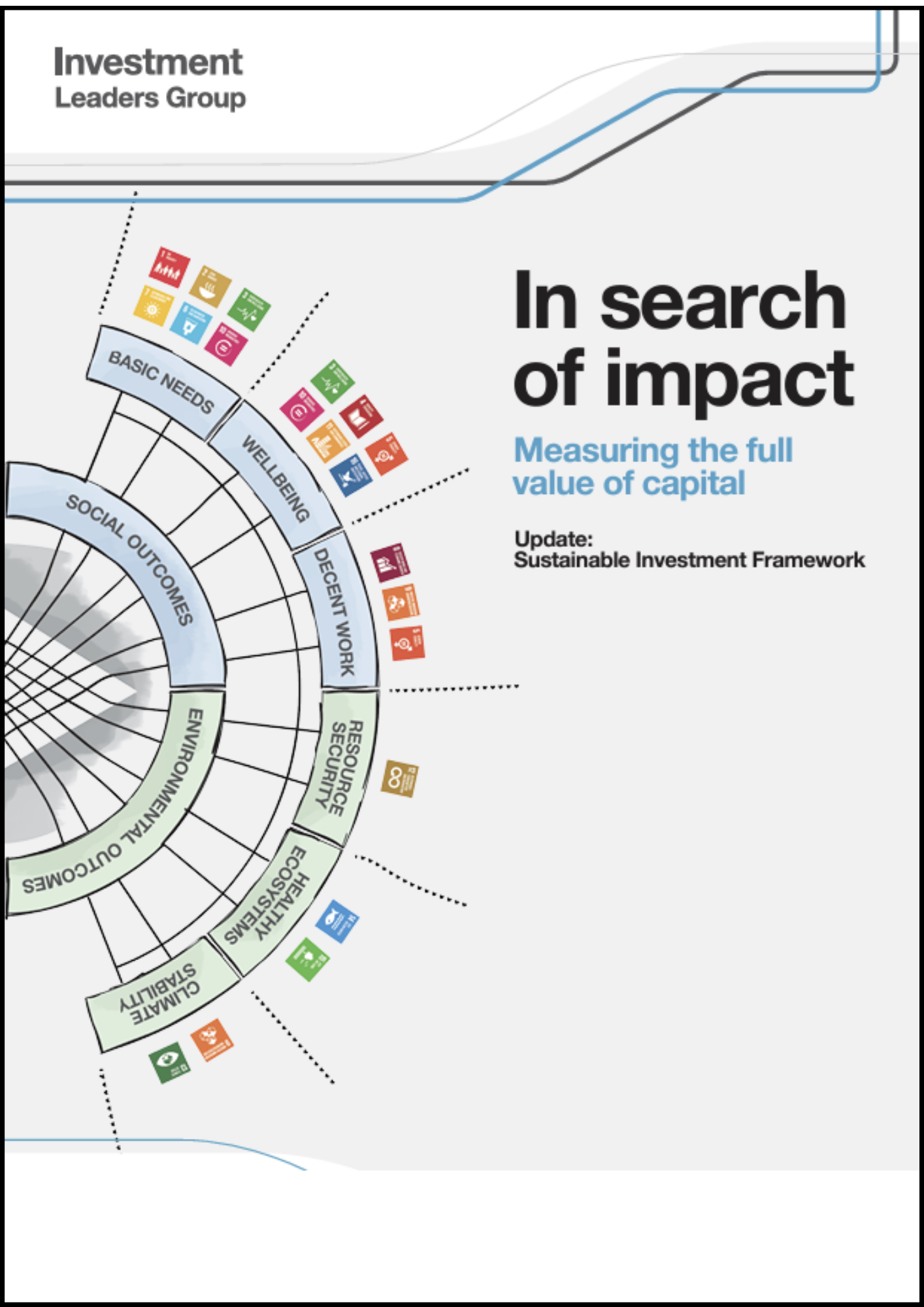
In search of impact: Measuring the full value of capital
This report outlines a sustainable investment framework, designed to empower individuals and organisations to better understand and make informed investment choices. The framework utilises six themes to communicate the impact of financial flows into the economy and contains theoretically grounded metrics that can be practically applied.

Why and how investors should act on human rights
This report outlines how institutional investors can respect human rights as defined by international standards. The six principles of ESG investing, such as incorporating ESG issues into decision-making processes and seeking appropriate disclosure help to promote acceptance of human rights in the investment industry.

Investor ESG guide on private security and human rights
This investor guide highlights that private security-related adverse human rights impacts are common and typically include excessive use of force, unfair working conditions and sexual exploitation. As fiduciaries, institutional investors are obligated to identify and mitigate these potential adverse impacts.

Guidance and questionnaire for assessing client sustainability preferences and motivations
This report presents guidelines for investment firms to assess client sustainability preferences and motivations, and select financial products accordingly. The guidance outlines a three-step process toward a product recommendation and identifies keyword categories of sustainability preferences and motivational characteristics.

A sustainable finance policy engagement handbook
This handbook introduces six principles outlining institutional investors' commitment to incorporate ESG issues in investment analysis, ownership policies and practices, and promotion of acceptance and implementation of the Principles. The report explains how responsible investors can engage with policymakers to promote a sustainable financial system.

Impact investing in biodiversity conservation with bonds: An analysis of financial and environmental risk
This report examines the financial and environmental risks associated with impact investing in biodiversity conservation through bonds. It evaluates five case studies, analysing the projects' theories of change, potential risks, and mitigation strategies. The findings highlight complexities in achieving both financial returns and conservation impact, with concerns about vague metrics and project uncertainties.

Investing for outcomes: Why impact is relevant beyond impact investing
This report explores the importance of measuring the impact of investing activities, particularly in the increasingly popular field of impact investing. It discusses the use of data to assess a company's social and environmental footprint, the role of taxonomies in impact investing, and the rise of impact awareness.

Impact investing for pensions
This report analyses the growth of impact investing strategies among European pension funds. The report examines challenges and opportunities, regulatory restrictions, impact measurement and management, private equity case studies, and emerging investments in affordable and social housing.

Gender bonds: A toolkit for the design and issuance of gender bonds in Africa
This toolkit was prepared to design and issue gender bonds in Africa. It provides recommendations for issuers and investors on the issuance and monitoring of gender bonds with a focus on transparency and reporting.


