
Library | Sustainable Finance Practices
ESG Integration and analysis
Tools, methodologies, and frameworks for embedding ESG factors into financial analysis, valuation, credit assessment, underwriting, and portfolio management, while separating out broader strategic elements.
Refine
537 results
REFINE
SHOW: 16


A review of the link between sustainability performance and company valuation
The report reviews recent evidence on links between sustainability performance and company valuation, finding growing but uneven market recognition. Strong strategies can improve resilience, EBITDA and capital costs, while inaction raises long-term financial risk amid evolving disclosure and regulation.
A risk professional’s guide to physical risk assessments: A GARP benchmarking study of 13 vendors
GARP benchmarks 13 vendors’ asset-level climate physical risk models, finding wide dispersion in hazard and damage estimates due to differing data, assumptions and methods. The report stresses due diligence, transparency and improved asset data when selecting vendors.
The Climate Resilience Investment Framework (CRIF)
IIGCC’s Climate Resilience Investment Framework provides investors with a structured approach to manage physical climate risks, integrate adaptation into portfolios, and guide asset-level, portfolio, and policy actions, prioritising real estate and infrastructure through a process-based methodology aligned with financial materiality.
The role of traceability in critical mineral supply chains
The report examines how traceability can support responsible critical mineral supply chains. It outlines policy drivers, system components, costs and limitations, and mineral-specific challenges, concluding that well-designed traceability can enhance due diligence, transparency and supply security when proportionate and risk-based.
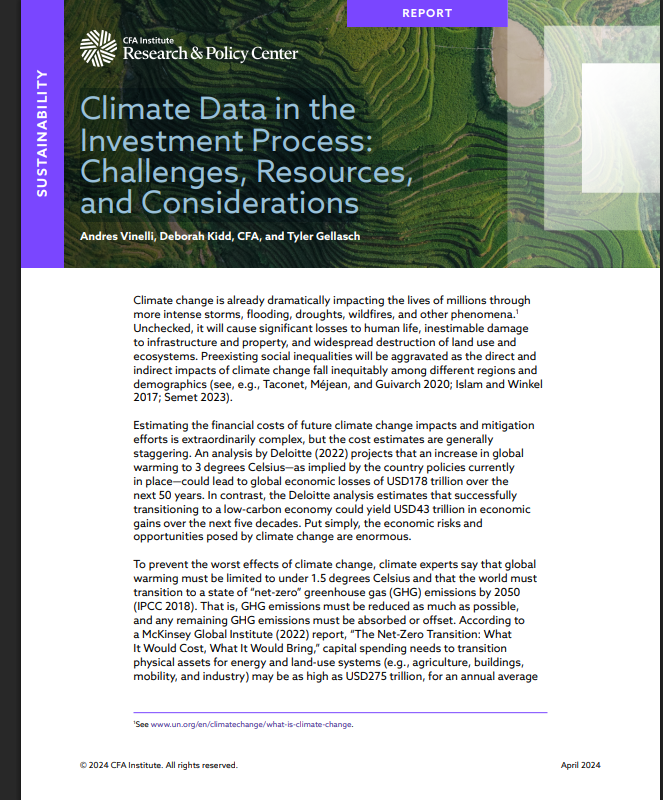
Climate data in the investment process: Challenges, resources, and considerations
The report examines how climate-related data are used in investment decision-making, highlighting limitations in availability, consistency, and comparability. It reviews greenhouse gas metrics, evolving global disclosure standards, and regulatory milestones, and outlines practical strategies for investors managing imperfect climate data.
Distinguishing among climate change-related risks
The report distinguishes planetary, economic and financial climate risks, clarifying their differing scopes, timeframes and responsible actors. It argues that conflating these risks weakens policy and investment responses, and calls for clearer delineation to improve risk assessment, accountability and targeted climate action.
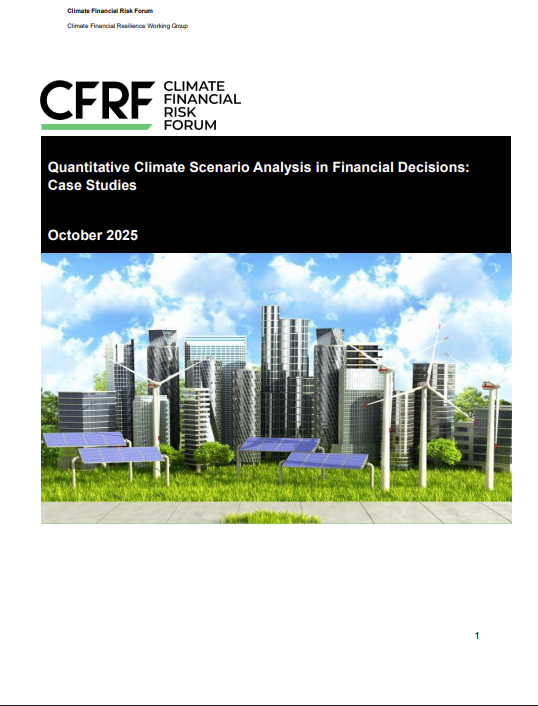
Quantitative climate scenario analysis in financial decisions: Case studies
This CFRF report presents nine case studies demonstrating how quantitative climate scenario analysis informs financial decisions. It assesses physical and transition risks across assets, sectors and geographies, translating climate pathways into impacts on valuations, credit risk and losses to support risk-based decision-making.
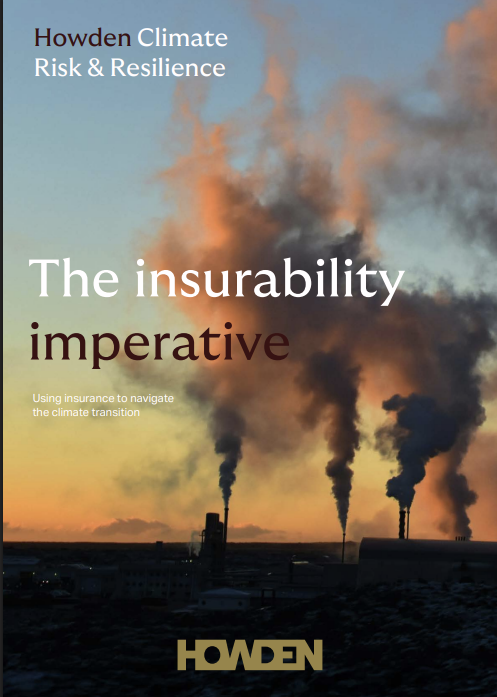
The insurability imperative: Using insurance to navigate the climate transition
This report argues that insurability is a strategic indicator of financial viability in a climate-disrupted economy. It explains how insurance, risk modelling, resilience investment, and policy alignment shape access to capital, asset values, and transition finance, urging leaders to embed insurability into decision-making.
First Sentier MUFG Sustainable Investment Institute
First Sentier MUFG Sustainable Investment Institute provides independent research on sustainable investing, ESG (environmental, social and governance), market trends and responsible investment. It supports investors, asset managers and policymakers with evidence-based reports and insights. Jointly backed by First Sentier Group and MUFG, it advances understanding of sustainable finance and investment practice.

First Street
First Street Foundation is a nonprofit 501(c)(3) research and technology group that quantifies and communicates climate-related physical risk, including flooding, wildfire, wind, and heat, at the property level. It produces peer-reviewed climate risk models and tools to help individuals, governments and financial institutions understand and act on climate risk data.

Theia Finance Labs (formerly 2° Investing Initiative Germany)
Theia Finance Labs is a non-profit research and innovation organisation focused on climate finance and financial system transformation. It develops open research, tools and methodologies to assess climate alignment, transition risk and systemic change, supporting investors, policymakers and financial institutions to align markets with climate goals and sustainability objectives globally.
Supplement to the target market to include information on sustainability related objectives1 and sustainability factors
This supplement outlines a framework for classifying financial products by sustainability objectives under MiFID II. It defines ESG target markets, minimum exclusions, PAIs, and alignment with SFDR and Taxonomy rules across securities, funds, bonds, and certificates.
Rearm europe, rearm finance: What role for responsible investment in the financing of european defense?
Mirova assesses Europe’s defence rearmament and examines how responsible investors could contribute without undermining ESG principles. It argues for selective financing, strict exclusions, and innovative tools such as defence bonds, while maintaining focus on environmental transition and European sovereignty.

Exponential Roadmap Initiative
Exponential Roadmap Initiative (ERI) is a global, mission-driven organisation accelerating science-aligned climate action. It works with companies, investors and partners to scale climate solutions, assess climate performance, and support pathways to halve global greenhouse gas emissions by 2030 through practical frameworks and collaborative initiatives across business, finance and policy contexts.
Investor's guide to impact wealth management
The guide outlines how wealth managers integrate sustainability and impact across the client journey, highlighting variability in capabilities, the importance of clear investor objectives, access to private markets, and emerging practices in measurement, governance, and ecosystem building to support more effective impact-oriented wealth management.
Investing with integrity ii: How corruption undermines environmental and social outcomes
The report guides impact investors on how corruption undermines environmental and social outcomes. It outlines linked business integrity and E&S risks, due diligence focus areas, and the importance of coordinated screening, action planning and monitoring across land, labour and pollution to strengthen governance and safeguard development impact.


