

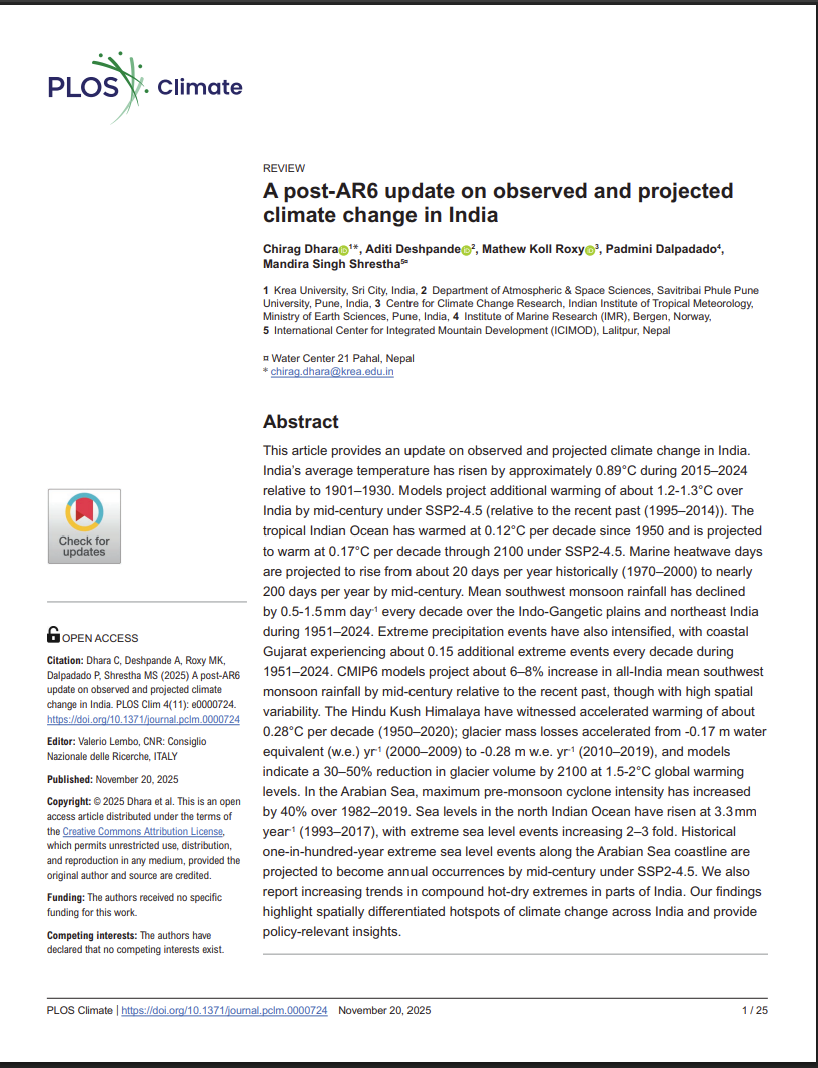
A post-AR6 update on observed and projected climate change in India
India has warmed by 0.89°C since the early 20th century, with further 1.2–1.3°C warming projected by mid-century. Evidence shows intensifying heat extremes, altered monsoon rainfall, rapid Indian Ocean warming, rising sea levels, glacier loss, and increasing compound hot–dry risks.
Please login or join for free to read more.

OVERVIEW
Introduction
This review updates evidence on observed and projected climate change in India using post-AR6 literature and CMIP6 models. It focuses on physical climate changes relevant to adaptation planning, recognising India’s geographic diversity, dependence on monsoon rainfall, and rapidly evolving climate risks. The assessment is policy-relevant but not prescriptive.
Data and methods
The assessment integrates updated observational datasets and recent peer-reviewed projections. Changes are generally reported relative to the IPCC AR6 baseline (1995–2014). Observations include gridded land temperature, sea surface temperature and rainfall data, while projections are based on CMIP6 multi-model ensembles under different emissions pathways.
Climate change assessments
Land temperature change
India’s mean surface temperature increased by about 0.89°C during 2015–2024 relative to 1901–1930. While warming is lower than the global land average, temperature extremes have intensified. Warm days and nights have risen by 5–15 days per decade across most regions since 1951. Under SSP2-4.5, all-India warming of around 1.2–1.3°C is projected by mid-century, with longer heatwave seasons and higher heat stress.
Indian ocean warming and marine ecosystem changes
The tropical Indian Ocean has warmed at approximately 0.12°C per decade since 1950, among the fastest globally. Marine heatwave days are projected to increase from around 20 days per year historically to nearly 200 days per year by mid-century under SSP2-4.5. Ocean warming, acidification and declining oxygen threaten coral reefs, fisheries and marine biodiversity, increasing risks to food security and coastal livelihoods.
Precipitation changes
Observed southwest monsoon rainfall has declined by around 6% since the mid-20th century, with drying over the Indo-Gangetic plains and north-east India and wetter trends in parts of north-west India. Extreme rainfall events have intensified, particularly along coastal Gujarat. CMIP6 models project a 6–8% increase in all-India mean monsoon rainfall by mid-century, alongside more frequent heavy rainfall events, though spatial variability and uncertainty remain high.
Cryosphere changes
The Hindu Kush Himalaya has warmed by about 0.28°C per decade since 1950, with faster warming at higher elevations. Glacier mass loss has accelerated from –0.17 m water equivalent per year in the 2000s to –0.28 m in the 2010s. At 1.5–2°C global warming, glacier volume losses of 30–50% are projected by 2100, increasing risks to water availability and glacial lake outburst floods, indicating the need for enhanced monitoring and risk assessment.
Tropical cyclones
Cyclone behaviour differs by basin. The Arabian Sea has experienced around a 40% increase in maximum cyclone intensity since the 1980s, linked to ocean warming and marine heatwaves, while trends in the Bay of Bengal are weaker. Projections indicate continued intensification and higher cyclone-related rainfall, raising flood and storm surge risks despite uncertainty in frequency changes.
Sea level rise
Sea levels in the north Indian Ocean have risen at about 3.3 mm per year since the early 1990s. Extreme sea-level events have increased two- to three-fold, largely driven by rising mean sea level. Under SSP2-4.5, mean sea level rise of around 0.2 m is projected by mid-century, with historical one-in-100-year extremes along the Arabian Sea coastline becoming annual events.
Compound events (focus on heatwave drought events)
Compound hot–dry extremes have increased by 1–3 events per decade since the late 1970s, particularly in north-central, western and north-eastern India. Soil moisture–temperature feedbacks are a key driver. Projections indicate further increases despite higher average rainfall, highlighting the need for integrated, multi-hazard adaptation planning.
Synthesis and summary
The evidence indicates that India is experiencing spatially uneven but accelerating climate change across temperature, rainfall, oceans, cryosphere and sea levels. Multiple regions face overlapping hazards, increasing the likelihood of compound extremes. Improved regional observations, modelling, and risk-informed adaptation are critical to managing future climate impacts.




