Overview
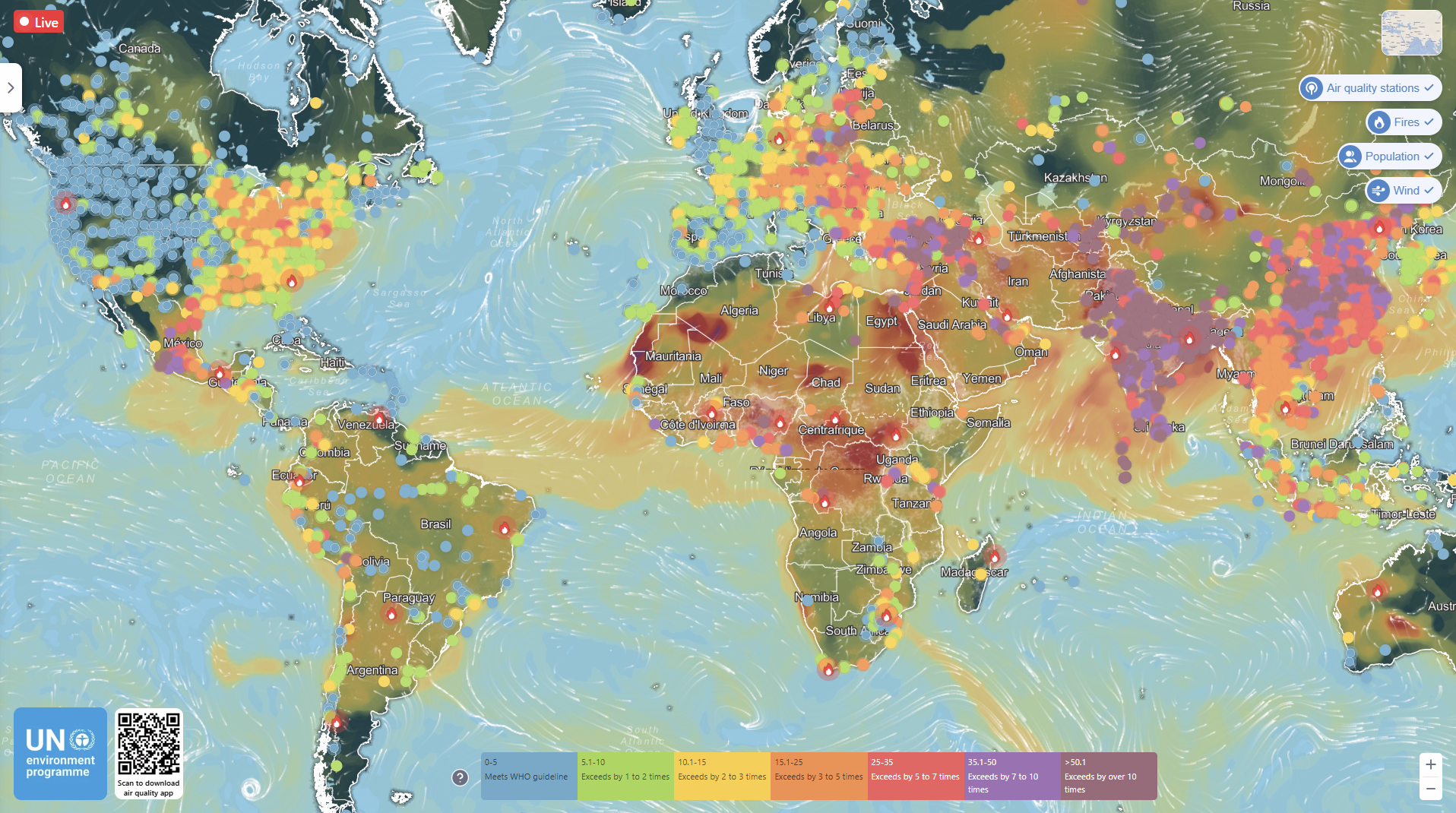
The IQAir–UNEP air quality platform is an online tool that provides global, near real-time information on ambient air pollution. Its primary purpose is to track PM2.5 concentrations and population exposure relative to health-based guidelines. Finance professionals may find it relevant for assessing environmental risk, regulatory pressure, and long-term public health externalities across regions and markets.
Organisation behind the tool
The tool is developed and maintained by IQAir in partnership with the United Nations Environment Programme (UNEP). IQAir provides the technical platform and global monitoring network, while UNEP supports alignment with international environmental and public health objectives.
What the tool does
- Displays global air quality data with a focus on PM2.5 concentrations.
- Provides near real-time readings from thousands of government and non-government monitoring stations.
- Shows population-weighted exposure estimates by country and region.
- Benchmarks pollution levels against World Health Organization air quality guidelines.
- Allows users to explore spatial patterns through an interactive global map.
- Presents summary statistics that support comparison across locations and time.
Target audience
The primary audience includes policymakers, environmental analysts, and public health professionals. Secondary users include researchers, civil society organisations, educators, and members of the general public. Finance and sustainability professionals can also use the tool for contextual environmental analysis.
Relevance to finance professionals
Risk assessment
- Identify regions with high air pollution exposure that may face increased health, productivity, or regulatory risks.
- Support analysis of physical and transition risks linked to environmental degradation.
ESG analysis
- Provide environmental indicators relevant to social and environmental impact assessments.
- Support context for corporate exposure in high-pollution jurisdictions.
Market and sector insights
- Inform analysis of sectors sensitive to air quality, including infrastructure, transport, energy, and urban development.
- Highlight regional disparities that may influence labour markets and healthcare costs.
Investment context
- Support long-term assessments of environmental trends affecting economic resilience and sustainable development pathways.