Overview
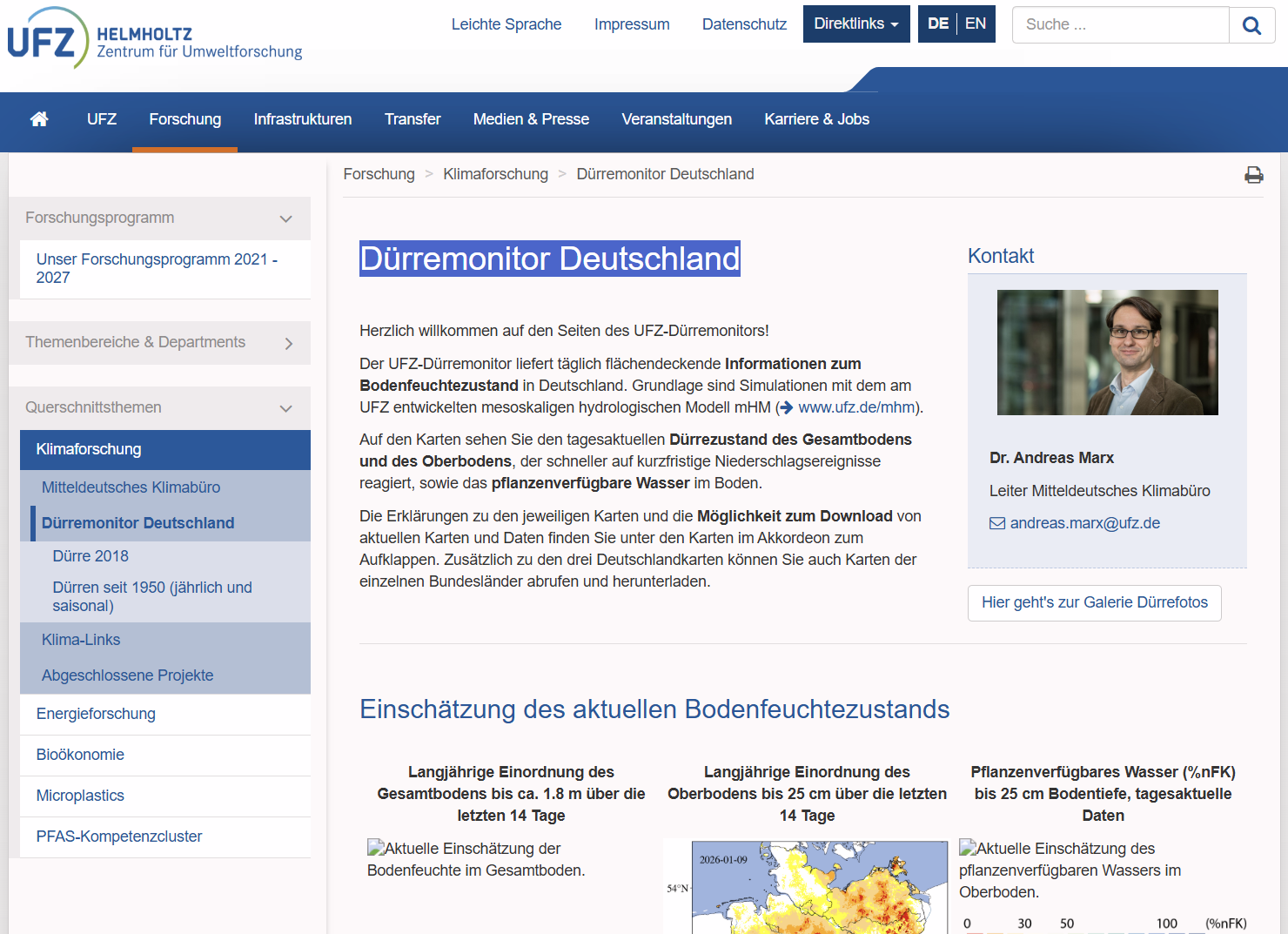
The UFZ Drought Monitor is an online analytical tool that provides regularly updated assessments of soil moisture and drought conditions in Germany. Its primary purpose is to monitor agricultural and hydrological drought using model-based indicators. Finance professionals may find it relevant for understanding climate-related physical risks affecting agriculture, water resources, and regional economic activity.
Organisation behind the tool
The tool is developed and maintained by the Helmholtz Centre for Environmental Research (UFZ). It is produced by UFZ researchers specialising in hydrology and climate impact analysis and forms part of the centre’s broader environmental monitoring and modelling work.
What the tool does
- Provides daily updated maps of drought conditions across Germany
- Assesses soil moisture deficits for:
- Topsoil (relevant for agriculture)
- Total soil profile (relevant for hydrology and water resources)
- Uses simulations from the mesoscale hydrological model (mHM)
- Classifies drought severity into defined categories (e.g. moderate to exceptional drought)
- Allows users to view historical drought conditions and trends
- Offers downloadable data for further analysis
Target audience
The primary audience includes researchers, hydrologists, and environmental scientists. Additional users include policymakers, agricultural stakeholders, water managers, insurers, and members of the public seeking information on drought conditions.
Relevance to finance professionals
Risk assessment
- Supports evaluation of physical climate risk related to drought impacts on agriculture, water availability, and regional economies
- Informs stress testing for assets exposed to climate-sensitive regions
ESG analysis
- Provides environmental data relevant to climate risk disclosure and nature-related assessments
- Useful for understanding water stress and land-related environmental pressures
Market and commodity insights
- Relevant for analysing drought exposure in agricultural supply chains
- Supports assessment of risks to food production and water-dependent industries
Investment context
- Enables analysis of long-term drought patterns and climate variability
- Supports scenario analysis for infrastructure, agriculture, and regional development investments