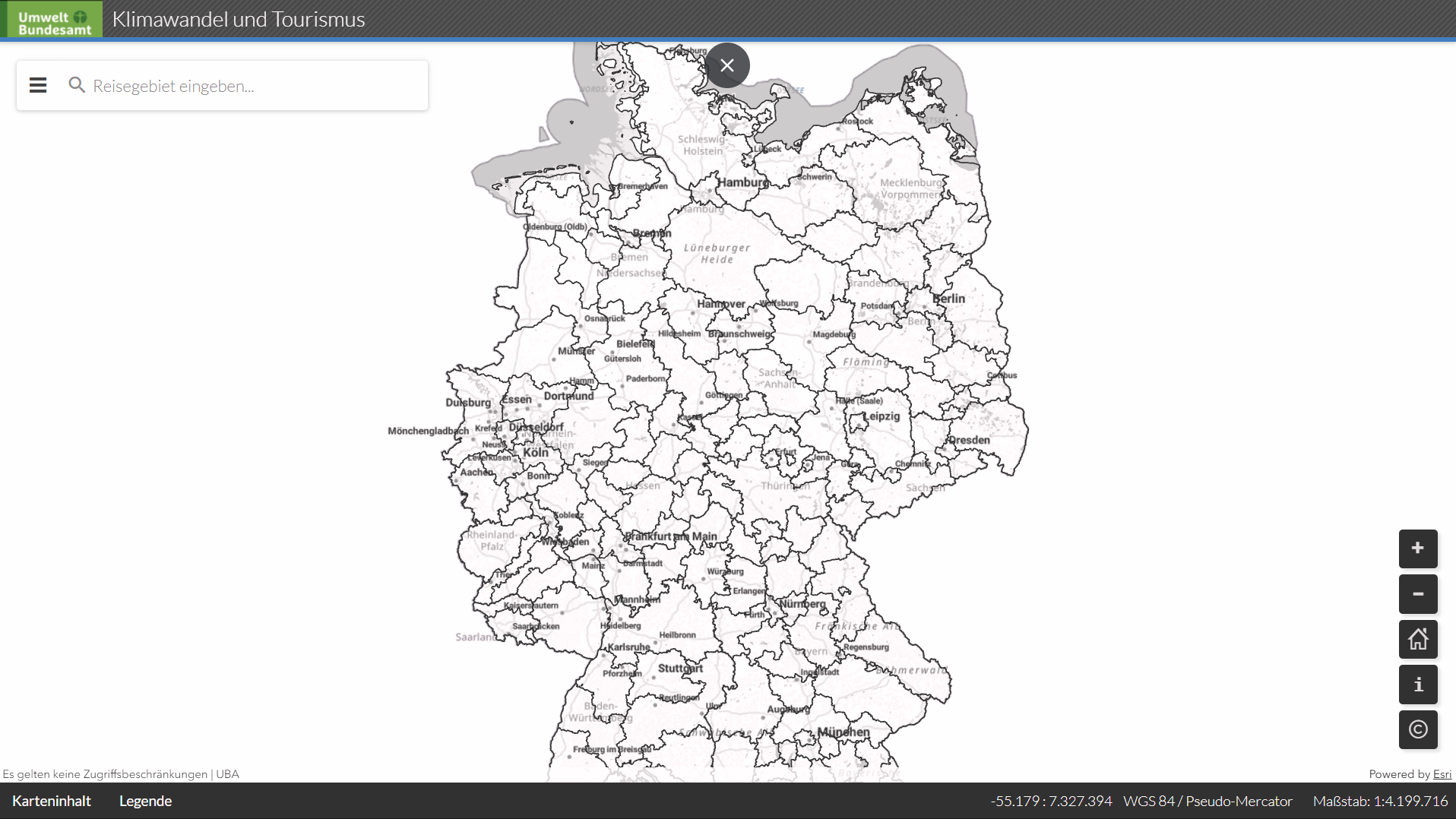
Overview
The Tourism Climate Map is an interactive, web-based GIS tool that visualises climate indicators relevant to tourism across Germany. It presents historical trends and projected changes in climate conditions that influence tourism suitability. Finance professionals may find it relevant for assessing regional climate exposure, transition risks, and long-term impacts on tourism-dependent economies and assets.
Organisation behind the tool
The tool is developed and maintained by the German Environment Agency (Umweltbundesamt, UBA). It forms part of UBA’s wider geospatial and climate information services, which support environmental monitoring, policy analysis, and public access to climate data.
What the tool does
- Provides an interactive map interface covering tourism regions in Germany.
- Displays climate indicators relevant to tourism, such as temperature patterns, heat stress, precipitation, snow reliability, and seasonal conditions.
- Allows users to explore historical data and climate projections across different time periods.
- Includes charts, tables, and time-series visualisations linked to geographic locations.
- Enables comparison between regions to assess relative climate suitability for tourism activities.
- Supports qualitative interpretation of how climate change may affect tourism seasons and destinations.
Target audience
The primary audience includes policymakers, regional planners, and environmental analysts working on tourism and climate adaptation. Other users include researchers, local authorities, tourism organisations, and members of the public seeking accessible climate information.
Relevance to finance professionals
Risk assessment
- Identifies regions where climate change may increase physical risks to tourism assets and infrastructure.
- Supports evaluation of exposure to heat stress, reduced snow cover, or changing seasonal patterns.
ESG analysis
- Provides environmental context for assessing climate-related risks within tourism and hospitality portfolios.
- Can inform climate risk disclosures and scenario analysis aligned with environmental reporting frameworks.
Market and regional insights
- Highlights potential shifts in tourism demand between regions and seasons due to changing climate conditions.
- Useful for analysing regional economic resilience where tourism is a significant income source.
Investment context
- Supports long-term assessment of climate trends affecting property, infrastructure, and regional development linked to tourism.
- Can inform strategic decisions on asset allocation, insurance considerations, and adaptation planning in tourism-exposed regions.