

How do-more-good frames influence climate action likelihood and anticipated happiness
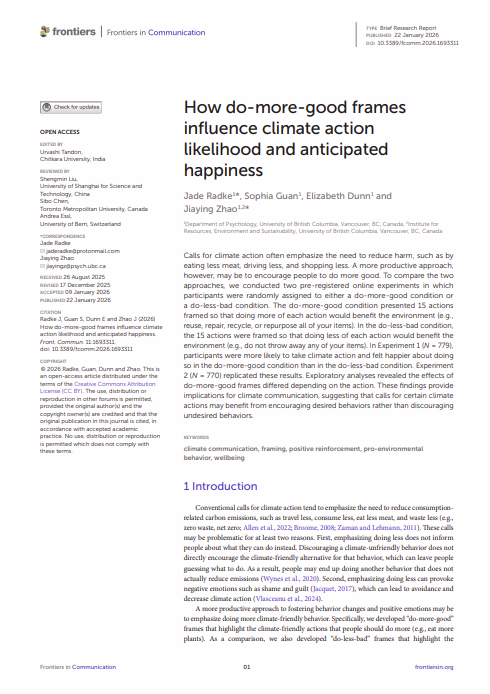
Two preregistered online experiments (N≈1,550) show that framing climate actions as “do more good” increases self-reported action likelihood and anticipated happiness compared with “do less bad”, with effects varying by specific action.
Please login or join for free to read more.

OVERVIEW
Introduction
This study examines whether climate actions framed as “do more good” are more effective than traditional “do less bad” framing. Conventional climate communication often focuses on reducing harmful behaviours, which may create confusion or negative emotions such as guilt. The authors test whether encouraging additive, climate-friendly behaviours increases individuals’ likelihood of action and anticipated happiness.
Experiment 1
Experiment 1 tested whether “do more good” framing increases climate action likelihood and anticipated happiness relative to “do less bad” framing. A preregistered online experiment was conducted with 779 US participants, randomly assigned to one of the two framing conditions. Participants evaluated 15 climate actions, including individual actions (for example, food choices and clothing use) and civic actions (for example, voting and supporting repair policies).
Results show that average action likelihood was significantly higher under “do more good” framing (mean 7.46) than “do less bad” framing (mean 6.85). Anticipated happiness was also higher (7.88 versus 7.41). Exploratory analyses indicate that positive effects were strongest for food choice, waste reduction, clothing, product use, voting, and supporting repair policies. In contrast, driving showed a reverse effect, with higher likelihood and happiness under “do less bad” framing. Mediation analysis suggests a bidirectional relationship between anticipated happiness and action likelihood.
Experiment 2
Experiment 2 replicated Experiment 1 and examined whether perceived difficulty or clarity explained framing effects. The preregistered study included 770 participants and used the same 15 actions, with additional questions on difficulty and clarity of implementation.
Findings replicate Experiment 1: action likelihood (6.38 versus 6.06) and anticipated happiness (7.39 versus 7.00) were higher under “do more good” framing. However, there were no overall differences between conditions in perceived difficulty or clarity. Action-level analyses again showed stronger effects for food choice, waste reduction, clothing, and product use, while driving and flying showed backfire effects under “do more good” framing. Mediation analyses confirmed that anticipated happiness and action likelihood indirectly influenced each other, while difficulty and clarity did not explain the framing effects.
General discussion
Across two experiments, “do more good” frames consistently increased self-reported climate action likelihood and anticipated happiness compared with “do less bad” frames. The authors suggest two explanations. First, “do less bad” frames may elicit shame, guilt, or reactance, reducing motivation. Second, “do more good” frames may benefit from an addition bias, where people associate “more” with “better” and anticipate greater wellbeing.
The benefits of “do more good” framing are action-specific. Strong positive effects were observed for actions such as eating more plant-based foods, reducing waste, extending clothing lifespan, and increasing reusable product use. Conversely, actions perceived as logistically demanding, such as driving more people or combining flights, showed backfire effects. These findings indicate that framing should be matched to action feasibility and context.
Implications for climate communication
The research suggests climate communication may be more effective when encouraging specific, additive climate-friendly behaviours rather than emphasising restriction. “Do more good” frames may increase motivation and positive expectations at low cost, but should be applied selectively to avoid counterproductive effects for complex behaviours.
Limitations and future research
Limitations include partial non-equivalence between paired actions (for example, driving more people versus driving fewer miles) and reliance on self-reported intentions rather than observed behaviour. Future research should test these frames across diverse populations and real-world settings, and further examine why framing benefits vary by action type.




